Photo by Diana Kowalski for Cornerstone Mansion · December 22, 2025
For years, I’ve chased the phantom of antiquity across America, seeking out those staunch, fluted sentinels of democracy: the Doric columns of Greek Revival architecture. It’s a style many dismiss as merely "neo-classical" or, worse, "boring government buildings," but to truly understand it, you must look closer. Our nation's early architects weren't just copying; they were making a profound statement, imbuing stone with the ideals of a young republic. These buildings speak volumes, if you know how to listen.
### Why Did America Fall for Greek Revival's Stoic Charm?
One might wonder, what was it about ancient Greece that so captivated America's nascent identity? The answer, I've found, is less about aesthetics and more about aspiration. Architects and politicians of the early 19th century saw in the Athenian Parthenon not just a beautiful structure, but a potent symbol of democracy, civic virtue, and enlightened thought – precisely the values they wanted to project for their burgeoning nation. The Doric order, in particular, with its robust simplicity and lack of decorative fuss, resonated deeply with an ethos of strength and purity, a stark contrast to the perceived decadence of European monarchies and their elaborate Baroque or Rococo styles. This wasn't merely a trend; it was a declaration.
The shift towards these classical forms became particularly pronounced after the War of 1812, a period when America consciously sought to define its cultural independence from Britain. Emulating ancient Greece, rather than Rome or contemporary Europe, offered a powerful visual metaphor for a new republic forging its own destiny. It was a bold architectural choice, one that would cement the Doric column as an American icon, even if few visitors today fully grasp the political philosophy embedded in those austere stone shafts.
### Philadelphia's Blueprint: The Second Bank of the United States
Stepping onto Chestnut Street in Philadelphia, you’re greeted by the imposing façade of the Second Bank of the United States. Completed in 1824, this structure isn't just historically significant; it's a foundational text in American architecture. William Strickland, its architect, gave us arguably the most influential early example of Greek Revival purity, directly modeling its eight severe Doric columns, both north and south, after the Parthenon itself. Here, you'll observe those signature thick, fluted columns, rising from a raised stylobate—a platform with no bases—a hallmark of authentic Greek Doric design. Look closely at the entablature above; you'll see a traditional triglyph frieze and a simple triangular pediment, eschewing any Roman frippery.
What might surprise you, however, is the state of the material. The building is constructed of Pennsylvania blue marble, a handsome stone that, over two centuries, has revealed its weaknesses. You can spot areas of deterioration, particularly on the southern columns, where the stone has begun to crumble or flake. It's a stark reminder that even the most ambitious architectural statements are subject to time and the elements, offering a tangible connection to the building’s age that glossy brochures rarely highlight. Visiting during a quieter weekday morning, perhaps in late spring or early autumn, allows for unhurried appreciation of these subtle details, especially since it's now a portrait gallery, making internal access easy and free.
### Wall Street's Parthenon: Federal Hall National Memorial
Venture down to New York City’s bustling Financial District, and you'll encounter Federal Hall National Memorial at 26 Wall Street. This isn’t the original Federal Hall where Washington took his oath; that burned down. What stands today, completed in 1842, was originally the U.S. Custom House. Alexander Jackson Davis and Ithiel Town, with later modifications, crafted a structure that screams democratic aspiration from every angle. Its monumental colonnade of eight fluted Doric columns on the main Hall Street façade immediately catches the eye, supporting a classical entablature and pediment. Observe how these columns, like Philadelphia’s Second Bank, lack bases, sitting directly on the stylobate—a conscious nod to true Greek Doric conventions.
The exterior, built from Tuckahoe marble, showcases incredibly shallow, broad flutes, reflecting accurate Greek proportions rather than a more decorative Roman style. It’s an interesting juxtaposition: the interior, surprisingly, shifts to the more ornate Corinthian order, a subtle stylistic departure that speaks to the functional needs of the Custom House. While the exterior boldly declares its classical lineage, the interior offered a touch of unexpected grandeur. Expect a small admission fee and the usual New York City crowds, particularly during lunchtime weekdays. To really soak in the architectural details, plan for an early morning visit (before 10 AM) when the street is less frantic, allowing you to appreciate the deliberate Parthenon mimicry intended to communicate democratic ideals to the financial heart of the nation.
### Andalusia: A Private Retreat Embracing Public Ideals
Traveling north of Philadelphia along the Delaware River, you might stumble upon Andalusia, the former estate of financier Nicholas Biddle. What began as a simpler residence in 1794 was dramatically transformed between 1834 and 1836 by architect Thomas U. Walter, who delivered one of the most compelling examples of Greek Revival adapted for residential grandeur. His addition of a two-and-a-half-story south wing, featuring six massive fluted Doric columns—again, without bases, in pursuit of classical purity—is simply breathtaking. These columns, painted a crisp white, project proudly toward the river, an iconic image of the style's adaptability.
Here, Walter wasn't just building a house; he was creating a statement of personal taste and national identity. The portico they support isn't merely decorative; it frames twin parlors on the main floor, divided by pocket doors, which could be opened to create one grand space for entertaining. It’s a remarkable insight into how the seemingly rigid Greek temple form could be translated into a functional, luxurious home while maintaining archaeological correctness. Unlike public buildings, Andalusia offers a much more intimate look at Greek Revival, accessible only through guided tours usually running from April through October. Check their website for specific dates and reservation requirements; it’s a living museum experience that's far more personal than visiting a bank or a custom house.
### The Capitol's Hidden Strength: Doric in the Crypt
Few visitors to Washington, D.C., realize that one of America's earliest and most robust applications of Greek Doric principles lies directly beneath their feet, tucked away in the U.S. Capitol Crypt. While the more famous, ornate Corinthian columns grace the main halls, the Crypt, located beneath the Capitol Rotunda, offers a foundational lesson in strength and simplicity. Here, between 1818 and 1827, Benjamin Henry Latrobe, building on William Thornton's original design, installed 40 smooth sandstone Doric columns. These aren’t just any Doric columns; they are explicitly modeled on the Temple of Poseidon, known for its shorter, thicker, and therefore immensely strong columns.
Their primary purpose is structural, supporting the tremendous weight of the Rotunda above. This isn’t a decorative flourish; it’s a feat of engineering cloaked in classical form. What's truly intriguing is that this design predates the peak of Greek Revival's popularity, making it an early, significant application of authentic Greek Doric in American public architecture. It’s often overlooked, a quiet testament to the enduring power of classicism, yet its stoic presence is critical. You can visit the Crypt as part of a free Capitol tour, but I recommend asking your guide to linger a moment longer here. The columns, with their smooth, unadorned shafts, speak volumes about foundational principles, both architectural and political, without needing a single flourish.
### Nashville's Unabashed Replica: The Parthenon
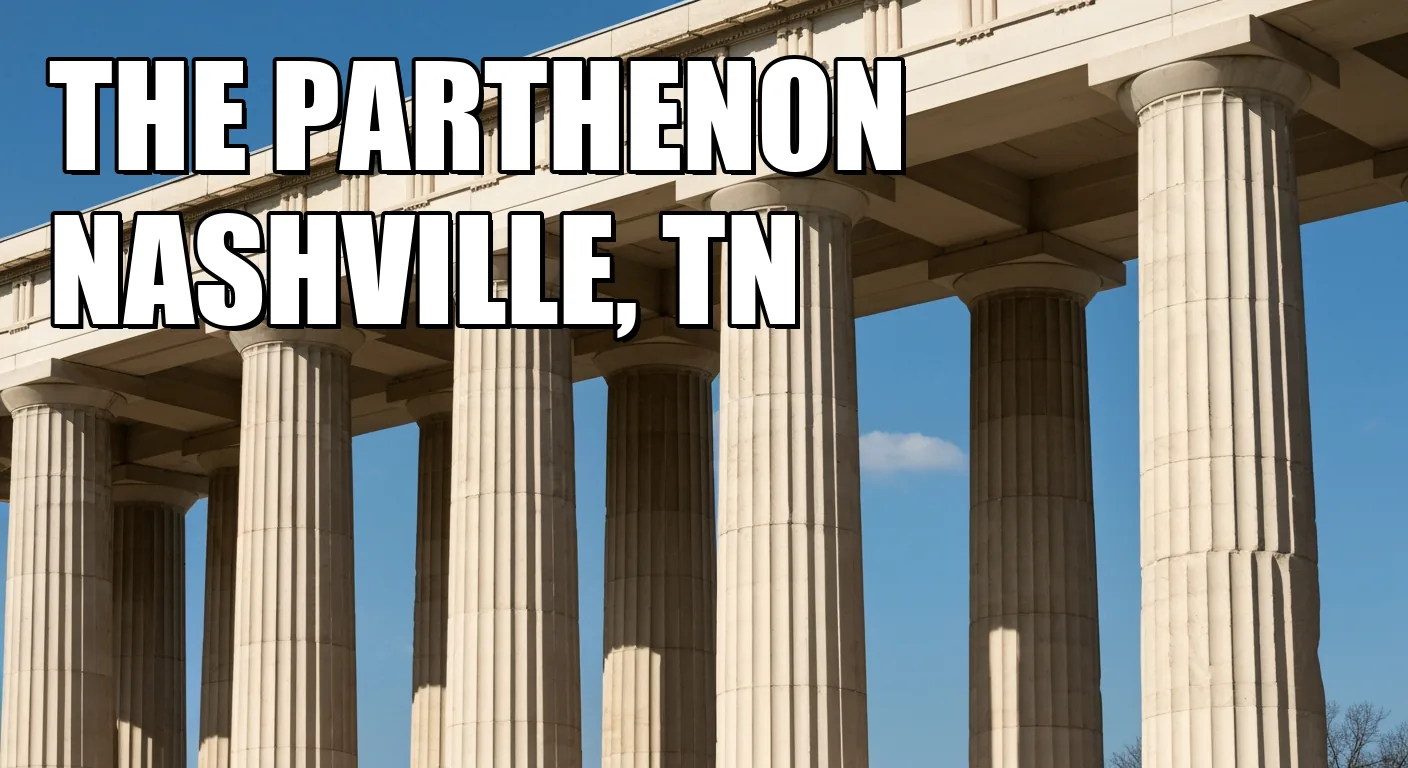
Finally, we arrive in Nashville, Tennessee, where the very concept of Greek Revival gets a fascinating twist: a full-scale, faithful reconstruction of the original Athenian Parthenon. Built originally as a temporary structure for the 1897 Tennessee Centennial Exposition, it was rebuilt permanently in concrete between 1921 and 1931 by Russell E. Hart. This isn’t an adaptation or an interpretation; it’s an archaeological endeavor in stone. You'll find 46 Doric columns here—17 on each side, six on each end—arranged as a peristyle identical to the original.
This Nashville Parthenon is a masterclass in architectural nuance, showcasing details rarely found in American adaptations. Every exterior column inclines slightly inward, with corner columns angled diagonally, a subtle optical refinement. Each column exhibits entasis—a slight bulge in the shaft that makes it appear perfectly straight from a distance, despite being subtly curved. Even the horizontal elements incorporate minute curves; there are no true straight lines in the entire design. These meticulous details, which defy simple geometry, are what elevate it beyond a mere copy to an experience that transports you directly to ancient Athens. Admission costs around $10-15, and while it's a popular attraction, the sheer scale of the building means crowds dissipate easily. Go early to catch the morning light on the columns, illuminating the subtle fluting and the incredible accuracy of this audacious tribute.
### A Legacy in Stone
Exploring these sites, from the foundational Second Bank to Nashville's daring replica, reveals that America's relationship with the Doric column was far more complex than simple imitation. It was a dialogue, a statement, and at times, a struggle between ideal and reality. These structures are not static monuments; they are living testaments to an architectural language that helped define a young nation. They invite us to look beyond the obvious, to question why these particular forms were chosen, and to appreciate the enduring power of classical ideals echoing through modern American landscapes. Next time you see a stern, unflinching Doric column, remember the stories it holds, and the aspirations it once embodied for a country still finding its feet.
Architecture Styles You Can Read From the Street
Use visible details like rooflines, columns, and ornament to identify building styles faster.
Exploring Doric Columns & Greek Revival Architecture Across America
What is the history of Doric columns?
Doric columns emerged as the oldest and simplest classical Greek architectural order during the Archaic Period (750-480 BCE), becoming prevalent in mainland Greece, particularly in temples like the Parthenon. The order was later revived during the Greek Revival movement from the 18th century onwards, dominating American architecture particularly from 1810-1860.
What do Doric columns symbolize?
Doric columns symbolize strength, simplicity, stability, and power, with their sturdy appearance often compared to the masculine ideals in Greek culture. In American architecture, they represent democratic ideals, permanence, and tradition, famously used in government buildings like the U.S. Capitol and Supreme Court.
Is Doric a Greek style of architecture?
Yes, Doric is one of the three classical orders of ancient Greek architecture, originating in ancient Greece. It represents the earliest and most fundamental Greek architectural style, characterized by fluted columns with 20 vertical grooves and simple capitals.
When did Doric first appear?
Doric columns first appeared in the 7th century BCE, with certain architectural models documented by the 6th century BCE. The Parthenon in Athens serves as the most recognized example of the evolved Classical Doric order.
What is the history of Doric?
Doric originated as the dominant architectural order in Archaic Greece (750-480 BCE), widely used in mainland Greek temples and southern Italy. Following the rediscovery of ancient Greek ruins in the 18th century, the Doric order became central to the Greek Revival movement, profoundly influencing American institutional and residential architecture.
What were the Dorians known for?
The Dorians were one of the four major Greek ethnic groups and played a significant role in ancient Greek culture, particularly during the post-Mycenaean and Classical periods. They developed and popularized the Doric architectural order, which bears their name and represents their cultural contributions to classical design.
Where did Doric originate?
The Doric order originated in the western and mainland regions of ancient Greece, particularly in the areas inhabited by the Dorian Greeks around the 7th century BCE. It became the primary architectural style across mainland Greece and was later adopted throughout the Hellenistic world.
What are the best U.S. cities to see Greek Revival architecture?
Top cities include Washington D.C. (U.S. Capitol, Supreme Court), Natchez Mississippi (over 500 Greek Revival buildings), Charleston South Carolina, New Orleans Louisiana, Boston Massachusetts, and Madison Indiana. The National Register of Historic Places lists over 5,000 properties designated as Greek Revival architecture.
How can I tour the Doric columns at the U.S. Capitol?
Free guided Capitol tours operate Monday-Saturday from 8:30 a.m. to 4:30 p.m. (reservations required in advance online). The Crypt features 40 smooth sandstone Doric columns supporting the Rotunda, modeled after the Temple of Poseidon.
What is the cost to visit Greek Revival mansions?
Costs vary: U.S. Capitol tours are free, Supreme Court tours are free (9 a.m.-3 p.m. weekdays), Lanier Mansion is $13 for adults, Natchez mansion tours range from $11-$20 per tour, and Charleston historic homes charge $15-$25 per tour. Multi-site passes offer discounts (e.g., Natchez Fall Pilgrimage 3-day ticket: $200).
What is the best time to visit Greek Revival buildings?
Spring (April-May) and fall (September-October) offer ideal weather, comfortable temperatures, and manageable crowds. These seasons provide perfect lighting for photography and outdoor exploration of columned architecture.
Are Greek Revival historic homes wheelchair accessible?
Accessibility varies by property; many historic homes have limited wheelchair access due to stairs and period construction. The Americans with Disabilities Act (ADA) applies to historic landmarks, though accommodations may be limited; contact specific sites in advance to confirm accessibility.
Can I take photographs inside Greek Revival buildings?
Photography policies vary by venue; exterior photography is generally permitted with golden hour (sunrise/sunset) providing optimal lighting. Interior photography is often restricted in active government buildings like the Capitol, while private museums may allow it for personal use.
Are group tours available for Greek Revival buildings?
Yes, most historic sites offer group tours with advance reservations; groups typically require 8 or more participants. Capitol, Supreme Court, and many mansion museums provide docent-led group experiences ranging from 60-90 minutes.
How far is it from Washington D.C. to major Greek Revival destinations?
Washington D.C. to Natchez: 1,069 miles (16+ hour drive); Washington D.C. to Charleston: 593 miles (9 hour drive); Natchez to Charleston: 812 miles (12.5 hour drive). These distances make multi-site road trips feasible during longer vacations.
What makes Doric columns different from Ionic and Corinthian columns?
Doric columns are the simplest and sturdiest with no base and 20 flutes, symbolizing strength; Ionic columns are more slender with scrolled capitals, representing grace and refinement; Corinthian columns feature elaborate acanthus leaf capitals, symbolizing luxury and ornament.
Why This Page Exists
Maison builds place guides to help readers plan a real visit or understand a real site. When a page makes present-day access, booking, or visitor claims, those details are revised against public-facing source material and editorial review. For the wider standards behind that work, see methodology.
The Cornerstone Brief
One historic place, once a week — what it is, why it matters, whether it's worth going. No filler, no paid placements.
Coming soon. Unsubscribe any time.
We use cookies to enhance your experience. By continuing to visit this site you agree to our use of cookies.