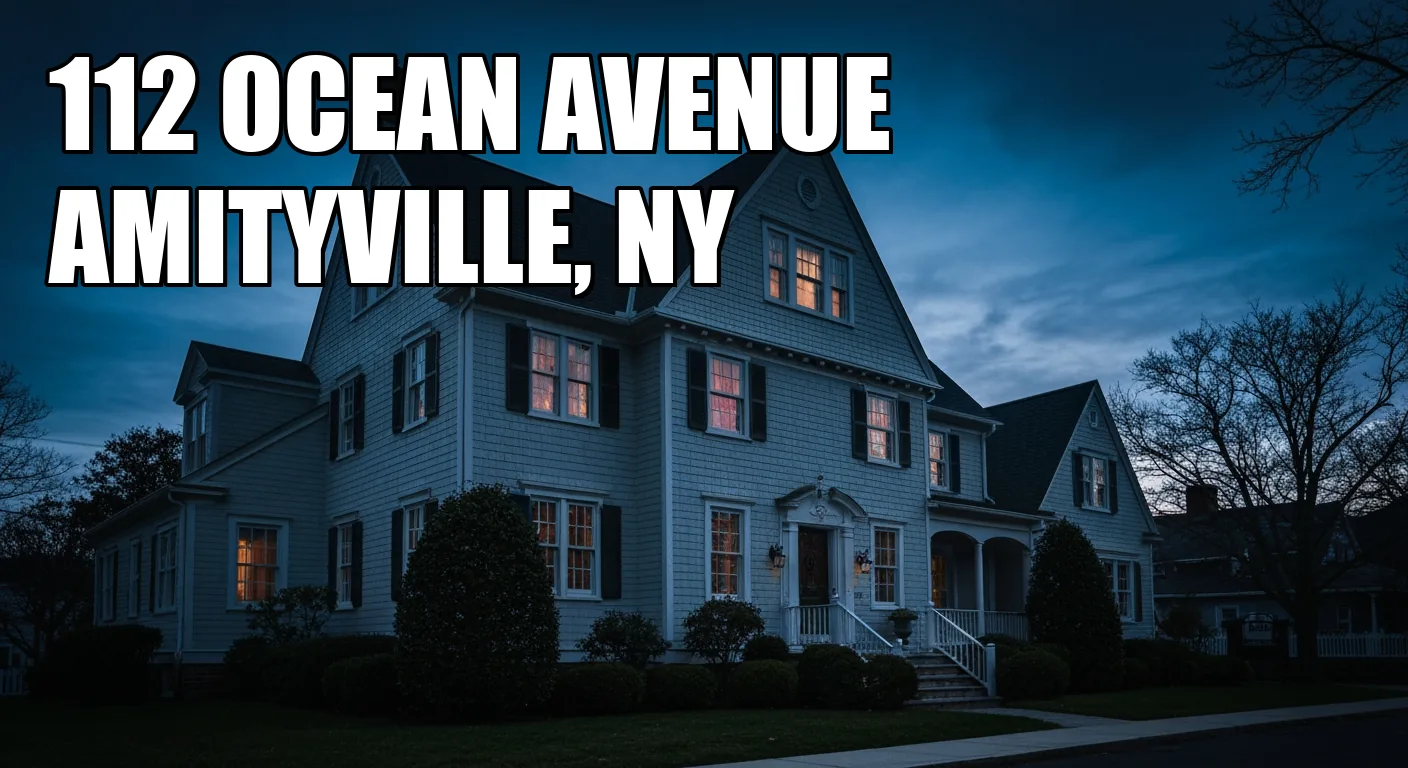
For decades, the phrase "Amityville Horror" has conjured images of a particular Dutch Colonial house, its ominous "eye windows" staring out like malevolent eyes, forever linked to a chilling true crime and a subsequent explosion of alleged paranormal terror. As someone who has traipsed across countless historical sites—some genuinely profound, others built on the thinnest of pretexts—I’ve learned to approach every legendary location with a healthy dose of skepticism and an even healthier dose of curiosity. My travels have taken me from battlefields to hallowed presidential homes, but few places command the same macabre fascination as 112 Ocean Avenue, a site that perfectly illustrates the sticky interplay between tragedy, media, and our insatiable human appetite for the supernatural.
So, what truly lies beneath the layers of sensationalism? Is it a portal to hell, a site of genuine evil, or simply a house scarred by a horrific crime, later amplified by a family’s compelling, if controversial, story? Let's take a closer look, stripping away the cinematic sheen to see what remains of the Amityville phenomenon.
The Genesis of a Nightmare: An Act of Unspeakable Violence
Any exploration of the Amityville Horror must begin not with a ghost story, but with a brutal fact: a family was systematically murdered here. This isn't just another spooky old house; it's a profound crime scene, the canvas upon which all subsequent legends were painted. On the night of November 13, 1974, Ronald DeFeo Jr., chillingly known as "Butch," meticulously murdered his entire family—his parents, Ronald Sr. (43) and Louise (42-43), and his four younger siblings, Dawn (18), Allison (13), Marc (12), and John Matthew (9). They were all shot in their beds with a .35 caliber lever-action Marlin 336C rifle in the early hours, around 3:00 a.m.
The sheer audacity and cold calculation of the crime itself is more terrifying than any phantom. How could one person silently kill six family members without anyone waking? DeFeo initially spun tales of mob hits, but his eventual confession—"Once I started, I just couldn't stop. It went so fast"—revealed a more disturbing, human evil. He was convicted in November 1975 and sentenced to six consecutive life sentences, remaining incarcerated until his death in March 2021. Understanding this horrific foundation is crucial, because it grounds the subsequent tales in a very real, very human nightmare. It's the psychological impact of such an event, rather than the ethereal, that truly haunts the property.
The Brief, Baffling Occupancy of the Lutz Family
Thirteen months after the DeFeo murders, a new family, the Lutzes—George, Kathleen, and her three children, Daniel, Christopher, and Melissa "Missy"—moved into 112 Ocean Avenue. They purchased the house for a remarkably low $80,000 on December 18, 1975, a clear indicator that the home's dark history already depressed its market value. Imagine the nerve, or perhaps the naiveté, to move into a house where six people were just slaughtered. The family even bought much of the DeFeo's furniture for $400, a detail that feels almost too morbid to be true, yet it speaks to a certain practical disregard for the house’s grim past.
Their stay lasted a mere 28 days, ending abruptly on January 14, 1976, when they fled, reportedly leaving most of their possessions behind. What transpired in those four weeks became the bedrock of Jay Anson's bestselling book, *The Amityville Horror*, and its iconic 1979 film adaptation. The alleged phenomena were legion and bizarre: green slime oozing from walls, swarms of flies in winter, cold spots, George waking nightly at 3:15 a.m. (the murder hour), Kathy levitating, and the chilling appearance of "Jodie," a demonic, pig-like creature with glowing red eyes that Missy supposedly communicated with. A Catholic priest, Father Ralph J. Pecoraro (dubbed "Father Ray" or "Father Mancuso"), allegedly experienced unsettling events during a house blessing, including a disembodied voice warning him to "get out." These stories, while captivating, invite immediate scrutiny. Could a house truly manifest such varied and specific horrors, or did the known tragedy, combined with psychological suggestion and perhaps a dose of embellishment, create its own, very real, terror for the family?
Architectural Amnesia: Tracking the Elusive 112 Ocean Avenue
So, you're intrigued enough to want to see this notorious house for yourself? Here’s a dose of reality: you can't, not really. The Amityville Horror House is a private residence, and its owners have gone to considerable lengths to ensure their privacy and discourage the endless stream of morbidly curious visitors. In a smart, albeit slightly disappointing, move for enthusiasts, the original address of 112 Ocean Avenue has been changed to 108 Ocean Avenue (some sources say 110), making it harder to pinpoint precisely.
Furthermore, the architectural character that made the house so visually distinctive in the movies has been deliberately erased. The iconic "eye windows"—those quarter-round attic windows characteristic of the Dutch Colonial style, which gave the house its menacing, watchful appearance—were replaced with standard square windows. The dark shingle cladding was also swapped for lighter-colored siding. These modifications, undertaken by subsequent owners, were a calculated effort to make the house less recognizable, effectively stripping it of its cinematic identity. The in-ground pool was filled, the boathouse restored, and a second sunroom added in the 2010s, further altering its original footprint. If you drive by, which many still do, especially on weekends, you might barely recognize it; it looks, for all intents and purposes, like any other large, well-kept suburban home. Expect absolutely no public access; the only exception was a brief moving sale in 2010 where limited access was granted, but this was a rare anomaly. Parking is residential, and lingering will surely draw the ire of neighbors, so a discreet drive-by is your only option, and frankly, it's not particularly rewarding.
The Specter of Doubt: Questioning the Paranormal Playbook
When considering the Amityville claims, it's vital to lean into critical analysis, especially when the narratives become so sensational. The Warrens, self-proclaimed demonologists Ed and Lorraine, certainly lent celebrity weight to the Lutz claims. Their televised séance on March 6, 1976, at 9:00 p.m., allegedly yielded high electromagnetic field readings, a sudden 30-degree temperature drop, rhythmic knocking, and the famous infrared photograph of a ghostly figure resembling a boy, often attributed to John DeFeo. Lorraine Warren famously declared the house "the closest to hell I ever wanted to get."
However, not everyone shared their conviction. Journalist Marvin Scott, present at the Warrens' investigation, later recounted that the only real excitement among the crew was wondering when they'd get to eat. This discrepancy highlights the theatrical nature often inherent in paranormal investigations designed for public consumption. More damningly, every single subsequent owner of the house—from James and Barbara Cromarty (1976-1987) to its sale in March 2017 for $605,000 and beyond—has reported precisely *zero* paranormal activity. Not a cold spot, not a fly swarm, certainly no pig-like demons. This stark absence of reported phenomena over decades, across multiple families, raises significant questions about the authenticity of the initial claims versus the profound psychological impact the known murders had on the Lutz family during their very brief, highly publicized stay. It challenges the conventional wisdom that a house can be inherently "evil" or "haunted" when subsequent residents experience only mundane domesticity.
Beyond the Myth: Why Amityville Still Haunts Our Imagination
So, is the Amityville Horror House "worth visiting"? In the conventional sense of a historical site or a tourist attraction, absolutely not. You can't enter, its appearance has been deliberately altered, and the true horror—the DeFeo murders—is a tragic human event, not a supernatural spectacle. Yet, the story persists, captivating new generations and fueling countless documentaries, books, and films. Why?
Perhaps it's the irresistible allure of a true crime that spills over into the inexplicable, offering a tantalizing glimpse into a world beyond our understanding. The Amityville legend taps into primal fears: the sanctity of the home violated, the evil that can lurk within ordinary people, and the chilling possibility of unseen forces. It's a modern ghost story, amplified by popular culture, that became greater than the sum of its parts. Visiting Amityville, in any practical sense, is less about seeing a haunted house and more about contemplating the power of storytelling itself—how a brutal crime transformed into a global phenomenon, how human tragedy can be reinterpreted through the lens of the supernatural, and how easily we can be convinced by a compelling narrative, even when evidence suggests a far more mundane, yet still heartbreaking, reality. The real "horror" of Amityville isn't a pig-demon or green slime; it's the chilling reminder of human violence and the enduring power of a good, terrifying yarn.
The Amityville Horror House: Complete Visitor's Guide & History
Where is the original Amityville Horror House located?
The original Amityville Horror House is located at what was originally 112 Ocean Avenue in Amityville, Long Island, New York, but the address was changed to 108 Ocean Avenue by a subsequent owner to deter tourists. The Dutch Colonial home sits on the waterfront in Amityville, south of New York City.
What is the history of the Amityville Horror House?
The house was built in 1927 at 112 Ocean Avenue and became infamous after Ronald DeFeo Jr. murdered his parents and four siblings there on November 13, 1974, using a .35 Marlin rifle. The Lutz family moved in 13 months later but fled after claiming to experience supernatural phenomena during their 28-day stay, which inspired the 1977 book and 1979 film.
Can you visit the real Amityville Horror House?
No, the real Amityville Horror House is a private residence and is not open to the public for tours or visits. The current owners are very private and do not allow visitors to the property.
Is the real Amityville Horror House still standing?
Yes, the real Amityville Horror House still stands and remains a private residential property. The house has been significantly renovated and remodeled over the years, with most recent interior and exterior modifications making it look considerably different from its appearance in the 1979 film.
Was the Amityville Horror filmed in the actual house?
No, the original 1979 film was not filmed at the real Amityville house; instead, it was filmed at 18 Brooks Road in Toms River, New Jersey, a riverside house that was converted to look like the infamous Long Island home. The town of Amityville refused to allow filming at the real location due to tourism concerns and residential privacy.
Why is the Amityville house blurred on Google Maps?
The Amityville house is blurred on Google Maps and Street View because the property owners requested the blurring to protect their privacy and security, a standard feature available to homeowners who submit privacy requests to Google. This is separate from any official restriction—any homeowner can request their property be blurred for safety and privacy reasons.
Where did they film the original Amityville Horror movie in 1979?
The original 1979 film was shot at 18 Brooks Road in Toms River, New Jersey, about 20 miles south of Asbury Park, with interior scenes filmed at MGM sound stages in Los Angeles. Additional filming locations included Town Hall in Toms River and St. Peter's Church in Point Pleasant, New Jersey.
Was the Amityville house built on a burial ground before?
The claim that the house was built on a Native American burial ground is largely a myth; the Lutz family never actually made this claim in their original account. While some unauthorized books and films speculated about power spots and the land's indigenous history, the town of Babylon designated separate burial grounds (Brewster Burial Grounds and Green Bunn Burial Grounds) in 1994, but not at the Amityville house location.
What is the number 1 scariest horror movie ever made?
The Exorcist (1973) is consistently ranked as the scariest horror movie ever made by critics, film experts, and audiences, emerging as the top choice in multiple comprehensive rankings from publications like Rotten Tomatoes and Rolling Stone. The film's psychological horror and groundbreaking special effects have maintained its status as the most frightening movie for over 50 years.
How far is the Amityville Horror House from New York City?
The Amityville Horror House is located approximately 25-30 miles east of Manhattan on Long Island's South Shore. You can reach it via the Long Island Rail Road (LIRR) from Penn Station to Amityville Station, which takes about 45 minutes to an hour depending on the time of day.
What does the Amityville Horror House look like today?
The house today is painted pale off-white (dramatically different from its dark exterior in the films), has had its iconic half-moon 'eye' windows replaced with ordinary square windows, and has been extensively renovated. The swimming pool was filled in, and the boathouse behind the property remains but is no longer visible from the street.
What happened to the DeFeo family that inspired the horror?
On November 13, 1974, Ronald DeFeo Jr., then 23 years old, murdered his parents Ronald Sr. and Louise DeFeo, and his four siblings using a .35 Marlin rifle as they slept. DeFeo was convicted of six counts of second-degree murder in 1975 and sentenced to six consecutive life sentences, where he remained incarcerated until his death in 2021.
How much did the Amityville Horror House sell for most recently?
The Amityville Horror House sold in February 2017 for $605,000, which was $200,000 less than the asking price, to an undisclosed owner. It has changed hands multiple times since the DeFeo murders in 1974, with each subsequent owner attempting to distance the property from its notorious past.
What is the book that started the Amityville Horror phenomenon?
The Amityville Horror, written by Jay Anson and published in September 1977, is a bestselling book that documented the alleged paranormal experiences of the Lutz family during their 28-day stay at 112 Ocean Avenue. The book was later adapted into the famous 1979 film starring James Brolin and Margot Kidder.
Where was the 2005 Amityville Horror remake filmed?
The 2005 Amityville Horror remake starring Ryan Reynolds was filmed at Oakwood Manor, a Queen Anne Victorian house built in 1880, located at 27618 Silver Lake Road in Salem, Wisconsin. Production crews built a $60,000 façade on the house to recreate the distinctive half-moon windows and sinister appearance of the original Amityville house.
Is the real story of the Amityville Horror proven to be true?
The DeFeo murders were real, but the paranormal claims made by the Lutz family and author Jay Anson are highly disputed and have never been scientifically verified. Many researchers, including those who studied the case, have concluded that the haunting story was largely fabricated, with some suggesting it was created primarily for the book and movie deal.
We use cookies to enhance your experience. By continuing to visit this site you agree to our use of cookies.