A “Goonies location” can be a nineteenth-century house, a former jail, an Oregon headland, a temporary plywood shell or a water-filled soundstage in Burbank. The film cuts those things into one adventure. The surviving places do not share the same history, material authenticity or evidentiary strength.
That distinction matters most in Astoria, where a private residence is treated like a monument while a public museum occupies a building with a much longer life before the cameras arrived. Farther south, the Fratellis’ hideout never functioned as a restaurant, and a California beach completed a finale that feels continuous with Oregon. Ask not only “Was this in The Goonies?” but what was already there, what production added and what remains.
One film left several kinds of evidence
| Place or object | Production relationship | What survives | Evidence limit |
|---|
| Walsh/Goonies house | Real Astoria residence recognized as the Walsh family house | The private residential building | The strict source set does not settle exterior-only, interior or attic filming claims |
| Old Clatsop County Jail | Historic jail used for the opening jailbreak | Building and cell fabric, now layered with museum exhibits | Exhibits are later interpretation, not 1984 set dressing |
| Flavel House | Later Oregon Film Trail material identifies it as a character’s curator workplace | The historic house museum | The exact character and scene are not established by the preservation record |
| Ecola Point | Landscape supporting the temporary Lighthouse Lounge exterior | Coastal landscape; the set and its road are gone | Reconstructed memories depend on retrospective ranger testimony |
| Warner Bros. Stage 16 | Studio environment for cavern and ship work | The active stage shell, not the film’s constructed world | Current tank specifications do not prove 1984 conditions |
| Goat Rock State Beach | Retrospectively identified as the California finale location | The natural shoreline | The current state-park page does not mention the film |
Lower Columbia Bowl appears throughout fan itineraries, but the official and institutional subset examined here did not verify its exact screen role. Repetition is not provenance. A responsible account can leave a popular pin unclaimed until a production record, attributable witness or reliable institutional marker connects scene and building.
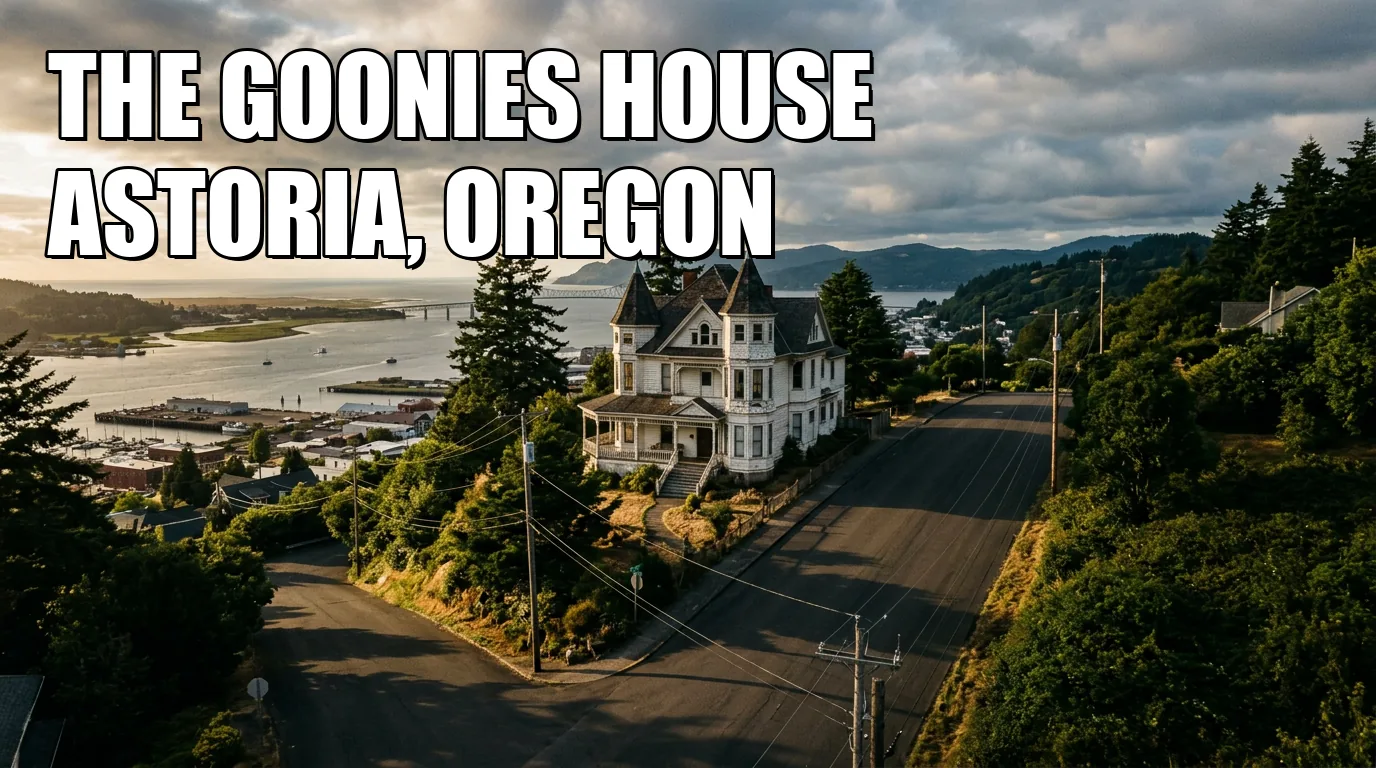
The Walsh house is a residence before it is an icon
Astoria’s January 2023 City Council packet identifies 368 38th Street as the property “also known as the Goonies house.” Public testimony describes pressure placed on the residential neighborhood by people seeking the famous property. A representative for the buyer then under contract described an intention to keep the house residential rather than commercialize it.
Those minutes establish a real address, a residential context and a conflict produced by screen fame. They do not establish a complete production history. In particular, the strict institutional set does not prove the common formulations that the house was exterior-only, that most interiors were filmed inside it, or that the attic alone was recreated elsewhere. Those versions circulate in retrospectives, but they should not be blended into a single confident sentence without a traceable production source.
A real pre-film home still carries the visual identity audiences attach to the Walsh family. Its present interior should not automatically be treated as preserved set fabric; later decoration that evokes the movie is interpretation, not evidence of what the camera recorded in 1984. The safest description is a private residential building made culturally legible by a film.
The old jail contains two histories at once
The Old Clatsop County Jail has a firmer documentary chain. Its National Register nomination records a construction contract awarded to local contractors Palmberg and Mattson on May 17, 1913. Steel cells came from the Stewart Jail Works Company of Cincinnati. The precise completion day was not found, but the building was in use by 1914 and housed county prisoners until 1976.
The nomination says the source of the design is undocumented and responsibility remains unattributed. Palmberg and Mattson were contractors, not proven architects.
Clatsop County Historical Society identifies the building as the location of the film’s opening jailbreak and now operates the Oregon Film Museum within it. The reinforced-concrete shell and jail cells belong to the pre-film institution and were present during production. Memorabilia and movie-themed displays belong to the later museum layer. Authentic location fabric and retrospective storytelling share rooms, but they are not the same thing.
County material says the historical society’s lease dates to 2009 and describes the museum as opening in 2010. Because that chronology appears within institutional and funding material rather than a contemporary opening record, it is best attributed to the organization instead of presented as an independently audited milestone.
Flavel House shows why a preservation record is not a shooting log
The Captain George Flavel House at 441 Eighth Street has its own strong history. Federal records describe a house built around 1885 for Columbia River bar pilot George Flavel. It passed to Clatsop County in 1933 and entered the care of the Clatsop County Historical Society for museum use in 1951. That chain can support architectural and institutional claims without mentioning Hollywood at all.
Later Oregon Film Trail material places the house within The Goonies geography as the museum where a character works as a curator. That is useful but different evidence: a later interpretive marker, not a 1984 call sheet or the National Register nomination. The exact character and scene should remain modestly phrased unless a production record supplies them.
A building can be unquestionably historic while its precise on-screen action remains less securely documented. Architectural provenance does not automatically verify screen provenance.
Ecola Point preserves the landscape, not the Lighthouse Lounge
The most convincing account of the Lighthouse Lounge comes from a 2015 Daily Astorian report based on retired park ranger Patrick Lines, who worked at Ecola State Park during the production. Filming there took place in October and November 1984. Lines described the apparent restaurant as an empty shell, apart from the small area around a window dressed so the children could peer into a convincing interior.
Picnic tables were disguised as beach debris, and a road served the set. The report says the Lighthouse Lounge and road disappeared soon after filming. What remains is the headland that carried the illusion, not a ruined restaurant.
Calling the Lounge a lost historic building reverses the evidence. It was a purpose-built exterior, designed to borrow age from the weather and landscape. Ecola’s heritage is the surviving place plus the documented memory of an intervention that was removed.
Stage 16 held a world that no town could preserve
Warner Bros. identifies Stage 16 among the stages used by The Goonies. American Cinematheque records the stage’s earlier industrial history: originally Stage 7, it was rebuilt in the mid-1930s with substantially greater height. A 2025 Guardian oral history describes a full-scale Inferno and an enormous pooled stage environment; Industrial Light & Magic’s own oral history documents model and visual-effects work that extended the illusion.
These sources establish a studio layer without questionable precision. Current corporate descriptions disagree with another retrospective over tank capacity, so neither figure proves 1984 conditions. Ship dimensions also vary according to whether a source describes overall length, waterline length, a model or the full-scale build.
The important distinction is physical. Stage 16 still exists as working production infrastructure. The cavern, ship environment, temporary scenic construction and effects elements were made for the film and do not survive there as an intact historic interior. The stage is provenance for the production process, not a preserved pirate cavern.
The finale breaks the illusion of one continuous coast
Lines’s retrospective account says the finale was intended for Indian Beach, but punishing Oregon weather persuaded the production to relocate. The report identifies Goat Rock State Beach in Sonoma County, California, as the place used for the final ship sequence. California State Parks confirms Goat Rock and Blind Beach as parts of the Sonoma Coast landscape, but its current public page is silent about The Goonies.
That makes the location a strong retrospective identification rather than a claim confirmed by a surviving permit here. It still exposes the film’s constructed geography: Astoria streets, an Ecola headland, a Burbank soundstage and a California shoreline become neighbors through editing.
Classify each “location” before treating it as a relic. Did it exist before filming? Did production photograph or transform it? Was the visible environment temporary or studio-built? Is what remains original fabric, a later exhibit or a landscape carrying memory?
That method leaves Astoria with something more interesting than a checklist. The Walsh house is a real residence burdened with a fictional identity. The old jail combines documented civic fabric with later interpretation. Ecola preserves the ground beneath a vanished shell. Stage 16 preserves the means of illusion rather than the illusion itself. Goat Rock reveals the final splice. The treasure is not one perfectly preserved movie world, but the evidence of how several unlike places were edited into one.