
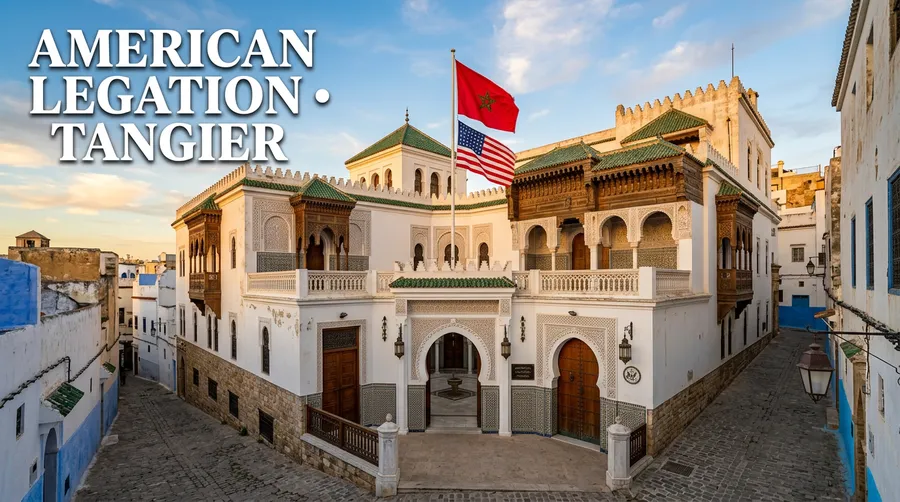
For decades, my travels have crisscrossed continents, unearthing stories that conventional guidebooks often gloss over. We’re on the cusp of the 250th anniversary of the American Revolution, a moment that beckons us not just to reflect, but to truly *understand* the sprawling, unexpected global tapestry from which the United States emerged. Most itineraries for such an occasion would naturally lead you to Boston, Philadelphia, maybe even Yorktown. But what if the deepest insights, the most profound understanding of early American diplomacy and identity, lay beyond the familiar? What if a significant piece of that narrative unfolds not just in London, but in the bustling medinas of Morocco?
This isn't just about a timeline; it's about perspective. While Great Britain's role as the colonial power is undeniably central, the story of the nascent American republic reaching out beyond Europe is often relegated to a footnote. Yet, it's in Tangier, Morocco, where you'll find the United States' first diplomatic property, a powerful reminder that our early nation was a player on a much larger, more diverse stage. This 14-day itinerary, split between the storied grounds of Great Britain and the vibrant landscapes of Morocco, isn't simply a trip; it's an education in the overlooked, a chance to connect dots you didn't even know existed.
What London's Grand Narratives Don't Always Reveal
Stepping off the plane in London, you're immediately enveloped by history, a city that breathes its past. The initial days of this Revolutionary journey are, quite intentionally, anchored here, offering a familiar entry point before we venture into less conventional territory. What I've consistently found, however, is that while sites like the British Museum are invaluable, their presentation of the American Revolution tends to be, understandably, from a distinctly British vantage point. You'll trace the colonial artifacts and pamphlets, yes, but the deeper questions of nascent American identity or the stirrings of a new global order are often left for you to ponder between the exhibitions.
Consider Westminster Abbey, a grand architectural masterpiece that practically drips with centuries of royal power. This hallowed ground, where King George III was crowned, serves as a stark reminder of the very monarchy against which the colonists rebelled. As you walk through its echoing halls, it’s easy to get swept up in the sheer scale of British imperial history. But pause for a moment, and try to imagine the parliamentary debates on colonial taxation that took place just a stone's throw away. It’s here that the ideological clash truly gains a visceral quality, forcing you to confront the immense power and tradition that America was daring to defy.
A journey down to Portsmouth Historic Dockyard offers a more tangible connection to the military might that sought to quell the American rebellion. Standing before HMS Victory, Admiral Howe’s flagship, you’re not just looking at an old ship; you’re gazing at a leviathan that symbolized British naval dominance. For those interested in the sheer logistical challenge of projecting power across an ocean, this place is gold. But what many guides won't emphasize is the sheer audacity of the American forces, largely a ragtag militia, to stand against such an overwhelming maritime force. It’s a powerful visual contrast, underscoring the revolutionary spirit’s triumph over conventional strength.
Perhaps the most unexpected British stop, and one that invariably sparks surprise, is a day trip to Winchester. Most guides bypass this charming city, but it holds a quiet secret: the home of Benjamin Franklin, the first official U.S. Consul in the 1780s. It’s a subtle shift from grand pronouncements to the nuts-and-bolts of establishing diplomatic ties. This wasn’t about declarations of war or grand speeches; it was about the painstaking work of nation-building, of establishing legitimacy in the eyes of the world. Seeing Franklin's former residence here offers a truly intimate, often overlooked, glimpse into the early, pragmatic steps of American diplomacy.
Morocco's Surprising Embrace: How an African Sultan Shaped American Destiny
Leaving the familiar landscapes of Britain for Morocco often feels like a cultural jump-cut, and it's precisely this disorienting transition that makes the second half of this itinerary so profoundly insightful. Most Americans are utterly unaware of Morocco’s crucial role in the Revolution. Yet, in 1777, Sultan Mohammed III of Morocco became the first sovereign nation to formally recognize American independence, a bold move that flew in the face of European colonial powers. This act wasn't just a courtesy; it was a diplomatic lifeline, providing legitimacy to a fledgling nation still fighting for its life.
The centerpiece of this Moroccan narrative, and arguably the most moving site of the entire journey, is the Tangier American Legation. Gifted in 1821 as a vow of gratitude, this building isn't just a museum; it's a living, breathing testament to that earliest recognition. I've spent hours wandering its labyrinthine rooms, absorbing the quiet weight of history. It offers a tangible connection to a moment when a nascent republic, thousands of miles from its shores, found an unexpected ally in North Africa, forever linking its destiny to the world beyond Europe. You'll find yourself questioning everything you thought you knew about the Revolution's international reach.
As you move south to Rabat, the capital, sites like the Kasbah of the Udayas and the Mausoleum of Mohammed V offer a glimpse into the Moroccan sovereignty that resonated so deeply with American ideals of self-determination. The Kasbah, a fortified ancient city, perched dramatically on a cliff overlooking the Atlantic, speaks of enduring independence and resilience. It serves as a powerful symbol of a nation that, much like the rebellious colonies, valued its autonomy. These sites, while not directly "Revolutionary" in the American sense, provide crucial context for understanding the diplomatic exchanges and the shared pursuit of sovereignty that characterized early U.S.-Moroccan relations.
Even Marrakech, with its chaotic, captivating souks and the opulent Bahia Palace, plays a role in this broader historical tapestry. These vibrant marketplaces weren't just for locals; they were hubs of cross-cultural trade, routes that American merchants, post-independence, were keen to access. The Bahia Palace, a sprawling complex of courtyards and gardens, symbolizes the wealth and power of a nation engaging with the wider world. It’s a sensory explosion, a world away from the intellectual debates of London, yet inextricably linked by the threads of commerce and diplomacy that defined the late 18th century.
Unpacking the Tab: What a 14-Day Continental Hop Really Costs
Alright, let's talk brass tacks: the money. A journey of this scope isn't exactly pocket change, but it’s remarkably achievable for the insights it offers. The source data pegs this 14-day, mid-range adventure at approximately $5,453 per person. While that figure provides a solid baseline, my experience tells me it’s always wise to pad that a bit, especially for incidentals and the inevitable souvenirs that will call your name from the bustling Moroccan souks. That $420 for incidentals across 14 days? That’s about $30 a day, which can feel a little tight if you enjoy a good coffee, a spontaneous street snack, and a couple of small mementos.
The budget breaks down quite neatly: $1,700 for international flights, $1,750 for accommodation, $546 for meals, and $280 for local transport. What I often find is that while accommodation and flights are fairly fixed once booked, meal and activity costs can fluctuate dramatically based on your personal travel style. For instance, in London, that £30/day for food (about $38) is achievable with careful planning—think pub lunches and supermarket picnics—but easily doubles if you indulge in frequent restaurant dining. In Morocco, however, you’ll find your dollar stretches further, with delicious, authentic meals often available at a fraction of European prices, allowing for a bit more gastronomic exploration.
A crucial factor to consider, particularly for Britain, is the fluctuating exchange rate (currently estimated at £1 = $1.25), which can impact your on-the-ground spending. Also, don't forget entry fees to some of the major attractions like the Tower of London or Westminster Abbey, which, while included in the "Activities & Tours" budget, can add up quickly if you visit every single site. For example, a single adult ticket to the Tower of London can be around £30. My advice? Prioritize what truly resonates with your interests, and consider a London Pass if you plan on hitting many paid attractions, though always do the math to ensure it actually saves you money. For Morocco, while many historical sites have nominal fees, the real "cost" can sometimes be in negotiating a fair price for a taxi or a souvenir, a skill you'll quickly develop.
Navigating Two Worlds: Practicalities for the Intrepid Explorer
Venturing across two continents demands a pragmatic approach to logistics. In Great Britain, particularly London, transportation is a dream. The Tube network is extensive, efficient, and surprisingly user-friendly once you get the hang of it. An Oyster card is your best friend here, or simply use contactless payment with your debit/credit card. For trips outside the city, like to Portsmouth or Winchester, the rail network is excellent, but do yourself a favor and book tickets in advance; spontaneity usually means higher fares. Language is, of course, no barrier for English speakers, and accessibility is generally good, though older historical sites may present challenges.
Morocco, by contrast, requires a different mindset. While major cities like Rabat and Marrakech are linked by a decent train network, local transport can be a bit more... spirited. You'll rely on "petit taxis" for short hops within cities, and haggling over the fare (or ensuring the meter is used) is part of the experience. For excursions like the Atlas Mountains or Essaouira, hiring a private driver is often the most comfortable and efficient option, especially for a group. Navigating the medinas, those ancient walled cities, is best done on foot, though a good GPS and a healthy dose of patience are essential. Expect to get lost, and embrace it; that's where some of the best discoveries are made.
Language in Morocco presents more of a cultural immersion, with Arabic (Darija) and French being the primary languages. English is widely understood in tourist areas, but learning a few basic Arabic phrases ("Shukran" for thank you, "Salam alaikum" for hello) goes a long way in fostering connections with locals. Modest dress is recommended out of respect, especially when visiting religious sites, and being mindful of local prayer times and Ramadan customs (should your visit coincide) is crucial. U.S. citizens enjoy visa-free travel for up to 90 days in Morocco and six months in the UK, simplifying entry, but always double-check current requirements closer to your travel date.
So, Why This Journey? Reclaiming a Global Revolutionary Story
Why undertake such a geographically diverse, historically layered journey when a simpler trip to colonial Williamsburg might suffice? Because this itinerary challenges the often Eurocentric narrative of American history. It forces us to confront the fact that the birth of the United States wasn't an isolated event, but a global phenomenon, influenced by and influencing powers far beyond its immediate geographical sphere. It’s about understanding that our nation's identity was forged not just in rebellion, but in early, shrewd diplomacy across continents.
What you gain from this journey isn't merely a collection of passport stamps or pretty photographs. You acquire a deeper, more nuanced understanding of America’s origins. You'll walk through the British Museum and see its artifacts with new eyes, understanding the power dynamics that spurred the revolution. Then, in Tangier, you'll experience the profound gratitude and mutual respect that characterized America's earliest diplomatic triumphs. It's an itinerary that promises not just historical facts, but an intellectual awakening, a re-evaluation of what it means to be an American in a globally interconnected world. Go, explore, and let this anniversary be a catalyst for true historical discovery.