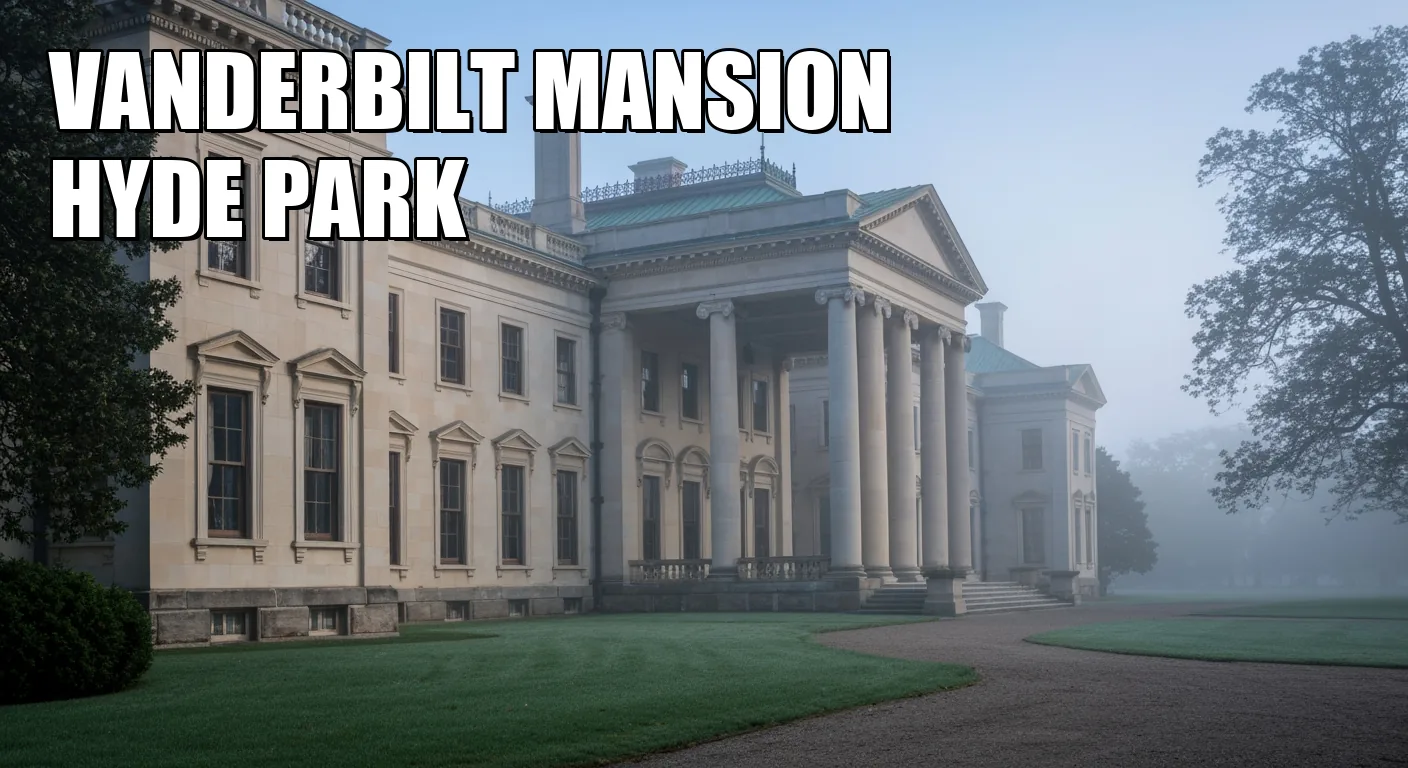
There's a particular kind of quiet that settles over Hyde Park, New York, especially when the Hudson River mist rolls in. It's in this picturesque setting that one of America's most enduring symbols of Gilded Age ambition, the Vanderbilt Mansion, stands sentinel. Many visitors arrive expecting simply a showcase of wealth, a monument to excess. They aren't entirely wrong, but to view it solely through that lens is to miss the intricate dance of power, domesticity, and sheer human will that unfolded within its fifty-four rooms.
What Opulence Really Looked Like: Peeking Behind the Grand Entrances
Upon entering the mansion, the
Elliptical Entrance Hall
immediately sets a tone of serene, almost understated elegance. It's not the bombastic, gold-leafed assault on the senses one might anticipate from a Gilded Age behemoth. Instead, its distinctive classical shape, reminiscent of Federal-style architecture, drew the eye upward to an octagonal skylight, bathing the space in a natural glow. This wasn't just a foyer; it was a carefully curated liminal zone where guests paused, shed the outside world, and prepared for the meticulously orchestrated social rituals to come. The butler, no doubt, had countless tales of nervous anticipation and hushed conversations by the fireplace, all before the main event.Few spaces encapsulate the Vanderbilt's social aspirations quite like the
Formal Dining Room
. Spanning a formidable fifty by thirty feet, it's a testament to scale and spectacle. Imagine thirty guests seated around a table, each place setting a work of art: specific china, linens, and even gold-plated service coordinated with the very flowers on the table. Louise Vanderbilt, the true orchestrator of this domestic empire, would spend weeks perfecting these details. It wasn't just dinner; it was a performance, a seven-course gastronomic journey accompanied by an array of wines, designed to impress, to solidify social standing, and to display a cultivated understanding of European luxury. This wasn't merely about feeding people; it was about asserting a family's place at the pinnacle of American society.The room itself holds treasures far older than the mansion. A
17th-century coffered ceiling salvaged from an Italian palazzo
looms overhead, its dark walnut contrasting sharply with the American Impressionist mural by Edward Simmons in the central panel. And then there's the carpet – a nearly400-year-old Persian Isphahan rug
, one of the largest Islamic carpets known, anchoring the entire space. These aren't just expensive decorations; they are declarations. They announce that the Vanderbilts had the resources, the connections, and the taste (or at least the advisors) to acquire fragments of ancient European grandeur and integrate them into their American dream. It makes you wonder what conversations transpired over those priceless threads, what deals were struck, and what rivalries quietly played out.The Social Rhythms: From Drawing Room Debates to Midnight Halts
After the men retired for cigars in the dining room, the women would gravitate to the
Living Room
, or Drawing Room, which mirrored the dining room in its impressive dimensions. This was the heart of evening entertainment: coffee, card games, charades, and music. The furnishings, a blend of Renaissance and Louis XV styles, were arranged in intimate conversational groups, suggesting a more relaxed, though still formal, atmosphere. A surprising detail, often missed in general tours, is Louise Vanderbilt's firm stance on Sabbath observance:gala balls, while occasionally held, were halted precisely at midnight on Saturday nights
. This isn't just a quirky anecdote; it offers a glimpse into the personal strictures and moral compass of a woman who, for all her outward extravagance, adhered to specific principles. It humanizes her, pulling her back from the caricature of a purely hedonistic Gilded Age matriarch.Then there was the
Reception Room, often called the Gold Room
. Designed in an opulent 18th-century French style, it was a common feature of mansions of the era—a room meant primarily for display, a statement piece. What's intriguing is that it wasinfrequently occupied
. This detail cuts through the veneer of pure function and reveals the performative aspect of Gilded Age wealth. Some rooms existed not primarily for living, but for showing that one *could* have such a room, that one possessed the wealth and connections to commission such a space, even if it sat mostly empty. It was a tangible manifestation of status, a silent boast.Beyond the Owner's Quarters: A Peek into the Private Realms
Moving upstairs to the second floor, one finds the more intimate, though no less lavish, private quarters.
Mrs. Vanderbilt's Suite, specifically, was a marvel of bespoke design
, explicitly patterned after the chambers of Marie Antoinette at Versailles. Think about that for a moment: an American heiress, in the late 19th century, modeling her most private sanctuary after a queen synonymous with extravagant spending and, ultimately, revolution. This choice speaks volumes about Louise's aspirations for refined elegance and her self-perception. It wasn't just about comfort; it was about embodying a certain aristocratic ideal, a European sensibility, right here on the Hudson.The numerous guest bedrooms on the second and third floors—the Blue, Large Red, Small Red, Mauve, Green, Pink, Lavender, and Empire bedrooms—each boasted its own distinct color scheme and meticulously coordinated 18th-century French furnishings, right down to the matching bathroom accessories. This attention to detail for guests underscores the Vanderbilt's commitment to hospitality as an extension of their social power. If the main mansion ever reached capacity, overflow guests were housed in the
Pavilion, a separate 16-room building
, originally used during construction. Imagine the logistics of hosting such an entourage, with guests having the option to dine in their rooms on specially coordinated china. This wasn't just a home; it was a self-contained luxury resort, meticulously managed.The Unseen Engine: Where the Gilded Age Really Labored
To truly understand the Vanderbilt lifestyle, one must venture beyond the grand public rooms and even the opulent private quarters, descending into the mansion's operational core. The third floor, for instance, housed not only more elaborate guest suites but also
thirteen rooms dedicated to visiting ladies' maids
, along with a two-room suite for the housekeeper and single rooms for seven maids, two cooks, and a kitchen girl. This often-overlooked detail reveals the sheer scale of the domestic staff required to maintain such a household. The glamorous life upstairs was entirely dependent on the ceaseless, largely invisible, labor performed on this floor and below.The
Basement Kitchen
was the nerve center of the estate’s legendary entertaining. Helmed by a formidable French range manufactured by DuParquet, Huot, and Moneuse, this was where the elaborate seven-course meals—the soup stocks, the filets, the foie gras—were meticulously prepared. Adumbwaiter system connected it directly to the dining room
, ensuring hot, perfectly timed delivery. This wasn't just a kitchen; it was a high-tech (for its time) culinary laboratory, a testament to efficiency and a relentless pursuit of gastronomic perfection. Adjacent, the Servants' Hall served as both dining and sitting room for the staff, operating on its own rigid schedule, a stark contrast to the leisurely pace upstairs. And let’s not forget theWine Storage suite
, a carefully temperature-controlled vault under the butler's watchful eye, safeguarding a collection undoubtedly as vast as it was valuable.From "Hideous Albatross" to National Treasure: A Mansion's Evolving Legacy
The Vanderbilt Mansion, for all its private grandeur, eventually entered the public sphere through a fascinating twist of fate. Frederick Vanderbilt, who built this monument to his stature, died without heirs in 1938. His niece, Margaret Van Alen, inherited the property. In 1940, she donated it to the
National Park Service
, a move strongly encouraged by none other than President Franklin D. Roosevelt. It's a deliciously ironic historical tidbit thatFDR, a neighbor, once described the mansion as a "hideous albatross,"
yet he recognized its undeniable historical and architectural significance, ensuring its preservation for future generations.Indeed, during
World War II, the mansion briefly served a surprising political purpose
. From 1943 onwards, selected rooms in the basement and on the third floor were temporarily repurposed for President Roosevelt's staff and Secret Service. This direct engagement with presidential history, even in a supporting role, adds another layer to the mansion's narrative, connecting it to a pivotal moment in American and global events. It’s a testament to the adaptable nature of historic spaces and how circumstances can unexpectedly redefine their purpose.Decoding the Architects' Intentions: A Symphony of Design Firms
The mansion's construction reveals a fascinating aspect of Gilded Age patronage: it employed
four interior design firms simultaneously
—Georges Glaenzer, Herter Brothers, A. H. Davenport, and Ogden Codman—all under the watchful eye of McKim, Mead & White architectStanford White
. This collaborative, yet clearly directed, approach resulted in a deliberate diversity of decorative schemes across the rooms. It wasn't about a single unifying vision; it was about showcasing the very best of different European styles, a curated collection of aesthetic prowess. White's role was to bring coherence to this opulent pastiche, ensuring the whole remained grander than the sum of its disparate parts.Beyond the stylistic choices, the mansion itself was a marvel of
cutting-edge Gilded Age technology
. Heated and ventilated systems, specialized laundry facilities, and the aforementioned dumbwaiters all contributed to an estate that could host massive, elaborate parties without a single hitch in its daily operations. This advanced infrastructure allowed the illusion of effortless luxury to persist, masking the considerable mechanical and human systems working tirelessly behind the scenes. It was, in essence, a perfectly engineered machine for refined living and social display.Planning Your Pilgrimage to Hyde Park: What to Know Before You Go
Visiting the Vanderbilt Mansion today offers a unique opportunity to step back into an era of unparalleled wealth and meticulous social engineering. To truly absorb the details and insights, I recommend visiting during the
shoulder seasons—late spring or early fall
. The crowds are generally lighter than in the peak summer months, allowing for a more reflective experience. Weekdays are always preferable to weekends, particularly if you wish to avoid long waits for guided tours. There is anadmission fee for entry to the mansion
, and while parking is available on-site, it can fill up quickly during busy periods. Arrive early, ideally shortly after opening, to maximize your experience.Don't just rush through the rooms; take the time to notice the small details: the texture of the fabric, the subtle shifts in light, the sheer scale of the art. And, importantly, consider the lives lived here, both by the Vanderbilts themselves and the army of staff who made their extravagant lifestyle possible. The Vanderbilt Mansion isn't merely a static display of wealth; it's a dynamic historical document, revealing the complex, often contradictory, story of America's Gilded Age. It challenges us to look beyond the glittering surfaces and understand the deeper currents of power, aspiration, and human ingenuity that shaped a nation.