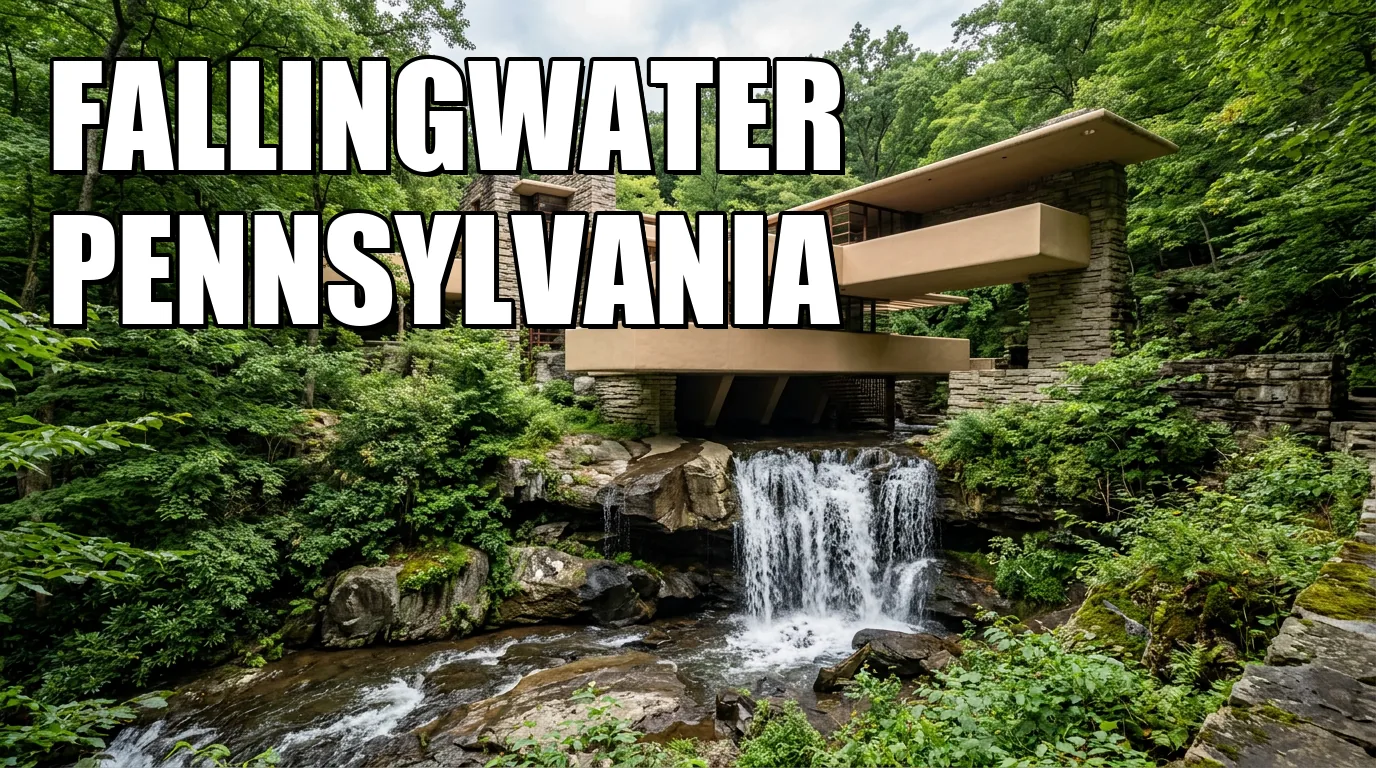
Taliesin’s living quarters burned to their stone foundations in 1914 and were destroyed by fire again in 1925. The Robie House now presents a carefully reconstructed 1910 appearance that combines surviving art glass with recreated plaster, fixtures, cabinetry, and an entry door destroyed decades later. Fallingwater carries a visible cantilever sag even after hidden steel cables stopped further movement.
All three belong to Frank Lloyd Wright’s architectural legacy; Taliesin, Robie House, and Fallingwater are also part of the eight-site World Heritage inscription. Their authenticity does not mean the same thing. One preserves Wright’s own sequence of rebuilding, one restores a selected historical moment, and one retains deformation while stabilizing the structure from within.
World Heritage does not mean untouched fabric
The 2019 serial inscription requires the group to retain integrity and authenticity. It does not certify that every board, brick, pane, surface, and structural condition remains exactly as installed at completion. The eight sites include buildings that Wright altered repeatedly, buildings returned to an earlier appearance after institutional reuse, and buildings kept standing through modern structural or envelope systems.
| Site | What changed | What the preservation decision protects |
|---|
| Taliesin, Wisconsin | Two fires, two major rebuilds, and Wright’s continuing alterations through 1959 | The authored sequence and surviving fabric from several Taliesin phases |
| Robie House, Chicago | Institutional conversion, removals, then restoration campaigns from 2000 through 2019 toward its 1910 appearance | A legible Prairie house at a selected date, using original, conserved, returned, and recreated elements |
| Fallingwater, Pennsylvania | Early cantilever deflection, decades of creep, 2001–2002 post-tensioning, and later waterproofing | The house’s visible form and historic material without forcing the terraces back to an undamaged geometry |
The useful question is therefore not “Is it original?” A historic building can contain original material in a later arrangement, new material in an original design, or an altered shape retained to avoid destroying more fabric. Each answer requires a date and an intervention.
Taliesin is authentic because it did not stop changing
Wright began Taliesin in 1911 as home, studio, and farm. The 1914 fire destroyed the living wing down to its stone foundations but spared the studio, workshops, and parts of the agricultural complex. Wright rebuilt the residence as Taliesin II. An electrical fire destroyed the living quarters again in 1925, leading to Taliesin III.
The third version did not erase the first two. Wright reused limestone from the earlier house, including fire-reddened and cracked blocks, and set damaged art objects recovered from the ashes into new masonry. Older foundations, surviving work spaces, rebuilt rooms, and salvaged fragments occupy the same composition.
Nor did Taliesin III become a finished 1925 object. With the Taliesin Fellowship, Wright kept converting farm structures, extending rooms, adding the Birdwalk balcony, revising circulation, and testing new cantilevers. A chicken coop became dormitory space as late as 1957.
Calling the current site “the original 1911 house” is inaccurate. Calling it a replica is equally poor. The surviving work spaces, foundations, reused stone, post-fire living quarters, and Wright’s later alterations form the document. At Taliesin, change made by Wright is part of the authorship being preserved.
Robie House reconstructs a chosen 1910 moment
Robie House followed a different path. The Chicago Theological Seminary used it as dormitory, classrooms, and refectory; the University of Chicago later adapted it for institutes and offices. Partitions, lighting, finishes, bathrooms, and other domestic features changed or disappeared.
The long restoration completed in 2019 did not preserve every stage equally. It deliberately returned the house toward Wright’s 1910 vision. Conservators cleaned and repointed the Roman brick, retained original plaster where it survived, recreated missing plaster textures and wash colors, removed office interventions, and rebuilt lost woodwork and fixtures.
The result is not wholesale replacement. Of Wright’s 175 original leaded-glass doors and windows, 163 survive. Original furniture and glass panels returned on loan sit beside recreated cabinetry, light fixtures, frosted globes, and the front entry door destroyed during a 1960s student demonstration.
A visitor sees a historically argued 1910 interior, not an untouched house that simply escaped the twentieth century. The restoration makes Wright’s spatial and color system readable by reversing later uses and reproducing missing evidence.
Fallingwater preserves a failure as well as a design
Fallingwater’s main cantilevers began deflecting as soon as construction formwork came away. Movement continued for decades until temporary shoring was installed in the 1990s. During the 2001–2002 stabilization, engineers threaded and tensioned high-strength steel tendons through the concrete system to carry the load and halt further sag.
They did not jack the terraces back to Wright’s intended level lines. The concrete had already changed shape through cracking and long-term creep; forcing it flat risked opening new cracks and damaging historic material. The intervention lifted the structure only enough to transfer weight from the temporary supports.
The visible deflection is consequently neither the pristine blueprint nor an untreated structural failure. It is a stabilized historical condition. The deeper cantilever and reinforcement history at Fallingwater explains why the retained sag records both the design’s ambition and the building’s engineering life.
Read the preservation choice during the tour
- Target date: Is the room interpreted to completion, a later Wright revision, or another documented period?
- Material status: Which elements are original, salvaged, conserved, returned, or reproduced?
- Visible change: Has damage been reversed, concealed, or retained because correction would destroy more evidence?
- Later history: Were institutional, residential, or apprentice-era changes removed, and why?
Taliesin asks the visitor to follow several versions at once. Robie House asks the visitor to understand a restoration’s selected date. Fallingwater asks the visitor to see modern engineering without expecting the house to look newly poured. Going beyond Wright’s blueprints means recognizing that preservation is another design decision—one that determines which version of the masterpiece can still be read.