The very term "Prairie architecture" often conjures images of Frank Lloyd Wright and his distinctive horizontal lines stretching across the Midwestern landscape. Yet, to reduce this dynamic movement to a single aesthetic or a lone visionary is to miss the profound revolution it ignited. Over decades, this style evolved, embracing radical concepts of integrated living, spatial fluidity, and a deep connection to the land. I’ve walked the halls of these buildings, felt the surprising intimacy of their open plans, and glimpsed the future they heralded. What follows isn't just a list; it's an invitation to understand the enduring genius of five pivotal structures that redefined American domestic architecture, offering insights you won't typically find in your standard guidebooks.
Chicago's Cantilevered Masterpiece: Unpacking the Robie House
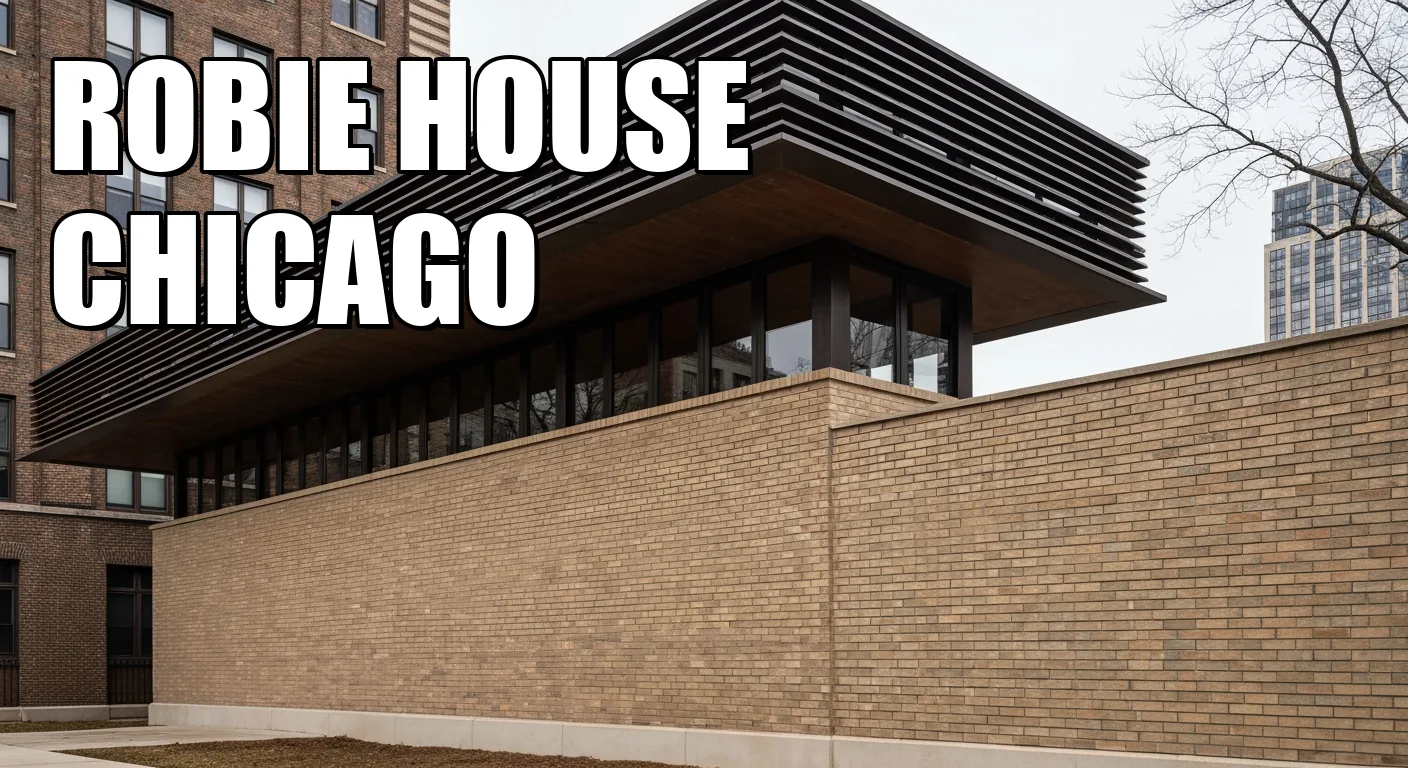
Stepping onto the grounds of the Frederick C. Robie House in Chicago, you’re immediately confronted by an audacious feat of engineering that still feels startlingly modern, despite its completion in 1910. This isn't just a house; it's a manifesto in Roman brick and steel. Wright's vision here was to make a dwelling that seemed to grow from its flat, urban lot, defying the constraints of a narrow parcel and local setback rules. He achieved this with a massive, 20-foot cantilevered roof on the west side, a bold overhang that appears to float effortlessly, suspending a porch without visible support. It’s an optical illusion, yes, but also a masterful demonstration of how steel could liberate domestic architecture from its traditional confines, letting the structure breathe and reach out.
The interior is where the true genius of Wright's "destruction of the box" concept comes alive. Most guides will tell you about the open-plan living and dining room on the second floor, a unified "great room." But what they often miss is the sheer *audacity* of that central chimney mass. It acts as the home's anchor, yet above the fireplace, a clever opening allows for visual continuity between the two zones. This wasn't just about combining rooms; it was about fostering a new kind of family interaction, where spaces flowed into one another, encouraging connection rather than separation. The bands of floor-to-ceiling leaded glass windows, with their delicate, floral-inspired geometric patterns, aren't just decorative; they filter light, creating an ever-changing tapestry of color and shadow that brings the outside in, even on a gray Chicago day. A standard "A Modern Home" tour will cost you $24 for 60 minutes, focusing solely on the interior. Frankly, for the full impact, I’d spring for the "Inside and Out" tour at $38, which gives you crucial context for Wright’s brilliant exterior solutions. Tours run Thursday through Monday, but be warned: groups are capped at 14, and prime weekend slots disappear faster than you can say "Prairie Style." Arrive early, even if you have a reservation, just to soak in the exterior details before your scheduled entry.
A Grand Statement in Buffalo: The Martin House's Integrated Vision
Moving eastward to Buffalo, New York, the Darwin D. Martin House Complex offers a different, yet equally compelling, chapter in Wright's Prairie saga. Unlike the singular statement of the Robie House, the Martin House, built between 1903 and 1905, is an entire integrated estate. Wright designed not just a main residence, but a pergola, conservatory, carriage house, and even a separate home for Martin's sister – all unified by a single, overarching design philosophy. This was revolutionary: the concept of an extended family living in distinct, yet interconnected, structures. It speaks to a less individualistic, more communal ideal of domesticity, something quite ahead of its time.
What truly sets the Martin House apart, beyond its sheer scale, is the staggering volume of art glass. With 394 examples across sixteen primary patterns, it boasts more decorative glass than any other Wright property. The "Tree of Life" windows in the reception room alone, each a mosaic of nearly 750 individual pieces, are simply breathtaking. They aren’t merely windows; they're monumental artworks, creating a "ribbon of art glass" that transforms the very quality of light within the home. On my visit, I found myself lingering in the reception room, mesmerized by how the light played through the iridescent and colored panes. This house isn't just about horizontal lines; it's about the interplay of light and material, form and function, across an entire designed landscape. The standard 75-minute tour at $25 is a good start, but if you have the time and the budget ($45), the 2-hour "Martin House Plus Tour" is an absolute must. It grants access to the second-floor rooms and the Barton House, offering a far more complete understanding of Wright's grand vision for the complex. Remember, advance reservations are highly recommended; this isn't a walk-in experience, particularly given its popularity.
The "Destruction of the Box" Defined: Willits House's Enduring Legacy
While it might not be a public attraction today, the Ward W. Willits House in Highland Park, Illinois, holds a pivotal place in the story of Prairie architecture. Designed in 1901 and constructed in 1902, it's often hailed as Frank Lloyd Wright's first truly mature Prairie style house. This claim isn't hyperbole; the Willits House cemented many of the design principles that would become synonymous with the movement. Its cruciform (cross-shaped) floor plan, with four wings radiating from a central fireplace, was a stroke of genius. It was more spatially efficient than traditional rectangular layouts and fundamentally challenged the rigid, box-like rooms that dominated turn-of-the-century homes.
Wright's brilliance here lay in more than just the floor plan. He pioneered the use of wood frame and stucco, a more accessible and adaptable construction method for the burgeoning middle class. More subtly, and perhaps more profoundly, the Willits House articulated Wright’s "destruction of the box" concept by eliminating traditional doorways. Instead, he used modulating ceiling heights, subtle shifts in floor levels, and screens of vertically oriented wooden slats to delineate spaces. This created an open flow, a spatial continuity that felt revolutionary. You can't tour the Willits House – it's privately owned – which is a real shame for architecture enthusiasts. However, its historical significance means that understanding its innovations is crucial for appreciating the evolution of the style. Imagine a home where the very structure encourages movement and visual connection, where nature is invited in through expansive bands of leaded glass windows opening onto verandas and yards. That was the Willits House, and its influence echoes through every subsequent Prairie design.
A Honeycomb of Innovation: The Hanna House's Hexagonal Departure
Venturing out to Stanford, California, we encounter the Hanna House, affectionately known as the "Honeycomb House." Begun in 1937 and expanded over a quarter-century, this structure represents a fascinating, and often overlooked, turning point in Wright's career. Here, he boldly abandoned the conventional right angle, embracing hexagonal geometry with 120-degree angles throughout the entire floor plan, the tiled terraces, and even the built-in furnishings. This wasn't just a quirky design choice; it was a profound exploration of "spatial continuity and flexibility." Without a single right angle, the house achieves an astonishing sense of openness and freedom of movement, proving how polygonal modules could create a dynamic, adaptable living environment.
The Hanna House was also a prime example of Wright’s Usonian ideals, designed to be adaptable for middle-class families. As the Hanna children grew and eventually left home, bedrooms could be effortlessly converted into studies without disrupting the flow of the house – a testament to its forward-thinking design. The sunken living room and expansive windows further blur the lines between inside and out, a classic Wrightian move amplified by the non-linear walls. Sadly, if you're planning a trip, be aware: the Hanna House is currently closed temporarily for repairs and conservation projects, with no reopening date yet determined as of late 2025. This means you can't walk through its unique, flowing spaces right now. When tours do resume, they're typically on select Thursdays and Saturdays, requiring advance online booking and a minimum age of 12. Keep a keen eye on their website; visiting this house is a truly distinct experience, offering a glimpse into Wright's later, more experimental phase.
Oklahoma's Organic Expression: Herb Greene's Prairie House
Finally, our journey takes us to Norman, Oklahoma, to a structure that pushes the boundaries of "Prairie" beyond even Wright's own innovations: Herb Greene's Prairie House, built between 1960 and 1961. Often dubbed the "Prairie Chicken House" by *Life Magazine* due to its sculptural, beak-like front beams, this home is a breathtaking leap into organic modernism. Greene, designing for his own family, didn't just integrate the house with nature; he made it *embody* nature, drawing inspiration directly from the prairie birds and the expansive landscape. This wasn't about horizontal lines anymore; it was about biomorphic forms, a sculptural response to place and purpose.
The interior is a revelation, cloaked entirely in unfinished cedar shingles, creating a unified, tactile, and deeply organic environment. It’s a departure from the refined surfaces of Wright, embracing a raw, earthy aesthetic. Greene thoughtfully positioned communal areas like the kitchen and family room to face east, bathing them in the soft, low morning light of the prairie, while the bedroom wing captures the afternoon sun and prevailing winds. This wasn't just passive solar; it was an active dialogue with the environment. One particular feature, the "eye" of the house – a special window offering expansive views of the surrounding prairie – became famous when photographer Julius Shulman spent four days documenting the home through its lens. The Prairie House demonstrates that organic architecture didn't stop with Wright; it continued to evolve, becoming more expressive, more sculptural, and deeply rooted in its specific regional context. Currently, monthly tours of the Prairie House are on hold as the Preservation Society diligently works on crucial restoration efforts. While disappointing for eager visitors, it underscores the commitment to preserving this unique piece of architectural history. Keep an eye on the Prairie House Preservation Society's website for updates; supporting their efforts, perhaps by attending a future tour, is a worthwhile endeavor for anyone intrigued by architecture that dares to be different.
Exploring these structures reveals the true depth and dynamism of Prairie architecture. It's not a monolithic style, but a living, breathing testament to architectural innovation, constantly evolving and challenging perceptions. From Wright's early cruciform plans to his later hexagonal experiments, and then to Greene's biomorphic expressions, these homes whisper stories of daring design, integrated living, and a profound connection to the American landscape. They are more than just buildings; they are lessons in seeing, experiencing, and living deliberately.
Discovering American Prairie Architecture: A Traveler's Guide to Organic Design Heritage
What is organic prairie architecture?
Organic prairie architecture is a design philosophy that harmonizes buildings with their natural environment and the needs of residents, characterized by horizontal lines, low-pitched roofs, large windows, and open floor plans that echo the flat landscapes of the American Midwest. This style emerged in the early 20th century through the work of Frank Lloyd Wright and other Prairie School architects who believed buildings should exist in harmony with nature and reflect American values.
What is the history of organic architecture?
Organic architecture emerged as a design philosophy in the early 1900s through the work of Prairie School architects, with Frank Lloyd Wright introducing the term 'organic' into his architectural philosophy as early as 1908. This philosophy was an extension of Louis Sullivan's teachings, emphasizing that buildings should be non-derivative, distinctly American, rooted in nature, and designed with a sense of place.
Where did prairie style architecture originate?
Prairie style architecture originated in Chicago, Illinois around 1900, emerging from the work of a small group of young architects including Frank Lloyd Wright and influenced by architect Louis Sullivan. The style developed from ideals of the Arts and Crafts movement and was specifically designed to express the character of the American Midwest landscape.
What is the philosophy behind prairie architecture?
The philosophy behind prairie architecture emphasizes harmony between human habitation and the natural world, rejecting European revivalist styles in favor of organic design rooted in nature. Wright's organic architecture principle held that buildings should exist in harmony and respect with humanity and its environment, erasing boundaries between inside and outside spaces.
When did the organic design movement start?
The organic design movement in architecture began in the late 19th century with Louis Sullivan's theories, fully developing in the early 20th century around 1900 with the Prairie School's emergence in Chicago. For furniture and product design, the organic design movement gained formal recognition in 1940 with MoMA's competition and exhibition.
Who invented organic design?
Frank Lloyd Wright pioneered organic architecture and is credited with developing this comprehensive design philosophy, building upon his mentor Louis Sullivan's theories about distinctly American architecture. While Wright didn't invent the concept alone, he systematized and popularized organic design principles through his extensive body of work spanning over 70 years.
What is the origin of the organic movement?
The organic movement's origins trace to late 19th-century Arts and Crafts ideals emphasizing nature, craftsmanship, and simplicity, combined with Louis Sullivan's call for non-derivative American architecture rooted in nature. Prairie School architects of the early 1900s synthesized these influences into organic architecture that rejected European styles in favor of designs reflecting the American landscape.
When did the design movement start?
The Prairie School design movement emerged around 1900 in Chicago and flourished through the early 20th century, with its fullest expression occurring between 1900-1920. The movement gradually declined after 1915, though its influence on modern architecture, modernism, and mid-century design remained significant.
Who started the organic food movement?
The organic food movement began in the early 20th century with pioneers like Albert Howard and Robert McCarrison advocating soil health and ecological farming, with the term 'organic farming' coined in 1940 by English naturalist Lord Northbourne in his book 'Look to the Land.' In the United States, J.I. Rodale popularized organic methods from the 1940s through his magazine and publishing house.
How did MoMA define organic design in 1940?
MoMA curator Elliot Noyes defined organic design in 1940 as 'a design may be called organic when there is an harmonious' relationship between form and function, materials and production methods. The Museum sponsored a competition challenging designers to submit furniture, lamps, and textiles embodying this organic design philosophy.
What are the defining architectural features of prairie style homes?
Prairie style homes feature strong horizontal lines, flat or shallow hipped roofs, broad overhanging eaves, bands of windows, open asymmetric floor plans, brick or stucco exteriors, large central chimneys, and minimal applied ornamentation. The horizontal emphasis is designed to unify the structure with the native prairie landscape and showcase Wright's belief in architectural democracy.
What are the best locations to visit prairie architecture in the United States?
Top prairie architecture destinations include Oak Park, Illinois (highest concentration of Prairie School buildings), Buffalo, New York (Frank Lloyd Wright's Martin House), Spring Green, Wisconsin (Taliesin), Kankakee, Illinois (B. Harley Bradley House), and Mason City, Iowa. Other notable locations include Little Rock, Arkansas, Sacramento, California, and Rockford, Illinois.
How much do tours of Frank Lloyd Wright homes cost?
Tour prices vary by location and tour type, ranging from $12-$25 for basic home tours to $45+ for comprehensive estate tours. For example, Martin House tours in Buffalo cost $25 for standard tours and $45 for extended tours; Taliesin West in Arizona charges $44 for adults; and Frank Lloyd Wright's home and studio in Oak Park costs $24-$38 depending on tour type.
When is the best time to visit prairie architecture sites?
Peak visiting seasons are July, August, and October, so advance booking 4-6 weeks ahead is recommended for these months. Spring (May-June) offers pleasant weather with fewer crowds, and fall provides beautiful foliage, though winter is generally slower for tourism.
What are the accessibility features at prairie architecture sites?
Accessibility varies significantly among sites; Frank Lloyd Wright's Laurent House in Rockford, Illinois is the only home specifically designed for wheelchair accessibility with wide hallways, accessible bathrooms, and no thresholds. Other sites like Martin House in Buffalo offer partial wheelchair access on some tours, while older homes may have limited accessibility.
Are photographs allowed inside Frank Lloyd Wright homes?
Photography policies vary by site; generally, personal, non-commercial photography is permitted outdoors and sometimes indoors without flash at the guide's direction. Fallingwater allows photography on the grounds, while Taliesin West requires permission agreements for photography and videography, and commercial use is prohibited across all sites.
We use cookies to enhance your experience. By continuing to visit this site you agree to our use of cookies.