Venturing across the American South, one cannot escape the imposing, often breathtaking, presence of Greek Revival architecture. These structures, whether sprawling plantation homes or robust civic buildings, stand as monumental testaments to a period obsessed with classical ideals, democracy, and, paradoxically, a deeply entrenched system of human bondage. Yet, to simply admire their pediments and columns is to miss the profound complexity—the ambition, the innovation, the adaptation, and the sheer human will—that went into their creation. I’ve spent decades walking their hallowed halls, feeling the weight of history in their broad timbers and cool marble, and I can tell you, the story is always richer than the postcard suggests.
Far from being mere copies of ancient temples, these American adaptations often reveal a fascinating tension between classical purity and regional practicality. What might appear as a uniform style upon first glance quickly unravels into a tapestry of local materials, evolving tastes, and even an audacious willingness to bend the rules. What follows isn't just a list of beautiful buildings; it’s an invitation to understand why they matter, how they challenge our perceptions, and what unexpected truths they whisper to those willing to listen beyond the guided tour patter.
Nottoway's Grand Scale: More Than Just a Mansion?
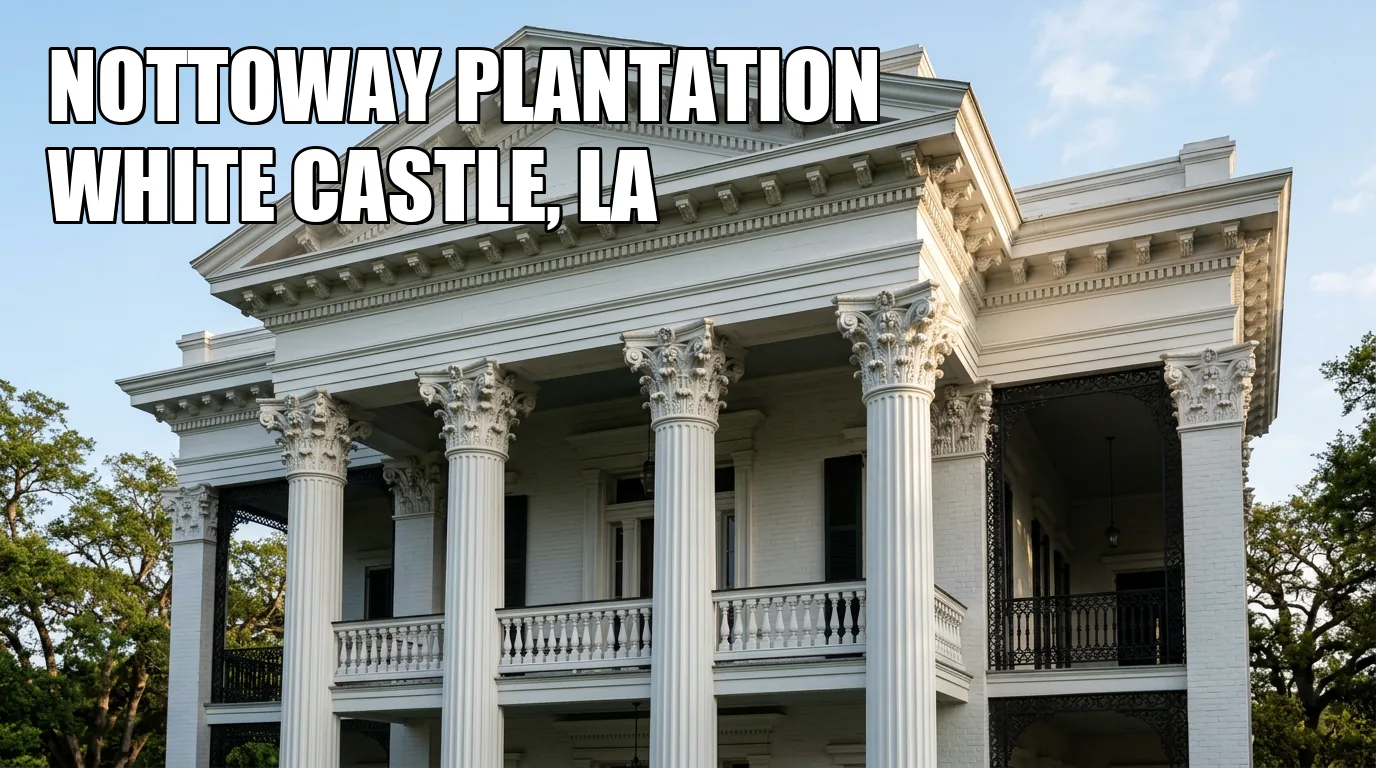
Driving through the flat, fertile landscapes near White Castle, Louisiana, Nottoway Plantation seems to rise from the earth as a veritable colossus. Completed in 1859 by architect Henry Howard, it remains the largest antebellum mansion in the entire Southern United States, boasting an astonishing 53,000 square feet. It's easy to dismiss such opulence as mere ostentation, yet Nottoway’s sheer scale and intricate detailing—from its rusticated stucco-covered brick base to its 22 angular gallery columns supporting a tall entablature adorned with modillions—speak volumes about the aspirations of its owner, John Hampden Randolph, a sugar magnate determined to make a statement. Is it a testament to success or a monument to excess? You decide as you wander its vast rooms.
What truly sets Nottoway apart for me isn't just its size, but the subtle, almost playful, architectural solutions Howard employed. Take, for instance, the double curved granite staircases that lead to the second story; they were famously designed with separate left and right flights specifically so that "gentlemen and ladies would not see one another's legs while ascending." This detail isn't just a quirky anecdote; it offers a glimpse into the social mores and anxieties of the era, revealing a society deeply concerned with propriety even amidst such extravagance. Furthermore, the mansion’s asymmetrical balance, with a projecting bedroom wing on one side and a large curved bay on the other, deviates from the stricter symmetry often associated with Greek Revival, hinting at a more innovative, less rigid interpretation of the style, perhaps even a nod to Italianate influences. Visitors should plan for a full day to appreciate the interior’s ambition and the expansive grounds, but beware the summer heat, which can make exploring the un-airconditioned upper floors a truly authentic, if somewhat sweaty, historical experience.
Oak Alley's Iconic Vista: Does the House Live Up to the Trees?
Few images are as synonymous with the Southern plantation as Oak Alley, its name itself conjuring visions of ancient live oaks dripping with Spanish moss. Indeed, the 28 colossal Doric columns that form the mansion’s unique peripteral colonnade—a free-standing ring of columns on all four sides—perfectly mirror the 28 magnificent oak trees lining the grand avenue leading to the house. This striking integration of natural and built environment, designed by Joseph Pilié and completed in 1839, is what makes Oak Alley truly unforgettable. Yet, the expectation set by that iconic alley can sometimes overshadow the house itself for many first-time visitors. The initial impression of grandeur is undeniable, but what about the substance?
Stepping inside, one finds a meticulously restored, though perhaps less architecturally surprising, interior than Nottoway’s eccentricities might offer. The square floor plan, organized around a central hall, is classical and functional. However, a detail often missed is that the exterior walls, while appearing solid and grand, were constructed of locally made bricks and then finished with stucco and painted white to *simulate* marble. This wasn't an uncommon practice, but it's a telling one: the desire for the appearance of classical luxury often outweighed the cost or availability of authentic materials. The beautiful Federal-style fanlights and sidelights adorning the doorways, framed by slim, fluted colonnettes, also illustrate how architectural styles rarely exist in pure isolation; they blend and borrow, creating a transitional elegance. For the best experience, arrive early in the morning, before the tour buses descend, to walk the alley in relative solitude—the house will be there, but the quiet magic of the oaks is fleeting.
The Hermitage Reimagined: Andrew Jackson's Lasting Legacy?
When most people think of Andrew Jackson’s Hermitage near Nashville, Tennessee, they picture the stately, columned mansion. What many don't realize is that the grand Greek Revival structure we see today, completed in 1836, is actually a redesign, a phoenix rising from the ashes of a devastating 1834 fire. The original home, a more modest Federal-style dwelling built in 1821, was significantly damaged, prompting Jackson to commission William C. Hume and Joseph Reiff to rebuild it in the then-fashionable Greek Revival style. This transformation isn’t just an architectural footnote; it’s a powerful statement about how public figures, even in retirement, curated their image.
Jackson, a man of strong will and clear vision, chose a style that projected strength, classical ideals, and democratic principles—a powerful message for a former president. The rectangular layout, featuring a central block with a five-bay, two-story structure and a portico supported by six modified Corinthian-style wooden columns, certainly achieves this effect. Yet, observe closely: the front facade, painted a light tan with sand applied to columns and trim to simulate stone, again reveals that common American pragmatism where appearance often took precedence over costly imported materials. Furthermore, the illusion of a flat roof from the front dissolves on the other elevations, revealing a more practical pitched tin-covered roof. Visiting The Hermitage today offers a rare opportunity to explore not just a historic home, but a meticulously preserved landscape and complex that includes slave cabins and a church, providing a more complete, if often uncomfortable, picture of early American life and the man who shaped so much of it. Don't rush through the grounds; the context is everything here.
Rosedown's Distinctive Blends: A Transitional Charm?
Deep in the quiet charm of St. Francisville, Louisiana, Rosedown Plantation offers a slightly different flavor of Greek Revival. Commissioned by Daniel and Martha Turnbull in 1835, this exquisite home, constructed primarily of cypress and cedar milled onsite, truly embodies a transitional Federal-Greek Revival style. While many guides might label a building as one style or another, Rosedown refuses such neat categorization, and that’s precisely its strength. It’s not a pure example, but rather a compelling dialogue between two dominant aesthetics of its time, making it, in my view, far more interesting than a strict adherence to a single doctrine.
The home’s two-story gallery, with its smooth Doric columns, is undoubtedly Greek Revival, but then your eye catches the distinctive, almost whimsical, bulbous vase-like balustrade. This unique feature, paired with matching fluted pilasters and a Doric entablature, gives Rosedown a character all its own—a graceful flourish that softens the classical rigor. Then, stepping inside, you encounter Federal-style elliptical arch doorways with their six horizontal panels, boldly formed fluting, keystones, and intricate leaded glass patterns—details more commonly associated with the earlier Federal period. These elements aren't afterthoughts; they are integral to the house’s original design, showcasing a builder (contracted through carpenter Wendell Wright, the primary architect remains unknown) who deftly wove together the prevailing tastes. Later additions in 1845 by T.S. Williams, with one-story brick side wings featuring their own Greek-style end porticoes, further demonstrate a continuous evolution of the estate, rather than a static monument. Rosedown’s extensive gardens are as significant as the house itself, so allocate ample time, especially in spring, to wander through what feels like a living historical tableau.
Charleston's Custom House: A Civic Statement Interrupted
Shifting from the grandeur of private estates to the enduring power of public architecture, the United States Custom House in Charleston, South Carolina, presents a formidable example of Greek Revival principles applied to civic purpose. This cruciform public building, completed in 1879 but with construction beginning in 1853, stands as one of Charleston’s most striking expressions of the style, dominated by the Roman Corinthian order. What’s most striking about this building, however, isn't just its imposing presence along the waterfront, but the dramatic story of its prolonged birth, interrupted and forever altered by the seismic shifts of American history.
Designed by Ammi Burnham Young, with Edward Brickell White superintending construction, this Custom House was envisioned as a monument to federal power and commercial prosperity. Its pedimented Roman porticoes on the east and west fronts, supported by monumental Corinthian limestone columns, immediately convey authority. The basement story, with its rusticated treatment, grounds the building, while the smooth marble of the upper walls adds a layer of refined elegance. Yet, the most profound insight into this structure’s journey lies in what isn't there: the originally planned rotunda with a soaring dome and skylight at the intersection of the cross arms. This ambitious feature was ultimately eliminated to reduce costs, a direct consequence of construction being halted for over a decade by the Civil War. That a project of such scale could be paused by national upheaval, only to be completed with compromises, speaks volumes about the priorities and limitations of the post-war Reconstruction era. Today, entering its two-story Business Room, supported by fourteen Corinthian columns, you still feel the weight of its original ambition and the resilience of a nation rebuilding itself. It's a testament to endurance, a stark reminder that even the grandest designs are subject to the messy realities of history.
These five structures, each in its own distinct way, offer far more than just architectural beauty; they are touchstones to understanding the aspirations, the contradictions, and the profound historical forces that shaped the American South. From the almost defiant opulence of Nottoway to the iconic harmony of Oak Alley, from Jackson’s rebuilt assertion of power at The Hermitage to Rosedown’s elegant blend of old and new, and finally, to the Charleston Custom House’s interrupted civic grandeur, these buildings tell a complex story. They demonstrate a national embrace of classical ideals, interpreted with regional flair, local materials, and, crucially, a human ingenuity that often bent the rules to achieve monumental effect. To truly appreciate them is to look beyond the columns and pediments, and to listen to the silent narratives they continue to share.