“Early American” is often treated as a visual category: a steep roof means colonial, symmetry means Georgian, and a fanlight means Federal. That shortcut fails where the history is best documented. Present appearances combine original frames, later wings, removed stories and reconstruction.
A better question is not “What style is this?” but “Which construction layer am I using to name it?” Fairbanks House can be dated timber by timber. Paul Revere House retains an early frame behind a reconstructed exterior. Independence Hall pairs an eighteenth-century block with a later steeple and rooms. Monticello incorporates an earlier house inside Jefferson’s redesign.
A style label is only the beginning
Before assigning a style, separate the original core, additions, removals, restoration or reconstruction, and the form visible now. These categories do not describe a decline from “authentic” to “fake.” They describe provenance.
An old beam can survive inside a new wall treatment. A room can retain its dimensions while its paneling and furniture are later interpretations. A roofline may belong to a redesign rather than the first campaign. The useful skill is learning what a feature can and cannot date.
Fairbanks House: the plaque date becomes a timber sequence
The Jonathan Fairbanks House in Dedham is commonly introduced with a single date: 1636. The Historic American Buildings Survey catalog still carries that traditional “initial construction” label. Tree-ring evidence produces a more precise and more complicated account.
The Oxford Tree-Ring Laboratory identified two felling seasons for the primary phase: winter 1637/38 and winter 1640/41. Individual samples include a summer beam dated to 1637, stair wall boarding dated to 1638 and 1640, and a joist dated to 1640. Oxford’s property account says that by 1641 Fairbanks had built a two-and-a-half-story central-chimney house with a hall and parlor below and two chambers above.
Those results do not turn 1641 into an exact completion date. Dendrochronology dates when sampled trees were felled; the result must still be connected to location, reuse and phase. Roof boards were felled in winter 1652/53 and winter 1654/55, roughly fourteen years after the main frame. Oxford interprets them as an early roofing alteration, not evidence that the house was first built in 1654.
Cedar clapboards survive high on the north wall because an early rear lean-to protected them. Oxford says it is unclear whether they belong to the house’s completion. Fairbanks replaces a confident plaque date with a sequence in which different pieces answer different questions.
Paul Revere House: an early frame inside a restoration image
The Paul Revere House in Boston presents the opposite problem. Its c. 1680 core is well supported, and a National Register study reports that about 90 percent of the structural framing survives. Yet the exterior encountered today is not an untouched seventeenth-century facade.
After the Revere family left, the house passed through tenement and commercial use. By the late nineteenth century its first floor contained storefronts, and a later third story had changed the silhouette. When the building was threatened in 1907, the Paul Revere Memorial Association acquired it and architect Joseph Everett Chandler directed the 1907–1908 restoration.
Chandler retained the structural skeleton but removed the third story, rebuilt the steep roof and reconstructed an interpreted seventeenth-century exterior. Boston National Historical Park documentation is blunt: cladding, pendants, windows, doors and roof shingles are reconstructions. Early interior material includes much of the oak frame, original subflooring throughout most of the house, several window frames and two doors, but the rooms also reflect Chandler’s choices.
Calling the house “First Period” is not wrong. Treating every visible First Period-looking detail as c. 1680 fabric is. The strongest reading holds both facts at once: an exceptionally substantial early frame survives, and the image that makes the house legible from North Square was shaped by Colonial Revival preservation.
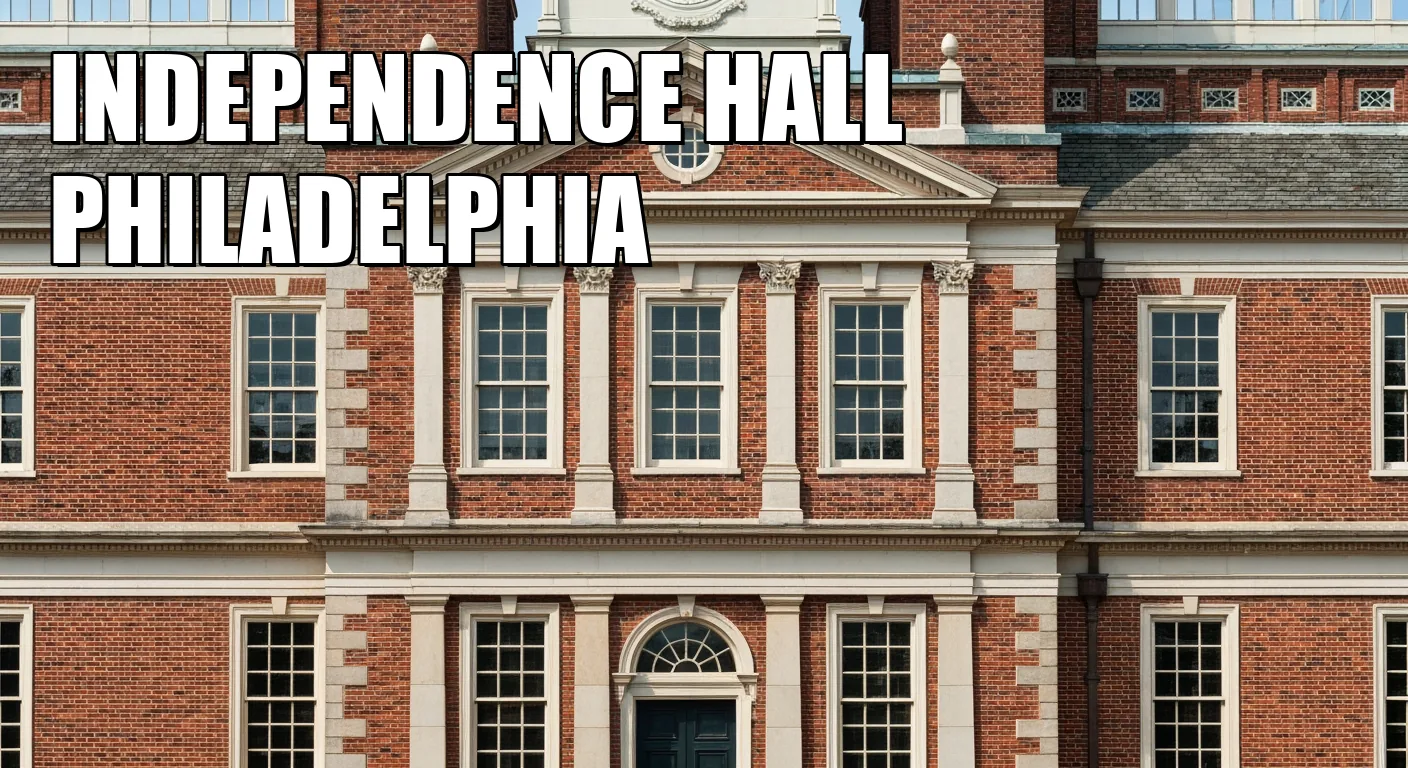
Independence Hall: an eighteenth-century block with later rooms and skyline
Independence Hall is often compressed into the year 1776, but the building itself resists that freeze-frame. Construction of the Pennsylvania State House began in summer 1732. The Assembly occupied unfinished first-floor space in 1735; the Supreme Court Chamber was ready in 1743; the second-floor Council Chamber and related rooms came into use around 1747. Official records place completion of the main block in 1747 or 1748, depending on which part of the sequence is being counted.
The familiar steeple is a separate layer. The original design had no tower or steeple. They were added around 1750, and the wooden upper structure deteriorated quickly enough to be considered unsafe by 1773. It was removed in 1781. In 1828 Philadelphia hired William Strickland to replace it. Strickland did not simply reproduce the lost form: he introduced clocks and additional ornament, and his timber engineering remains inside the tower visitors see.
The rooms are layered too. The Assembly Room’s original paneling was removed in the early nineteenth century. John Haviland’s 1831 restoration included inaccuracies and was later removed by the National Park Service. Later nineteenth-century partitions were removed between 1895 and 1900 to return the second floor toward its earlier arrangement.
A National Park Service account rejects the idea of an untouched founding-era interior. It says the Founding Fathers would not easily have recognized the building in 1954: modernization and reconstruction had altered it, most furnishings were gone, and deterioration was advanced. Refurnishing then acquired roughly 300 objects, mixing period antiques with temporary modern tables, reproduced inkstands, copied paintings and new baize covers based on surviving evidence.
Independence Hall is genuine without being frozen: an eighteenth-century civic block, Strickland’s nineteenth-century skyline and evidence-based twentieth-century rooms.
Monticello: the first house remains inside the second design
Monticello is the clearest warning against imagining building phases as separate objects. Jefferson began leveling the mountaintop in 1768, and construction of the mansion began in 1769. The South Pavilion, built in 1770, gave Jefferson an early place to live while the house rose nearby.
After returning from France in 1789, Jefferson planned a radical remodeling. The Thomas Jefferson Foundation calls the schemes Monticello I and Monticello II; execution of the second began in 1796 and was effectively complete in 1809. It did not erase Monticello I. The National Park Service says rebuilding retained most rooms of the original eight-room Palladian villa while more than doubling its depth. The neoclassical composition contains earlier fabric.
The South Pavilion makes the layering physical. Its lower room began as a kitchen. During conversion to a wash house in 1807–1808, workers filled it with about three feet of earth to reach the new South Wing level and altered openings and the fireplace. Archaeology has identified surviving brick paving, chimney evidence, crane anchors, plaster and buried stair treads.
Modern preservation added another structure beneath the image. The Foundation acquired Monticello in 1923; the South Terrace was reconstructed in 1941; and hidden steel girders and environmental systems arrived in 1954. In 1991–1992, tinned stainless steel replicated earlier roof shingles, a new balustrade incorporated more than fifty original balusters, and skylights were rebuilt in Jeffersonian form. “Jefferson’s Monticello” describes a relationship among retained fabric, his redesigns and later preservation—not an untouched surface.
Four buildings, four different layer problems
| Building | Strongest original layer | Major later layer | What the present form can prove |
|---|
| Fairbanks House | Frame timbers felled in 1637–1641 | Roof alteration using boards felled in 1652–1655; later additions not precisely dated | Physical dating can separate phases, but not reduce the house to one exact year |
| Paul Revere House | Most of the c. 1680 structural frame | Chandler’s 1907–1908 exterior and interior interpretation | The early structural core survives; many visible “early” details are reconstructed |
| Independence Hall | 1732–1740s civic block and limited surviving woodwork | Strickland’s 1828 steeple and NPS restoration/refurnishing | The historic place survives, but the skyline and rooms combine several centuries |
| Monticello | Rooms and fabric incorporated from the first villa | Jefferson’s 1796–1809 redesign plus twentieth-century reconstruction and engineering | The later composition contains the earlier house rather than replacing it wholesale |
The question to ask at the next old building
Start with what you can see: frame, wall, roof, plan or furnishing. Then ask which record dates it. A construction date may apply to the core but not a wing. A restored room may reproduce a documented arrangement without original paneling. A famous silhouette may be a significant replacement.
“First Period,” “Georgian” and “neoclassical” should be hypotheses about form, not certificates of material age. Early American buildings are arguments made in timber, brick and plaster by builders, occupants, restorers and curators.
At Fairbanks, ask which tree was cut when. At the Revere House, look past the reconstructed skin to the frame. At Independence Hall, separate the revolutionary building from Strickland’s skyline and the NPS rooms. At Monticello, look for the first villa inside the redesign. The building becomes clearer when the label stops pretending that all of it happened at once.