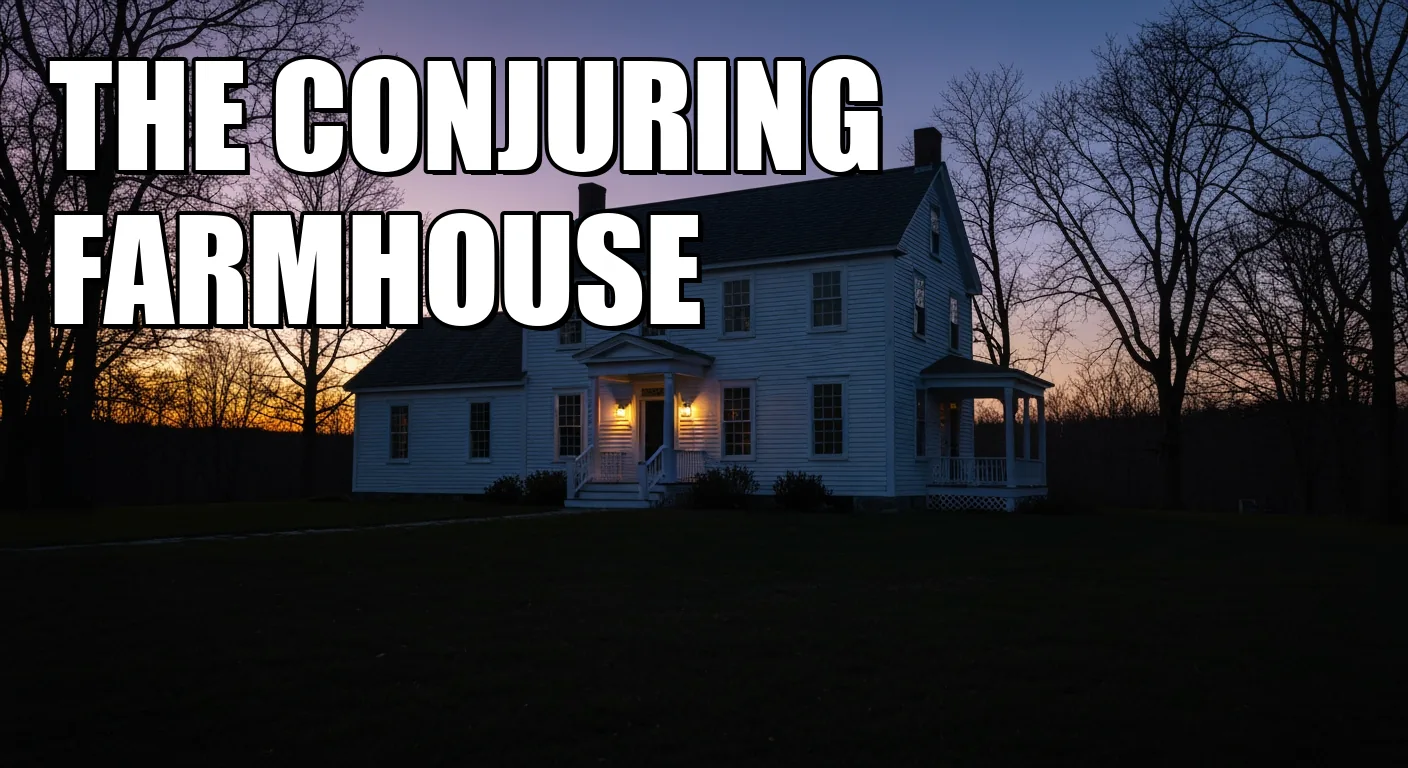
The Conjuring begins with an address problem. Bathsheba Sherman—the woman turned into the film’s witch—did not live or work at the Old Arnold Estate later occupied by the Perron family. Historical research places her on a separate Sherman farm elsewhere in Burrillville. The movie attached one person’s name to another property, then rewrote her natural death as a satanic hanging.
That does not settle whether the Perrons experienced anything unusual. It does show why the house story must be split into four evidence levels: records, family or investigator testimony, later folklore, and screen invention.
Bathsheba belonged to a different property
Census and property research reviewed by local historians separates the Sherman farm from the Perron farmhouse. The strongest safe conclusion is geographic, not paranormal: Bathsheba was a nearby Burrillville resident, not a former occupant of the house portrayed as hers.
The infant-death story is weaker still. Later accounts accuse her of killing a child with a needle, yet reviews of 1849 town records found no warrant, arrest, or court proceeding against her. That absence cannot prove nobody ever whispered an accusation. It does mean the murder claim has no identified legal or inquest record and should not be narrated as documented nineteenth-century fact.
Her documented death reverses the film’s climax
Genealogical records and historian-reviewed local sources agree that Bathsheba died on May 25, 1885. Her obituary and death record describe paralysis—a term commonly interpreted as a stroke—and place her death at home in bed. She received a Christian burial in Harrisville Cemetery.
The hanging, declaration of loyalty to Satan, and curse on the property are film construction. So is the neat biographical arc that turns an alleged child murder into suicide and then into a haunting at the same house. The underlying records do not supply those links.
The Perron account remains testimony, not a court file
Roger and Carolyn Perron moved their family into the Arnold Estate in January 1971 and left in 1980. Accounts of apparitions, attacks, and Carolyn’s possession come from the family and the Warrens rather than independent contemporary documentation.
The distinction is clearest in the final intervention. The reported 1973 event was a séance, not the successful exorcism shown in the film; the Catholic Church did not authorize an exorcism. Claims that Carolyn spoke in tongues, rose in her chair, or was thrown across the room remain testimony from participants. They can be reported as claims without being converted into verified physical events.
Other deaths assigned to the farmhouse also require an address check. Prudence Arnold’s murder is often placed on the estate, but her death record locates it in Uxbridge, Massachusetts. A surname shared with former property owners is not proof that a death occurred inside their Rhode Island house.
The screen house is a third location
The 2013 film did not use the Rhode Island farmhouse. Exterior scenes used a house in Pender County, North Carolina; most interiors were built at EUE/Screen Gems Studios in Wilmington. The movie therefore combines a Rhode Island family account, a woman from a different Burrillville property, a North Carolina exterior, and studio rooms into one apparently continuous place.
Label the claim before deciding what it means
- Documented: separate properties, Perron occupancy, Bathsheba’s natural death and burial, and the North Carolina production locations.
- Testimony: the Perrons’ experiences and the reported effects of the Warrens’ séance.
- Unsupported lore: the infant murder and deaths transferred to the farmhouse without matching records.
- Film invention: Bathsheba’s hanging, the satanic curse, possession presented as fact, and the heroic exorcism.
The franchise did not uncover one hidden history at one haunted address. It created a composite. Deconstructing that composite does not require disproving every personal experience; it requires refusing to let testimony, rumor, and screenplay borrow the authority of records they do not possess.
The Cornerstone Brief
One historic place, once a week — what it is, why it matters, whether it's worth going. No filler, no paid placements.
Coming soon. Unsubscribe any time.