Photo by Claire Beaumont for Cornerstone Mansion · December 23, 2025
For the seasoned traveler, especially one with a keen eye for the unspoken narratives etched in wood and stone, the true allure of America's colonial estates often begins at the front door. These aren't merely points of entry; they are declarations of status, artistic statements, and sometimes, subtle deceptions, designed to welcome, impress, or even intimidate. Forget the typical glossy brochure; let's peel back the layers and understand *why* these particular portals stand out, what they reveal about their original occupants, and what surprises await the discerning visitor.
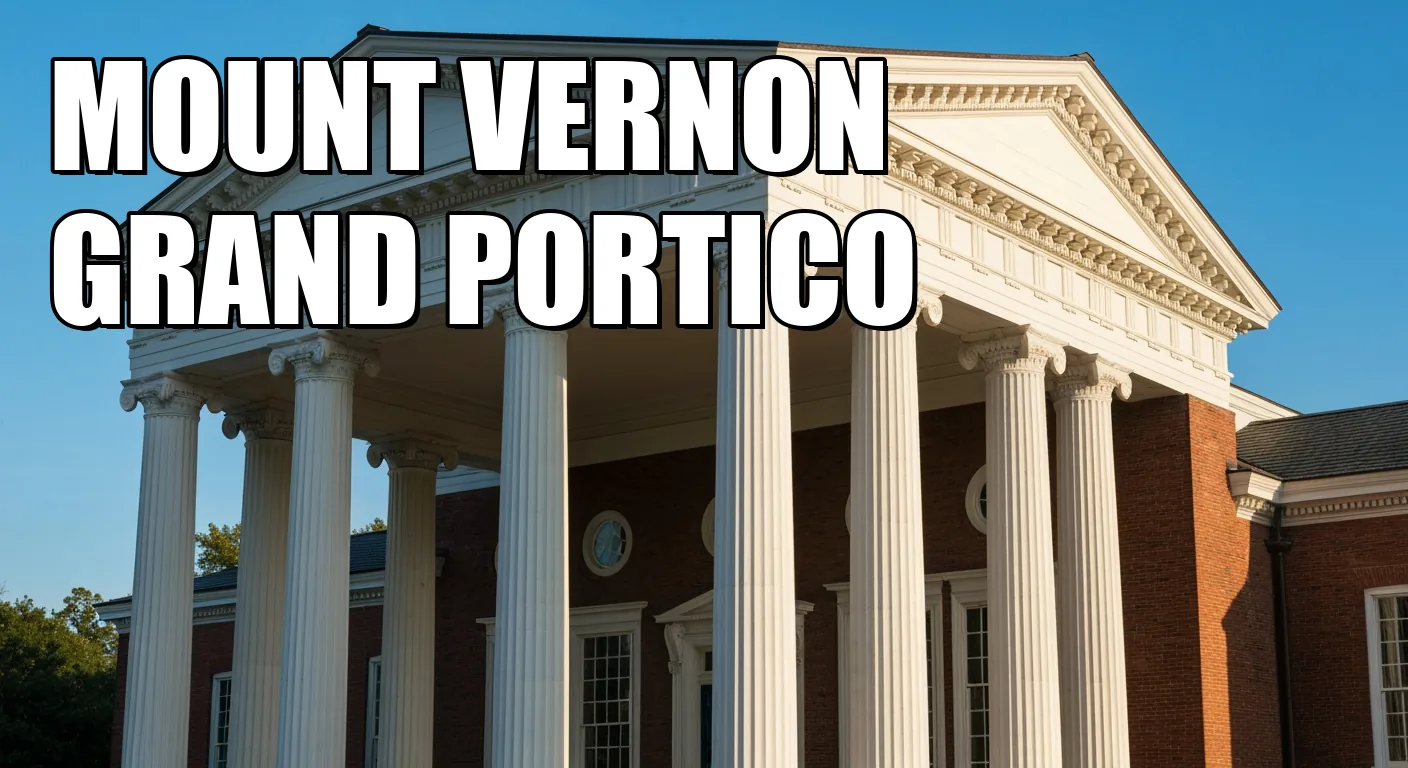
Mount Vernon's Grand Portico: A Statement of Presidential Ambition
Most people flock to Mount Vernon expecting to see George Washington’s home, and indeed they do. Yet, pause at the entrance, and you’ll grasp something deeper: it’s not just a house, but a meticulously crafted political and social statement. Begun by Augustine Washington in 1734, it was George who transformed it into the iconic symbol of refined Georgian architecture we recognize today, starting in 1754. His chosen Palladian style, with its classical elements—pediments, columns, and a robust central passage—was no accident. This was an American aristocrat, a burgeoning leader, signaling his embrace of Enlightenment ideals and European sophistication, adapted for the New World.
The challenge here, as with any site of such immense popularity, lies in managing expectations. Yes, the central passage where Frank Lee, Washington's enslaved butler, once greeted dignitaries, remains a pivotal space. But be prepared for crowds. Admission runs about $28 online ($30 at the gate) for adults, and it’s open 365 days a year, meaning there’s rarely a truly quiet moment. Arriving right at the 9:20 a.m. opening for mansion tours is your best bet to avoid the peak rush. You might also find some rooms closed due to ongoing preservation work; it's a working estate, not a static museum, a reality often overlooked in the romance of a visit. What truly sets Mount Vernon apart isn't just its association with Washington, but the sheer ambition of its architectural evolution, reflecting a man who literally built his public image alongside his dwelling.
Drive south from Washington D.C., and you'll discover Gunston Hall, the more intimate, yet equally profound, Georgian estate of George Mason. This home, built between 1755 and 1758 in Lorton, Virginia, offers a fascinating counterpoint to Mount Vernon's more overt grandeur. Its entrance porches, particularly the north one, are an absolute masterclass by William Buckland, an indentured English craftsman whose genius truly blossomed here. Buckland wasn't just following trends; he was innovating.
Observe the north entrance and you'll find something utterly unexpected: pointed arches, characteristic of a "Gothik" style, woven into an otherwise classical Georgian facade. This wasn't merely decorative; it was a deliberate design choice that subtly masked the house's inherent asymmetry, creating an inviting, almost whimsical, portal that belies the rigorous philosophical work happening inside. Why the "Gothik" influence on a Georgian mansion? Buckland, drawing from English pattern books, wasn't afraid to mix and match, showcasing a pragmatic creativity often missing in more rigid architectural interpretations. This unexpected blend makes Gunston Hall's entrance a unique specimen in colonial America. At $10 for adult admission, with tours running every half-hour from 9:30 a.m. to 4:30 p.m. daily, it offers a more personal, less overwhelming experience than some of its larger counterparts.
Annapolis's Jewel Box: Unpacking the "Most Beautiful Doorway" at Hammond-Harwood House
If Gunston Hall hinted at Buckland's genius, the Hammond-Harwood House in Annapolis, Maryland, completed in 1774, stands as his undisputed final masterpiece. This isn't just *a* beautiful doorway; it’s widely hailed as "the most beautiful doorway in America." But why the hyperbole? Step closer. Buckland modeled this National Historic Landmark on Palladio's Villa Pisani, and the front doorway is a symphony of hand-carved wood elements.
Look for the Scamozzi Ionic columns, whose capitals aren't just decorative but symbolize wisdom—a subtle message to all who entered. The arched opening is adorned with delicate egg-and-dart motifs, often interpreted as representing a shield and spear, adding another layer of symbolic meaning. Intricate spandrel ornamentation with draped garlands of roses further elevates its artistry. Yet, here's a detail typical guides often miss: the door itself, crafted from locally harvested southern pine, was originally grain-painted to mimic expensive mahogany. This common 18th-century practice reveals a fascinating insight into colonial aspirations and the clever use of local materials to project an image of wealth. Visiting requires planning: the house closes on Tuesdays and seasonally from late December to early April. Adult admission is $15 for a full tour, but a shorter, half-hour tour is available for $10 if you're pressed for time or just want to focus on the architectural highlights.
Drayton Hall's Stark Authenticity: A Pioneer in American Palladianism
Near Charleston, South Carolina, sits Drayton Hall, a structure that immediately challenges any preconceived notions of what a "historic home" should be. Begun in 1738, it's the earliest and arguably finest example of Palladian architecture in America, but its enduring power lies in its *unrestored* condition. This isn't a museum piece meticulously polished; it's a raw, honest testament to endurance.
Its defining feature, the recessed two-story portico, represents a truly groundbreaking architectural statement. Derived directly from Palladio's *The Four Books of Architecture*, it features superimposed Doric and Ionic columns. What's remarkable is that this specific two-story recessed format had no known English precedent; it was an innovative American interpretation, a clear sign of colonial ingenuity in adapting European ideals to local tastes and contexts. Built with an astonishing 360,000 hand-made bricks, Drayton Hall isn't just about elegant symmetry and refined proportions; it’s about a deliberate preservation philosophy that prizes authenticity over romanticized reconstruction. How does this impact a visit? You won't find period furniture in every room, but you'll experience the building itself as an artifact. This stark reality can be jarring for some expecting a fully furnished, idealized historical tableau, but for those seeking a deeper connection to the past, its unvarnished state is profound. Admission is $17 ($14 if purchased online in advance), and while it's open daily from 9:00 a.m. to 5:00 p.m., be aware that the gate closes at 3:30 p.m., meaning the last few tours of the day might feel rushed if you arrive too late.
Shirley Plantation's Soaring Welcome: The Enduring Legacy of Family and Craft
Finally, we arrive at Shirley Plantation in Charles City, Virginia, an estate that captivates not only with its grand Georgian entrance portico but also with its incredible story of continuous family ownership. Completed in 1738 for Elizabeth Hill Carter, this mansion is often cited as one of Virginia’s most intact 18th-century estates. "Intact" here means more than just well-preserved; it means a living history, still occupied by descendants of the original builders.
The hand-carved walnut elements throughout the entrance and indeed the entire house speak volumes of colonial craftsmanship. However, what truly elevates Shirley's architectural narrative is its famous "Flying Staircase." This three-story walnut marvel rises without visible support, a feat of engineering and artistry that remains the only example of its kind in America. It’s an interior "sidelight" of sorts, an unexpected architectural flourish within, that complements the formal welcome of the front door. This staircase isn’t just a structural element; it's a silent testament to generations of family life and the enduring skill of colonial builders. For $25 (adults), your guided house tour will delve into these details, running from 9:30 a.m. to 4:00 p.m. daily, with the last tour at 4:30 p.m. If you're short on time or budget, a grounds-only admission for $5 lets you appreciate the exterior grandeur and the historic outbuildings.
These five estates, each with its unique interpretation of the colonial entrance, offer far more than just a glimpse into the past. They are lessons in ambition, artistry, and the ever-evolving American identity, beautifully carved into wood and brick. The next time you visit a historic home, don't just walk through the door; truly *see* it. You might just find yourself surprised by the stories it has to tell.
Architecture Styles You Can Read From the Street
Use visible details like rooflines, columns, and ornament to identify building styles faster.
Exploring Colonial Entrances: Your Complete Guide to American Sidelights and Historic Doors
What is a sidelight on a door?
A sidelight is a narrow, vertically-oriented window with fixed glass that flanks a door or larger window, typically found in pairs on both sides of a front door. Sidelights are essential features of colonial and colonial revival architecture, providing both light and decorative elegance to entryways.
What is a colonial-style window?
A colonial-style window typically features multiple small panes divided by muntins (grilles), commonly arranged in patterns like 6-over-6 (six panes on each sash) or 9-over-9, creating a traditional double-hung sash window found in colonial homes from the 17th and 18th centuries.
Sidelight colonial entrance history
Sidelights became prominent architectural features during the colonial revival period (1880-1955), particularly in American homes built in the late 19th and early 20th centuries. These decorative elements framed front doors, often paired with transoms and fanlights, creating grand, symmetrical entrances inspired by earlier Georgian and Federal-era architecture.
What kind of door is on a colonial house?
Colonial house doors are typically solid wood paneled doors featuring 4 or 6 panels (arranged 2 panels wide), often with raised panels rather than flat ones. These doors frequently include decorative architectural elements such as sidelights, fanlights, and pediments.
What is a fanlight on a colonial door?
A fanlight is a semi-circular or fan-shaped transom window positioned above a door, with glazing bars radiating outward like a fan pattern. Fanlights became increasingly important architectural features in Georgian and colonial-era designs, adding light and visual interest to entrances.
What was the architectural style of the 1890s?
The 1890s featured multiple coexisting architectural styles including Queen Anne, Shingle Style, Colonial Revival, and late-stage Victorian design, blending ornate details with emerging functionalism. This period also saw the influence of Art Nouveau emerging from Europe.
Is 1890 Victorian or Edwardian?
The year 1890 is firmly within the Victorian era, as Queen Victoria reigned until 1901. The Edwardian period (1901-1910) began only after her death; the 1890s represent the end of the Victorian era, sometimes called the "Fin de Siècle" or "Gilded Age."
What is the difference between Georgian and colonial architecture?
Georgian architecture (1700-1780) emphasizes strict symmetry and formal, balanced proportions based on classical principles, while Colonial Revival (1880-1955) offers more flexibility in layout with side porches, varied rooflines, and dormer windows. Georgian homes feature grand, highly ornamented entryways, whereas Colonial Revival homes often incorporate simpler designs with sidelights and porticos.
What is the 1890s era called?
The 1890s is known as the "Fin de Siècle" (French for "end of the century"), "The Gilded Age," and the "Belle Époque" period, reflecting the end of the 19th century marked by cultural flourishing, economic prosperity, and significant social transition.
What was the art style of the 1890s?
The 1890s featured Art Nouveau, which emerged in the late 19th century as a reaction against mechanical uniformity and historicism, along with Impressionism, Symbolism, and the continued influence of Queen Anne and Shingle Style architecture in the United States.
What was the style of architecture in the late 1800s?
Late 1800s American architecture encompassed Queen Anne (1880-1910), Shingle Style (1879-1890), Colonial Revival (1880-1955), and late Victorian styles, characterized by ornamental details, asymmetrical forms, complex rooflines, and a blend of historical influences that reflected the era's cultural confidence.
Where are the best locations to visit colonial homes with sidelights in the USA?
Top destinations include Mount Vernon in Virginia (George Washington's estate), Colonial Williamsburg in Virginia, Charleston South Carolina historic homes (Nathaniel Russell House, Heyward-Washington House), Philadelphia's historic district (Independence Hall area), and Cape May New Jersey, all featuring authentic colonial and colonial revival architecture with period sidelights.
What is the admission price for Mount Vernon in 2025?
Mount Vernon admission is $28 for adults (ages 12+), $15 for youth (ages 6-11), and free for children under 5. Tickets purchased online at least 3 days in advance save $2, and 2025 offers unlimited return visits for the rest of the year when purchasing at full price.
What are the Colonial Williamsburg ticket prices for 2025?
Colonial Williamsburg single-day admission is $35 for adults (down 30% from previous pricing), $10 for children ages 6-12 (66% reduction), free for children under 6, with an additional 10% discount for online purchases. Annual passes are $75 for adults, and admission to the Art Museums is now free.
What is the difference between a sidelight and a fanlight?
Sidelights are tall, narrow vertical windows flanking a door for side-to-side light, while fanlights are semi-circular or fan-shaped transom windows positioned above a door with radiating glazing bars. Both are common colonial architectural elements, but fanlights specifically refer to the ornamental window above the door.
How do I preserve and restore original colonial sidelights and doors?
Original colonial sidelights and doors should be restored by specialists in historic preservation who understand period-appropriate materials and techniques. Professional restoration typically involves repairing glazing, refinishing wood, preserving original hardware, and maintaining structural integrity while preventing further deterioration.
Why This Page Exists
Maison builds place guides to help readers plan a real visit or understand a real site. When a page makes present-day access, booking, or visitor claims, those details are revised against public-facing source material and editorial review. For the wider standards behind that work, see methodology.
The Cornerstone Brief
One historic place, once a week — what it is, why it matters, whether it's worth going. No filler, no paid placements.
Coming soon. Unsubscribe any time.
We use cookies to enhance your experience. By continuing to visit this site you agree to our use of cookies.