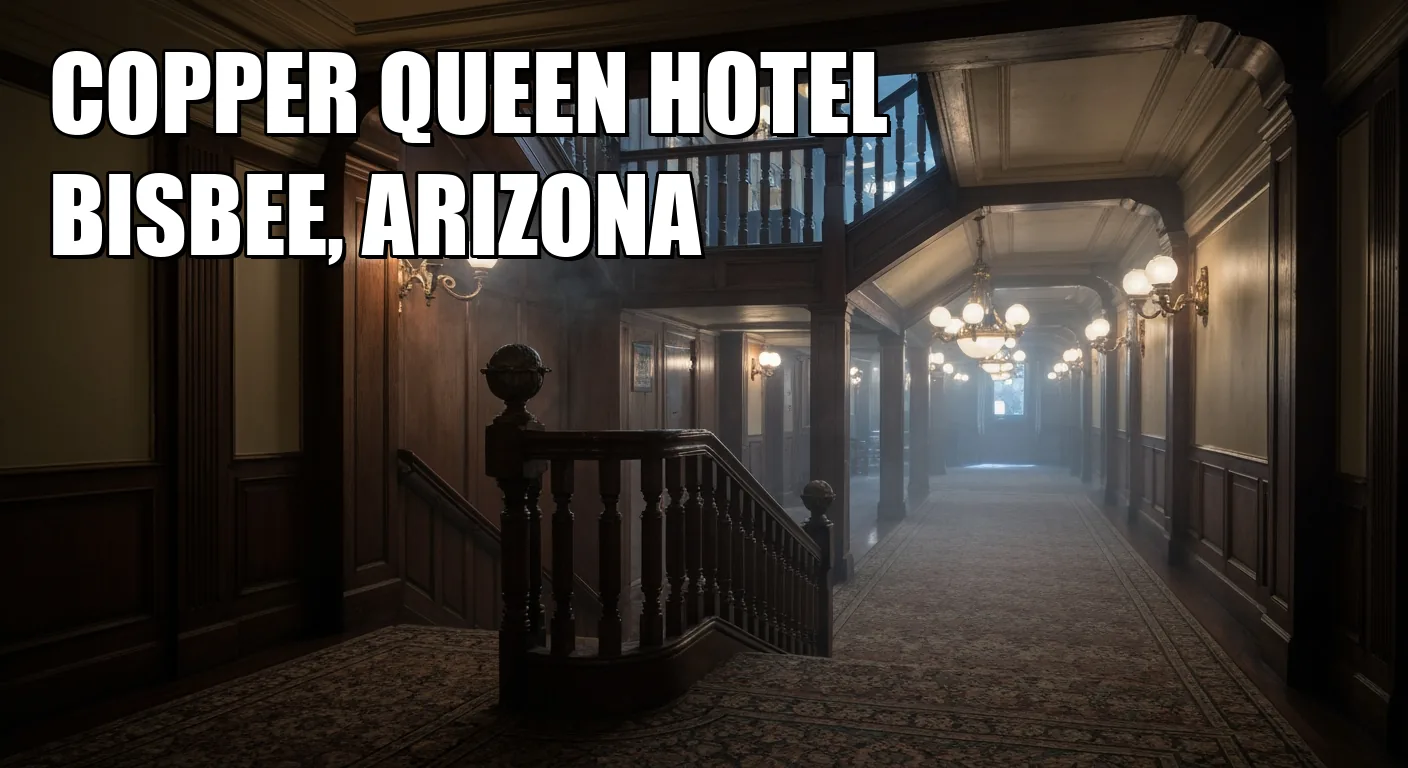
Room 315 exists. The Copper Queen Hotel’s current site calls it the Julia Lowell Room and sells its “hauntingly romantic” atmosphere. Room 412 is presented as Billy’s Room, complete with antique toys and an eerie theme. The hotel building is real too: preservation records identify it as a Copper Queen Consolidated Mining Company hotel completed in 1902.
The missing piece is the bridge between those facts. The available historical sources do not provide a contemporary record for Julia Lowell, a documented suicide in Room 315, a record for Billy or a floor-plan crosswalk connecting today’s room numbers to the hotel as it opened. That does not prove the people never existed. It means a room number cannot do the work of an archive.
Six claims need six different labels
| Claim | What supports it | Responsible label |
|---|
| The Copper Queen was built as a company hotel in 1902 | Regional history and preservation records | Documented |
| Room 315 is now associated with Julia Lowell | The hotel’s current room page | Current branding |
| Julia Lowell lived or worked at the hotel | Later retellings, without a contemporary record in the available sources | Unverified |
| Julia died by suicide in Room 315 | Ghost lore, without a cited death, coroner or newspaper record | Unverified |
| Billy drowned and now occupies Room 412 | Later legend, without a surname or primary record | Unverified |
| The hotel has operated without interruption since 1902 | Repeated promotional language, not an operating chronology | Not established by the preservation record |
The reservation promise is therefore narrower than the legend: a themed stay inside a historic hotel. The historical event attached to the theme remains a separate claim.
The strongest Copper Queen story is corporate hospitality
On April 16, 1900, the Bisbee Daily Review reported that plans for the mining company’s new hotel had been approved, the older buildings on the site had been removed and work would begin. Regional historians date completion to February 1902 and the first meal to February 10.
The hotel was not conceived as a neutral grand building for an anonymous boomtown. The National Register material describes a four-story brick-and-stucco hotel constructed by the Copper Queen Consolidated Mining Company to resemble an Italian villa. Its job was to house visiting company executives and other guests considered entitled to quality accommodations.
That purpose places the building within Bisbee’s company geography. The same mining power that shaped work, housing and land created a polished reception space for managerial visitors. A guest today is sleeping in a surviving piece of corporate hospitality, not merely a Victorian-looking backdrop for a paranormal story.
The building did not remain static after opening. The original hotel is described as having 44 rooms. Frederick Hurst made improvements and additions in 1910, although the source does not say what he changed. A 2024 newspaper account describes 48 guest rooms. Preservation material calls the building four stories; modern sale material has called it five. Bisbee’s slope may affect how levels are counted, but the available records do not resolve the discrepancy.
The published record does not map a 1902 room to 315
An archival finding aid for the Goldwin Goldsmith collection catalogs 1900 drawings for the Copper Queen Consolidated Mining Company hotel. The finding aid confirms that design records survive, but it does not reproduce a numbered plan or connect any room to Julia.
None of the preservation and regional-history material reviewed here reproduces an original numbered-room list or maps a 1902 room to modern 315 or 412. The difference between 44 original rooms and 48 current rooms makes a crosswalk more important, but it does not reveal when rooms were added, subdivided or renumbered. The 1910 work cannot be assigned to those changes without further documentation.
For a death-site claim, four links would be needed: a documented person, a contemporary record of the death, a historical room number and proof that the number identifies the same physical room today. The Copper Queen legend, as currently published, does not complete that chain.
Julia became a character without becoming an archival identity
Modern accounts usually describe Julia Lowell as a sex worker who died by suicide after an unreturned love. They add whispers, perfume, pulled covers or an apparition at the foot of the bed. Those details become more elaborate as the story is repeated, but repetition is not independent verification.
The available sources do not cite a death certificate, coroner’s report, census entry, city directory, hotel register or contemporary newspaper report that establishes Julia’s identity and connects her to a death at the hotel. The careful conclusion is “not verified in the available record,” not “proved fictional.”
Arizona Opera later made that gap explicit: its treatment of Julia was described as a fictionalized account of who she might have been, and it later became a film. The adaptation gives the figure motives and a voice; it does not become a primary source for the hotel story.
Billy’s trail is thinner. Later versions disagree on his age while describing a boy who drowned in the San Pedro River, sometimes as the child of a former hotel employee. They do not supply a surname, obituary, coroner record or employment record. The official room page establishes that Room 412 is now decorated and sold as Billy’s Room. It does not establish the child’s historical identity.
How to book the ghost rooms without buying the wrong claim
- Choose 315 or 412 for the theme. The hotel itself emphasizes mood, furnishings, toys and paranormal atmosphere. Those are real features of the current room presentation.
- Ask whether the exact room is guaranteed. The public material reviewed here shows named room pages but does not publish a general rule for room-number requests or substitutions.
- Confirm the physical route. An elevator is reported, but the hotel’s current site does not publish a complete accessible route from parking to a specific room. Bisbee is steep; entrance, elevator and bathroom details deserve a direct answer.
- Keep outside ghost tours separate from the room booking. The current rules for the Ghost Hunt of Old Bisbee say the tour cannot enter guests’ private accommodations or floors where it lacks permission. A tour ticket should not be read as access to 315 or 412.
- Use “continuous since 1902” cautiously. The building date and original hotel function are documented. Uninterrupted operation requires an ownership and closure chronology that the preservation sources do not provide.
The Copper Queen does not need an invented certainty to be worth staying in. Its documented history is sharper than the usual “grand old hotel” label: a mining company built a 44-room reception house for executives, the building changed, and the present hotel now uses two room numbers as vessels for Bisbee’s ghost culture. Book the room for that layered experience. Treat the key as access to a story, not proof of the death that story describes.
The Cornerstone Brief
One historic place, once a week — what it is, why it matters, whether it's worth going. No filler, no paid placements.
Coming soon. Unsubscribe any time.