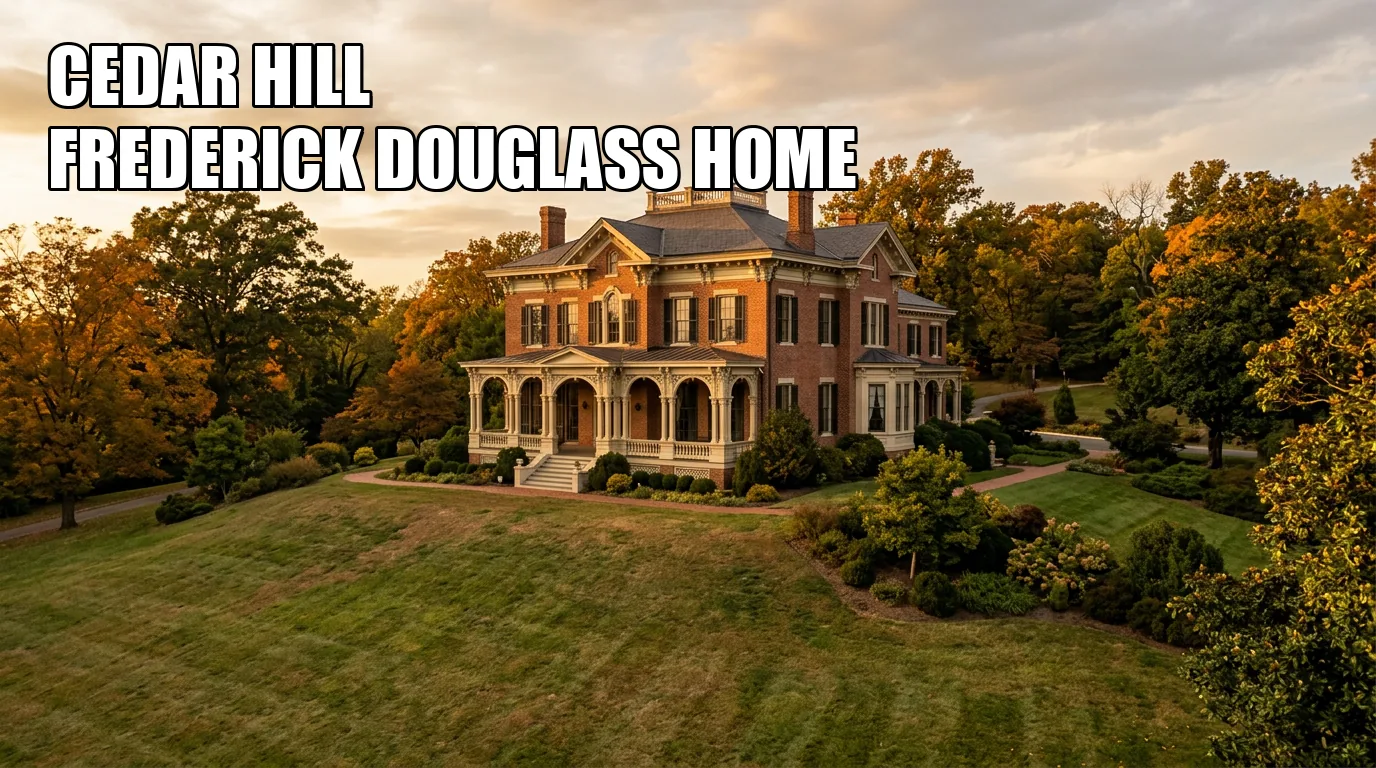
There are historic homes, and then there is Cedar Hill. Nestled high in the Anacostia neighborhood of Washington D.C., the Frederick Douglass National Historic Site offers far more than a glimpse into the final chapter of a great American life. For an experienced traveler who has walked the hallowed halls of countless preserved estates, what truly arrests the senses here is the profound sense of presence, the lingering spirit of a man who shaped a nation with his words.
Most guidebooks will tell you that Frederick Douglass lived here, that he died here, and that it's worth a visit. They're not wrong, of course, but such brief mentions barely scratch the surface of what makes Cedar Hill so profoundly important. This estate was Douglass's hard-won sanctuary, a symbol of his personal and political victories, and a deliberate defiance of the systemic oppression that sought to deny Black Americans property, dignity, and intellectual space. It’s a place where history isn't just displayed; it breathes.
What Cedar Hill Meant to Frederick Douglass
Imagine, for a moment, the significance of a man born enslaved, having endured the brutal dehumanization of the chattel system, acquiring a sprawling 9¾-acre estate complete with a magnificent 14-room Victorian mansion. On September 1, 1877, Douglass purchased Cedar Hill for $6,700 from the Freedmen's Savings and Trust Company, a remarkable sum at the time, especially for a Black man just a decade removed from the Civil War. This wasn’t just a house; it was a declaration, a tangible manifestation of Black excellence and self-determination in an era still rife with racial animosity and economic disparity.
His vision for Cedar Hill was expansive. Following substantial renovations throughout 1877-1878, Douglass and his first wife, Anna Murray Douglass, settled in during the fall of 1878. The original structure, though impressive, didn't quite match his grand ambitions; he promptly added a two-story rear extension, transformed the old kitchen into a formal dining room, and finished the attic, creating a 21-room residence by the time of his death. This was a man who understood the power of symbolism, and Cedar Hill was his grandest testament to the American Dream, achieved against impossible odds.
Life at Cedar Hill, however, was not without its shadows. In 1882, Anna, his steadfast partner for 44 years, passed away from a stroke, leaving Douglass temporarily bereft and prompting a period of grieving in New England. His return to Washington D.C. in January 1884 marked another pivotal, and intensely controversial, chapter: his marriage to Helen Pitts. She was a white woman, twenty years his junior, and his former secretary. The societal uproar was immense, even from some within his own community, but Douglass, ever the individualist, defied norms once more, cementing Cedar Hill as a place where personal conviction trumped public opinion.
Despite significant absences—he served as U.S. Minister Resident and Consul General to Haiti from November 14, 1889, to July 30, 1891, and traveled extensively with Helen to Europe and Africa in 1886-1887—Cedar Hill remained his unwavering anchor. It was the intellectual and social epicenter of his existence, the place he always returned to, even from diplomatic postings abroad. He died there, peacefully, after attending a National Council of Women meeting on February 20, 1895, having transformed the property into a testament to his extraordinary life.
Who Shared Douglass's Grand Table?
One might expect a figure of Douglass's stature to host important guests, but a deeper look at the visitor logs reveals Cedar Hill was less a formal mansion and more a vibrant, intellectual salon. It served as a crucial gathering place for many of the era's leading lights, a nexus where the fight for civil rights and social justice was passionately debated and strategized. This wasn't just polite society; these were fellow warriors in the ongoing struggle.
Among the most storied visitors were two titans of the women's rights movement: Susan B. Anthony and Elizabeth Cady Stanton. Douglass proudly displayed a portrait of Stanton, a gift commemorating their decades-long collaboration for women's suffrage, in his home. This detail alone offers a powerful counter-narrative to those who might simplistically categorize Douglass solely as an abolitionist; his commitment to universal human rights, irrespective of race or gender, was absolute and profoundly personal.
Beyond the suffrage movement, Cedar Hill welcomed a remarkable cross-section of influential figures in the Black community and national politics. John F. Cook, a prominent District tax collector and one of D.C.'s wealthiest Black men, was a frequent visitor, as was Blanche K. Bruce, the former Mississippi Senator and Register of the Treasury. The Reverend Francis J. Grimke, a revered pastor of the Fifteenth Street Presbyterian Church, became particularly close to the family, recalling "many pleasant days" spent in their beautiful home. These were the architects of a post-Reconstruction future, forging alliances and planning strategies from Douglass's hilltop estate.
Cedar Hill was also very much a family home. His three surviving children—Lewis H., Charles, and Rosetta Douglass Sprague—lived in the nearby Hillsdale section of Anacostia and were regular guests, creating a lively family atmosphere. His grandson, Joseph H. Douglass, a pioneering concert violinist who would tour the United States and record his music, often filled the parlors with melodies. Even Helen Pitts Douglass's relatives were frequent guests, further illustrating the complex social tapestry woven within the mansion's walls. This wasn't just a political hub; it was a deeply personal one.
The Library and Study: Unlocking Douglass's Mind
For me, the study and library at Cedar Hill offer the most profound insights. These weren't mere rooms; they were the engine rooms of his intellect, the spaces where Douglass translated his experiences and convictions into powerful prose and stirring oratory. To stand among his possessions here is to feel the weight of history, but also the vibrant energy of creation.
Douglass’s study, with its iconic roll-top desk, feels as though he just stepped away for a moment, poised to return and continue his work. It was here he penned his third autobiography, The Life and Times of Frederick Douglass, and crafted countless speeches and articles addressing everything from women's suffrage to the insidious nature of Jim Crow laws. Among the personal effects, one artifact stands out with particular resonance: a picture of Abraham Lincoln, a personal gift from the Great Emancipator himself. This wasn't merely a political memento; it signified the complex, often challenging, but ultimately transformative relationship between two men who, despite their vastly different stations, profoundly shaped the course of the nation.
Next to the study, the library, which Douglass often called his favorite room, contained over 900 books. This wasn't just a collection; it was a testament to his lifelong conviction that literacy was indeed "the pathway from slavery to freedom." The sheer volume and diversity of works—many autographed gifts from prominent individuals and friends—reveal a man with an insatiable hunger for knowledge, a self-taught intellectual who leveraged every opportunity to learn and grow. His collection included walking canes, notably one that had belonged to President Lincoln, given to Douglass by Lincoln’s widow, a quiet symbol of shared purpose and enduring respect.
A Harmony of Spaces: The Parlors' Artistic & Social Flourish
Moving from the intense intellectual gravitas of the study, the parlors reveal a different, yet equally compelling, facet of Douglass’s life: his appreciation for beauty, art, and the social graces. Many historic homes feel staged, but Cedar Hill, with its remarkable 70 percent original furnishings, offers an exceptionally authentic window into his world—a rare feat in preservation.
The East Parlor, for example, beautifully illustrates Douglass’s refined taste and deep connection to the natural world. Behind a bust of his fellow abolitionist, Wendell Phillips, hangs an oil painting of dandelions, framed in deep purple velvet, a gift from his close friend, artist Sarah Eddy. Above a Greek statue of Psyche, another oil painting of flowers and ferns adds to the room's serene elegance. These weren't merely decorations; they were curated pieces reflecting a man who understood the power of aesthetics and found solace and inspiration in art.
In the West Parlor, the presence of a piano immediately signals a different kind of activity. Douglass's love for music was as profound as his devotion to reading, and this room often reverberated with melodies from family and guests. He played the violin for his grandchildren and visitors, owning several instruments in addition to the piano. These musical interludes underscore a vibrant, multifaceted home life that often gets overlooked in narratives focusing solely on his political achievements. It's a reminder that even towering historical figures found joy and solace in everyday pleasures.
Planning Your Pilgrimage: Practicalities and Unexpected Joys
So, you’re ready to experience Cedar Hill for yourself? Excellent. While it’s not a heavily trafficked site compared to, say, the Smithsonian museums, a little planning goes a long way to ensure a meaningful visit. First, know that the Frederick Douglass National Historic Site is a free attraction, operated by the National Park Service, which is always a pleasant surprise in D.C. However, parking in Anacostia can be tricky, especially on weekends; consider ridesharing or public transportation (the Anacostia Metro station, Green Line, is about a 20-minute walk away, or a short bus ride).
The best months to visit are typically April, May, September, and October when the D.C. weather is most agreeable and the crowds are generally lighter than the peak summer season. I’d strongly advise going on a weekday morning. You'll likely encounter fewer school groups and have a more intimate experience with the house and grounds. Tours of the interior are ranger-led and operate on a timed schedule, so arriving early to secure your spot is crucial, especially if you visit during a busier period. Don't just show up expecting to wander through; plan on joining a tour for the full contextual experience.
What might surprise you during your visit? Beyond the sheer authenticity of the furnishings, it’s the powerful view from the hilltop. Douglass named it Cedar Hill for a reason: the panoramic vista encompasses the U.S. Capitol, the Washington Monument, and the Potomac River. Standing there, you understand his profound statement: a former slave, looking out over the symbols of the very nation he helped reshape. This view isn't just scenic; it's a testament to his enduring impact, a silent, powerful dialogue between the past and the present. Take a moment, breathe it in, and let that realization truly settle. It’s a perspective few guides truly emphasize, but it’s undeniably the most profound takeaway from Cedar Hill.