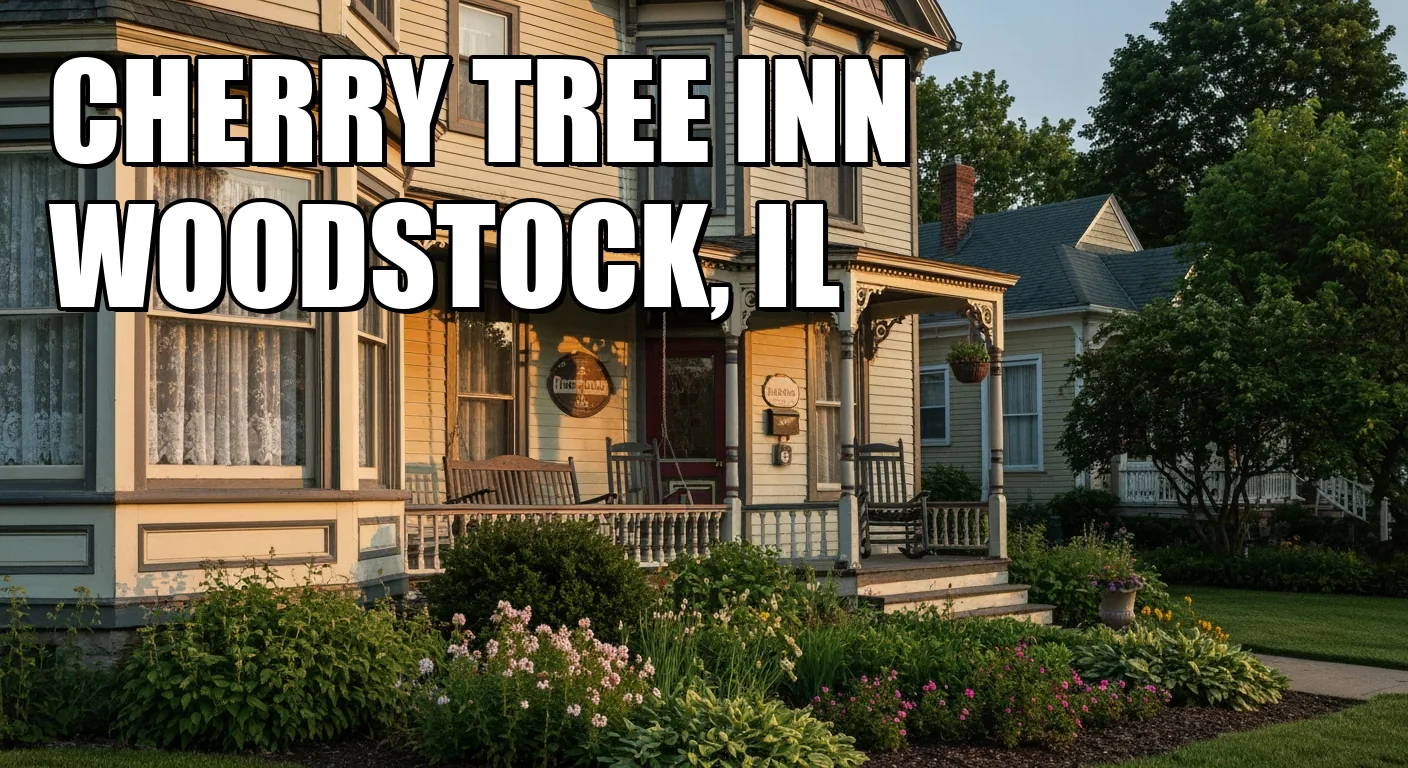
A key to a film-famous house can buy five different things. At the Cherry Tree Inn, you sleep behind the exterior seen in Groundhog Day, but not in the bedroom built for Phil Connors. At A Christmas Story House, the Cleveland shell is authentic and the familiar interior is a later reconstruction of a Toronto set. Mountain Lake Lodge preserves only part of Dirty Dancing’s geography. Timberline Lodge supplied the Overlook’s front, not its rooms. Steel Magnolia House is the rare case where the camera used the house inside and out.
“Filmed here” is therefore the beginning of the question. Before booking, separate the camera footprint, the pre-film building, lost or altered production fabric, later theming and the room in which guests now sleep.
Five keys, five kinds of screen authenticity
| Bookable property | What the camera used | What the current key buys |
|---|
| Cherry Tree Inn, Woodstock | The 1894 Victorian exterior, porch, lawn and entrance became the fictional Cherry Street Inn. Phil’s bedroom was a set in Cary, Illinois. | A room inside the real exterior shell; present interiors and film-themed details are later hospitality, not the filmed bedroom. |
| A Christmas Story House, Cleveland | The 1895 house supplied the Parker-home exterior. Interior scenes were filmed on a Toronto soundstage. | An overnight stay inside a post-2004 reconstruction built by studying the movie, or in the neighboring Bumpus House. |
| Mountain Lake Lodge, Virginia | The stone lodge, Virginia Cabin, gazebo and dining room supplied part of Kellerman’s. The water lift, staff camp, ballrooms and bridge belonged to North Carolina locations. | Rooms and cabins at a genuine practical resort location, including the altered but surviving Virginia Cabin associated with Baby’s family. |
| Timberline Lodge, Oregon | The front exterior appears in establishing views of the Overlook. Interiors and a giant exterior façade were built at Elstree Studios. | A room in the real WPA mountain landmark, not in an Overlook corridor, Gold Room or hedge-maze set. |
| Steel Magnolia House, Natchitoches | The Cook-Taylor House supplied the Eatenton exterior, backyard and most home interiors, including the staircase and kitchen. | A room in the practical filming house; current character names, memorabilia and décor still require a later-curation warning. |
Cherry Tree and Christmas Story sell opposite illusions
The Cherry Tree Inn is an authentic filming shell. Local reporting identifies the Fremont Street Victorian as the fictional boarding house exterior and states that Phil Connors’s bedroom was built as a set in Cary. The current Magnolia Suite may approximate the screen room, but geography is the connection: the camera used the outside of the house, while the bedroom performance happened elsewhere.
That makes the overnight offer legitimate but narrower than “sleep in Bill Murray’s room.” Guests stay inside the building whose porch, lawn and entrance established Phil’s repeated morning departure. DVDs, flip-clock references and room styling are later interpretation by innkeepers, not surviving production dressing.
A Christmas Story House reverses the arrangement. The 1895 Cleveland house is the filmed exterior, while the Parker interiors were created on a Toronto soundstage. After buying the house in 2004, Brian Jones gutted its existing residential interior and reconstructed it by studying the movie scene by scene. The result is not an untouched film interior. It is a physical translation of a set into the shell the audience saw from outside.
That reconstruction now supports tours and overnight stays in the Christmas Story House, with additional lodging in the neighboring Bumpus House. The associated museum holds genuine production artifacts, but a real prop in the collection does not turn every lamp, rifle or furnishing in the overnight space into original set material.
Dirty Dancing needs two states and a scene map
Mountain Lake Lodge is a genuine practical location, but not a complete Kellerman’s. In Virginia, the production used the 1930s stone lodge, the dining room, the gazebo and Virginia Cabin—the building marketed as Baby’s cabin. The cabin survives, although its stairs have moved and exterior lighting is a later addition.
Several of the film’s most remembered spaces belonged to Lake Lure and the former Chimney Rock Camp for Boys in North Carolina. The water-lift practice was filmed at Lake Lure. The camp supplied staff cabins, a gym converted into two ballroom settings and the wooden bridge used for dance practice. Those North Carolina cabins were later demolished, the gym burned, and the bridge disappeared.
This division changes the meaning of an overnight at Mountain Lake. You can sleep within a substantial surviving portion of the Virginia production landscape. You cannot look at its periodically empty natural basin and call it the water-lift site, or treat replica-named cabins at another hotel as the lost camp structures.
Timberline preserves a landmark, not the Overlook interior
Timberline’s cinematic role is visually powerful and physically thin. The real Mount Hood lodge anchors the Overlook’s front exterior. The Stanley Kubrick Archive, described by the British Film Institute, preserves research photographs of Timberline, photographs of the Ahwahnee interiors used as design references, technical drawings for the sets and production images of a giant exterior façade at Elstree Studios.
The building a guest enters is instead a 1930s Works Progress Administration landmark documented by the National Park Service: heavy rubble masonry below, massive timber construction above, hand-work and a mountain roof designed for snow. That fabric is more historically substantial than a themed replica, but it is not the Overlook’s impossible interior geography. The movie’s corridors, rooms, rear exterior and maze belong to studio construction and editing.
For a visitor, the distinction is not disappointing. It is the point. Timberline offers the real exterior anchor and its own federal craft history. Expecting Kubrick’s interiors would replace both the actual lodge and the production achievement with one invented building.
Steel Magnolia House is the practical-house test
Official Louisiana tourism material dates the Cook-Taylor House to circa 1840 and identifies it as the Eatenton home. Unlike the exterior-only houses, it was used for the front, the backyard and most scenes inside the family home. The staircase and kitchen still allow a direct room-to-scene comparison. Truvy’s Beauty Stop interior, however, was a separate set built in a Northwestern State University building.
The house now operates as a B&B with character-named rooms. That is unusually close custody: guests sleep inside the practical domestic location, not merely behind a matching façade. But proximity does not prove that present paint, furniture, memorabilia or a pink bathroom finish is original film dressing. The reliable claim is the surviving house and layout seen by the camera; current décor is a later hospitality and fan layer unless a specific object has its own documented provenance.
The four questions to ask before booking
- Which shot? Exterior, practical interior, both, or only a design reference?
- Which structure? The room on sale may be in the filmed house, a neighboring house, a replica cabin or a hotel whose exterior stood in for something else.
- What changed after filming? Look for gutted interiors, moved stairs, demolished cabins, burned sets and later room theming.
- What has object-level provenance? A museum may hold real props while the overnight room uses replicas. Do not transfer authenticity from one object to an entire interior.
The best cinematic stay is not automatically the one with the most intact screen image. Cherry Tree offers the genuine shell; Christmas Story House offers an unusually committed reconstruction; Mountain Lake preserves a major but incomplete location network; Timberline joins one exterior image to a deeper architectural history; Steel Magnolia House preserves the rare practical home. Choose the kind of evidence you want to sleep inside, then book the building that actually contains it.
The Cornerstone Brief
One historic place, once a week — what it is, why it matters, whether it's worth going. No filler, no paid placements.
Coming soon. Unsubscribe any time.