There’s a certain charm to the clapboard siding that graces so many of America's oldest homes, isn't there? It’s the visual shorthand for "colonial" – a clean, horizontal rhythm that feels inherently American. Yet, like much of history, what appears simple on the surface often conceals layers of unexpected complexity, born from necessity, evolving craftsmanship, and a surprising amount of regional flair. As someone who’s spent decades crawling through attics, examining weathered timbers, and poring over dusty restoration reports, I can tell you: colonial clapboard is far more than just pretty planks nailed to a wall. It’s an entire ecosystem of material science, clever engineering, and a testament to the sheer grit of early builders.
How did our forebears manage to clad their homes against brutal New England winters or humid Southern summers without modern mills or synthetic sealants? The answer, as I’ve found, lies in a deep understanding of wood and an installation philosophy that prized function over flawless aesthetics. Forget what you think you know about uniform panels; the earliest clapboards were anything but. These weren't just decorative elements; they were the building's first line of defense, a sophisticated system designed to shed water and protect the precious timber frame within.
The Wood Whisperers: How Trees Became Timeless Walls
What timber did colonial builders reach for when constructing their homes? The answer, like so much in early America, depended entirely on where you stood. In 17th-century New England, the earliest iterations of clapboard were often cleft oak – planks laboriously split from logs rather than sawn. This "riving" process, as it was called, followed the wood's natural grain, producing boards remarkably resistant to the cupping and warping that plagued early sawn lumber. Imagine the sheer muscle required: swinging froes, driving splitting mauls, cleaving axes biting deep. It wasn't just carpentry; it was a communion with the forest itself, understanding its inherent strengths and weaknesses.
As the centuries progressed and milling technology slowly advanced, the palette of preferred woods broadened considerably. Eastern white pine and yellow pine became mainstays in the North, valued for their workability and abundance. Venture south, and you’d increasingly encounter white cedar and cypress, chosen for their natural resistance to rot and insects in damper climates. The species choice wasn't arbitrary; it was an ingenious adaptation to local resources, a pragmatic solution that speaks volumes about the self-sufficiency of colonial settlements. This regional variation is a detail often glossed over in generic historical accounts, but it fundamentally shaped the character and longevity of these structures.
The Feather-Edged Secret: Dimensions That Defied the Elements
Walk up to a truly old colonial house and look closely at the clapboards. Do you notice a subtle taper? That's not an accident; it's a critical design feature. Early riven clapboards weren't uniformly thick. They were crafted with a distinct feather-edged profile, tapering from a robust 5/8 inch at the butt (lower) edge down to a knife-thin upper edge. This ingenious design allowed the boards to be "attached thin side up and overlapped thick over thin," creating a robust, water-shedding surface. The consistent exposure—the amount of board visible between courses—typically ran around 4 to 4.5 inches, with each board overlapping the one below by about 0.5 to 1.5 inches. This wasn't just an aesthetic choice; it was calculated engineering, ensuring maximum weather protection while conserving precious material. It's a detail that, once you notice it, reveals the remarkable precision and foresight of builders working without blueprints or laser levels.
Why this specific exposure, you might wonder? It was a hard-won compromise, a sweet spot balancing material economy with effective weatherproofing. Too little overlap, and water would wick inwards; too much, and you'd waste valuable wood. This standardization of dimensions, persisting from the late 17th through the 18th century, underscores its effectiveness. You won't find this level of nuanced explanation in most tourist pamphlets, but understanding the "why" behind these measurements transforms a simple wall into a testament to practical ingenuity.
The Paul Revere House and the Illusion of "Originality"
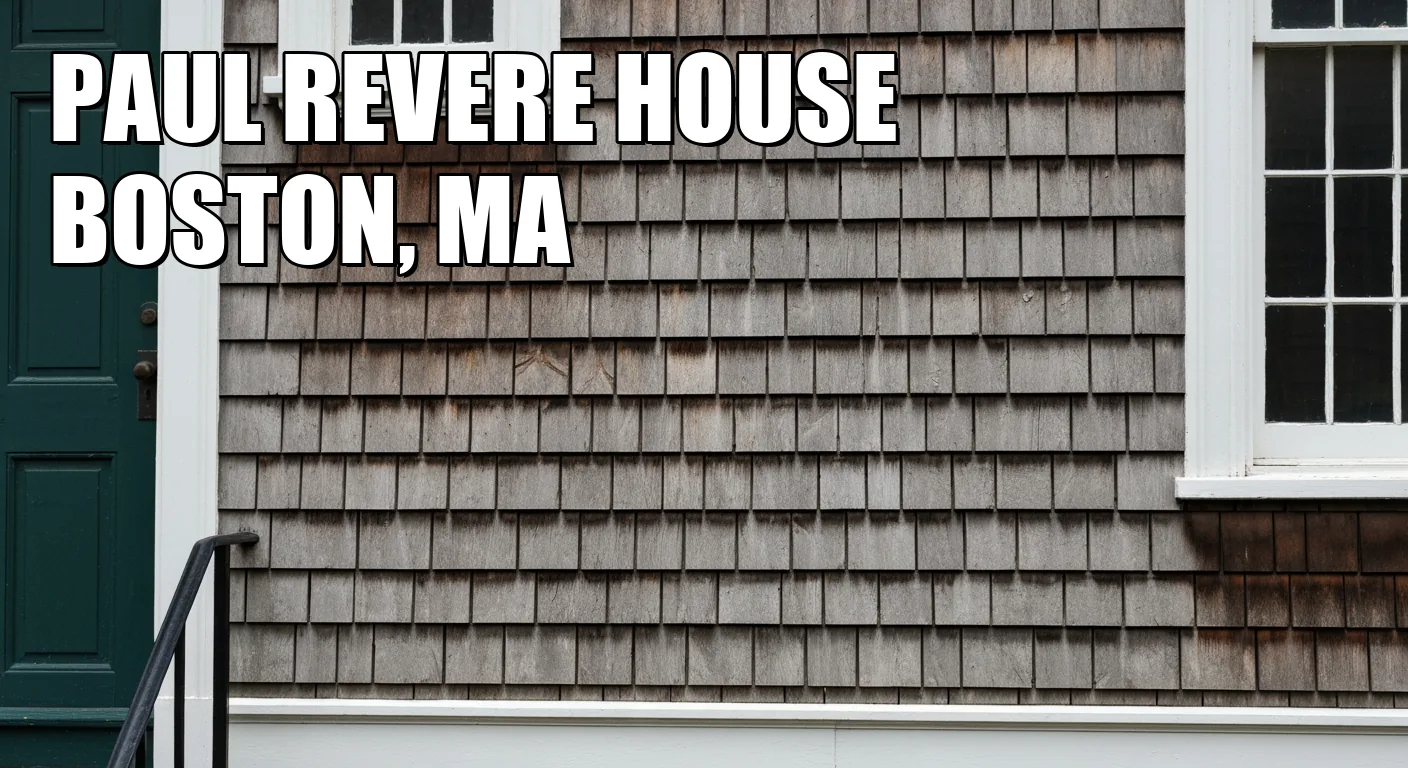
This is where things get truly interesting for the curious observer: the question of authenticity. Take Boston's Paul Revere House, dating back to around 1680. It's a landmark, a touchstone of colonial history. Yet, its exterior clapboard isn't exactly what Revere himself would have seen. Architectural investigations during the 1907-1908 restoration by Joseph Everett Chandler revealed something startling: the front facade, at that point, was clad in "parallel" rather than the expected feather-edged clapboards, complete with beaded lower corners. This wasn't necessarily its original look, but rather a reflection of later modifications or Chandler's own interpretation of "appropriate" colonial detailing at the time.
What does this mean for the modern visitor? It's a crucial lesson in historical interpretation. We often expect historic sites to be perfectly preserved time capsules, but the reality is far more complex. The clapboard you see today on the Revere House is a reconstruction, an informed guess based on evidence and the restoration architect's vision. Ninety percent of the structural framing inside is original—the heavy timber, the massive fireplaces—but the exterior surfaces, including the clapboard, are essentially a re-telling of the story. This isn't a critique of the restoration; it's an invitation to look deeper, to question what "original" truly means, and to appreciate the layers of history a building accumulates over centuries, including its many faces.
Nails, Underboarding, and the Hidden Structure
How did these carefully crafted planks stay put for centuries? Colonial installation methods were straightforward but robust. Unlike modern practices that often discourage face-nailing, early clapboards were secured by driving wrought iron nails directly through the board's surface, typically at the overlap point, into the underlying framing. This direct attachment, while potentially creating entry points for water if not meticulously maintained, was incredibly strong. The nails themselves were handmade, their inconsistencies adding to the character, and their enduring grip speaks to the quality of the iron.
Beneath that clapboard skin lay another layer of protection. Many 18th-century structures, and even some from the late 17th century, incorporated underboarding. These were substantial sawn planks, sometimes as wide as 21 inches, providing a continuous substrate for the clapboard. This wasn't universally present in the earliest structures but became increasingly common, adding structural rigidity and an extra barrier against the elements before the clapboard was applied. It reminds us that colonial builders were thinking holistically, constructing a multi-layered envelope that worked in concert to protect the heavy timber frame – a frame, incidentally, almost always featuring robust mortise-and-tenon joints secured by wooden pegs, demonstrating an unparalleled structural integrity.
Beyond the Postcard: How to Truly See Colonial Clapboard
Visiting a colonial home isn't just about admiring the old furniture or imagining the lives of its inhabitants. It's an opportunity to become an architectural detective. When you approach one of these venerable structures, don't just glance at the exterior; truly *look* at the clapboard. Can you discern the subtle tapering of a feather-edged board? Are there variations in the wood grain that hint at its riven origins? Does the exposure measurement seem consistent, a testament to careful planning?
Consider the Paul Revere House again: while the exterior you see is a reconstruction, understanding that fact allows you to appreciate the *story* of its clapboard, not just its present appearance. Does it feature any subtle beading—a small, decorative ridge at the board's edge—like that noted in some restoration records? This seemingly minor detail served both aesthetic and functional purposes, creating a distinctive shadow line and aiding water shedding by breaking capillary paths. The John Vassall House (c. 1760) in Cambridge, a more refined Georgian home, would have showcased similar principles, though perhaps with the greater consistency afforded by mid-18th century milling advancements. These are the kinds of specific observations that elevate a casual visit into a genuine historical inquiry.
What can you expect when you actively seek out these details? You might be surprised by the beautiful irregularities in hand-split boards compared to the uniform perfection of modern lumber. You’ll begin to notice patches where repairs have been made over the centuries, revealing different wood types or nailing patterns. This isn't about finding flaws; it’s about appreciating the building as a living document, a testament to successive generations of inhabitants and craftsmen. To truly appreciate colonial clapboard, visit on a bright, sunny day when the low angle of the sun casts distinct shadows, highlighting the overlaps and the texture of the wood. The quiet of an off-season weekday morning might also offer the chance to stand back, observe, and let the history seep in without the distraction of crowds. This deep dive into the practicalities of construction not only makes these old homes more fascinating but also cultivates a profound respect for the early American builders who solved complex problems with elegant, enduring solutions.