Bed & Breakfast

Courthouse Square B&Bs: Unearthing America's Past

Find Nearby Hotels

Book Flights

There's a certain gravitas to a courthouse square. It's the heart of any American town, a place where justice was meted out, community decisions were forged, and life unfolded with often dramatic regularity. For a travel writer like myself, who’s spent years sifting through the layers of America’s past, the lure of a bed and breakfast nestled right off such a square is almost irresistible. It promises not just a room for the night, but a direct connection to the pulse of a bygone era. You can almost feel the whispers of old trials, the rustle of important documents, and the echoes of civic life just outside your window.

Yet, the very term "Courthouse Square Bed and Breakfast" often conjures a singular, almost mythical image—a grand Victorian edifice with a story around every corner. My travels have taught me that reality, as always, is far more complex and, frankly, more interesting. While the archetype certainly exists, it’s not a single entity you can point to on a map; instead, it's a genre of historic accommodation, a shared spirit found in various guises across the country. You'll find properties bearing similar names or descriptions from sleepy Texas towns to the rolling hills of Virginia, each offering its own particular slice of local lore.

The Enduring Allure of the Courthouse Square: Why These Inns Capture Our Imagination

What is it about the courthouse square that makes it such a compelling setting for a B&B? It’s not merely the aesthetic appeal of often stately, well-preserved buildings. It’s the profound sense of place, the historical gravity that permeates the air. These squares weren't just administrative centers; they were the stages for local dramas, the backdrop for everything from civic celebrations to public discourse. When you stay in an inn overlooking such a place, you’re not just admiring architecture; you're inserting yourself into the continuum of that community's story. It’s a tangible link to the past, offering a unique perspective that a highway-side motel simply cannot replicate.

I’ve often reflected on how these locations serve as unintentional museums. The inns themselves are typically historic homes, offering a glimpse into domestic life as it was lived a century or more ago. Then, step outside, and you’re immediately immersed in the public square, a tangible representation of local governance and social interaction. This juxtaposition—the intimate, personal history of the inn against the public, shared history of the square—creates a truly rich experience for the curious traveler. It's a subtle form of time travel, without any need for elaborate reenactments or gift shop gimmicks.

Navigating the Namesake Labyrinth: Dispelling the "Courthouse Square B&B" Myth

It's easy to assume there's one definitive "Courthouse Square Bed and Breakfast" when you begin your search, but that's where the expert eye comes in. The truth is, many charming properties across the United States have capitalized on this evocative name, or variations of it, leading to a delightful, if sometimes confusing, array of options. From Mason, Texas’s Red Door Bed & Breakfast, a grand 1894 building, to Clarksville, Texas’s Courthouse Inn Bed & Breakfast, an 1889 Queen Anne marvel, and even The Inn at Court Square in Charlottesville, Virginia, these establishments share a common theme but remain distinct entities. What you gain from this variety is a chance to explore how different regions interpreted similar historical influences and architectural trends.

Instead of a single destination, think of it as a compelling theme. Each of these inns offers a unique window into its specific locality. For example, while the Guest House Inn on Courthouse Square in Hinton, West Virginia, might evoke images of Appalachian history and coal country, the properties in Texas whisper tales of cattle barons, early statehood, and frontier life. They are individual chapters in a larger, national narrative, each contributing a vital piece to the mosaic of American heritage. This means you must clarify exactly which property you’re eyeing, as their individual stories and amenities vary widely.

A Texan Queen Anne Gem: Peeling Back the Layers of Clarksville's Courthouse Inn

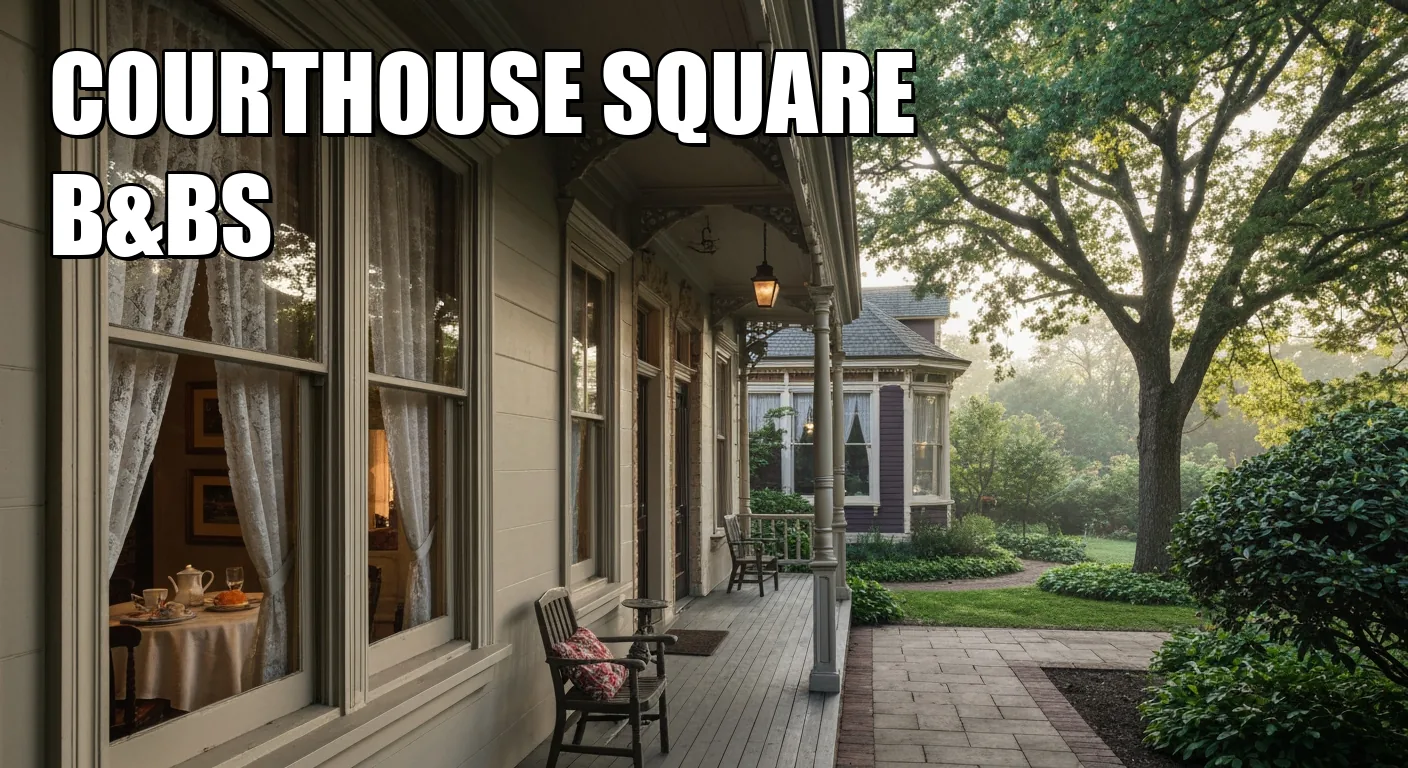
Among the many similarly named establishments, the Courthouse Inn Bed & Breakfast in Clarksville, Texas, offers one of the most compelling narratives. Completed in 1889, this isn't just an old house; it's the former Norris House, a prime example of the elaborate Queen Anne architectural style, a popular Victorian movement known for its asymmetrical facades, turreted towers, stained glass, and intricate woodwork. The home belonged to H.I. Norris, a saloon owner—a detail that instantly adds a layer of unexpected character. Imagine the conversations, the deals, perhaps even the clandestine meetings that must have taken place within these walls, all while the county courthouse presided just a stone's throw away.

Stepping inside, you're greeted by six distinct guest rooms, each with its own evocative name: the Shannon Suite, the Governor's Suite, Norris, Juliet, Romeo, and Tower. While I haven't found documented specifics on whether historical figures actually stayed in the "Governor's Suite," these names immediately invite a sense of romanticism and curiosity. The presence of a "Juliet" and "Romeo" room, alongside a "Tower" room (likely referring to the prominent turret common in Queen Anne homes), suggests a deliberate nod to historical romance and architectural grandeur. It challenges the conventional view that small-town history is always dry; here, it’s alive with the potential for personal tales and architectural splendor.

Beyond the Gilded Cage: Practicalities and Unexpected Truths for Your Stay

Booking a stay at a historic inn like the Courthouse Inn in Clarksville comes with its own set of practical considerations, which a simple Google search won't always highlight. First, understand that these are not hotels. They are often private homes lovingly converted, meaning amenities and services might differ from what you're accustomed to. Current pricing information suggests rates starting at approximately $136 per night, but this is a fluctuating market, especially for October 2025. You’ll absolutely need to contact your desired property directly for exact rates and availability, particularly if your visit falls on a weekend or during a local festival. Booking 2-4 weeks in advance for weekend stays is a general rule of thumb for B&Bs, but for unique properties, I’d push that to two or three months, especially for popular seasons.

Parking can be another nuanced challenge. While being on a courthouse square sounds idyllic, it often means limited dedicated parking, especially if the town is active. You might find yourself circling the square a few times, particularly if a local event is underway—a small-town charm that can quickly turn into a minor logistical headache. Accessibility, too, is a consideration. Grand old homes, with their sweeping staircases and multiple levels, often predate modern accessibility standards. Always verify if you or anyone in your party has specific mobility needs. Don't expect these historic places to be immune to the quirks of aging; creaky floors, temperamental plumbing, and varying water pressure are all part of the charm, and sometimes, the reality. It’s part of the authentic experience, a trade-off for staying in a genuine piece of history rather than a cookie-cutter chain.

More Than Just a Bed: What Really Makes a Courthouse B&B Stand Out

You might arrive at one of these courthouse-adjacent inns hoping for tales of famous historical figures or even spectral encounters—the kind of dramatic narratives that often get amplified in travel brochures. And yes, it’s tempting to imagine spectral judges pacing the halls, or forlorn lovers sighing from the Juliet balcony of the Norris House. Yet, for all the atmospheric charm, publicly documented ghost incidents or famed historical guests are surprisingly sparse across these properties. This isn't a deficiency; it's an insight. The true value often lies not in sensationalized legends, but in the subtle, everyday history that permeated these communities.

What truly makes these courthouse B&Bs stand out is their ability to connect you with the often-overlooked fabric of American life. They represent the dreams and ambitions of local families, the architectural trends of their eras, and the enduring importance of community hubs like the courthouse square. They invite you to slow down, to notice the intricate details of a Queen Anne spindle, to imagine the lives lived within these walls, and to appreciate the quiet dignity of a town’s persistent history. Forget the sweeping national narratives for a moment; these inns offer a chance to understand America one small town, one historic building, and one genuine conversation at a time. It’s a richer, more authentic connection than any grand monument could ever provide.

Your Complete Guide to Historic Courthouse Lodging & Masonic Heritage B&B Experiences

What is the history of Courthouse Square Bed and Breakfast?
Courthouse Square Bed and Breakfast in Crandon, Wisconsin, is located in a historic downtown setting near the courthouse square and offers guests a unique lodging experience with personalized hospitality from delightful hosts who provide clean accommodations, comfortable beds, and delicious homemade breakfast.
What is the history of Courthouse Hotel?
The Courthouse Hotel in London, England, was originally built in 1913 as the Great Marlborough Street Magistrates Court designed by police architect J.D. Butler, and it remained the only Metropolitan Police Court on its original site until closing in 1990 before being converted into a five-star hotel while preserving courtroom features.
What is the history of Mason, Texas?
Mason, Texas was established around Fort Mason in 1851 and grew as a frontier settlement and ranching community, with the town officially becoming the county seat in 1861; it developed into a thriving cattle-ranching center with strong German immigrant heritage and is now known for its historic charm, outdoor recreation, and Hill Country location.
What does 3-5-7 mean in Masonic symbolism?
In Freemasonry, the numbers 3, 5, and 7 are highly symbolic: 3 represents the three principal officers and three stages of life (youth, manhood, age), 5 symbolizes the five points of fellowship and five human senses, and 7 represents perfection and the seven liberal arts and sciences (grammar, rhetoric, logic, arithmetic, geometry, music, and astronomy).
Why do some Christians not like Freemasons?
Some Christian denominations view Freemasonry as incompatible with biblical Christianity because they believe it denies the exclusivity of Jesus as Messiah, emphasizes universal religious truth over Christian distinctiveness, requires ritualistic oaths that contradict Scripture, and promotes a syncretic spirituality that places Freemasonry on equal footing with Christianity.
What is the story behind the Masons?
Freemasonry traces its origins to medieval guilds of stonemasons in Europe and evolved into a fraternal organization emphasizing charitable work, moral development, and philosophical inquiry, with its rituals and symbolism drawing from stonemason traditions and incorporating teachings about virtue, fellowship, and enlightenment.
What is the history of the Masons in Texas?
Freemasonry was formally established in Texas in March 1835 when Dr. Anson Jones and five other Masons met secretly under the Masonic Oak near Brazoria and petitioned the Louisiana Grand Lodge for a charter, with Holland Lodge No. 36 becoming the first Texas lodge; Masons played a dominant role in founding the Republic of Texas, with all presidents, vice presidents, and secretaries of state being Masons.
Is Mason, Texas a good place to live?
Mason, Texas offers a desirable lifestyle featuring affordable cost of living compared to larger Texas cities, strong community spirit with friendly neighbors, historic charm and architecture, excellent outdoor recreation with hunting and fishing, and proximity to Hill Country attractions, though housing appreciation has increased costs in recent years.
What do Masons say instead of amen?
Masons traditionally use the phrase 'So Mote It Be!' instead of 'Amen' to close prayers in lodge meetings, which means 'so may it be' and dates back to the 1300s Regius Poem, making it a ritual expression meaning the same as 'Amen' but representing a 600-year Masonic tradition.
What is the 8-hour rule for Freemasons?
The 8-hour rule in Freemasonry, symbolized by the 24-inch gauge, teaches Masons to divide their 24-hour day into three equal 8-hour periods: 8 hours for worship and service to God and distressed worthy brothers, 8 hours for work and vocational pursuits, and 8 hours for rest and refreshment.
What amenities are typically offered at courthouse square bed and breakfasts?
Most courthouse square B&Bs offer complimentary breakfast, free WiFi, free parking, comfortable bedrooms with quality bedding, air conditioning, and garden or patio areas; many feature historic architecture and personalized service from innkeepers who provide local recommendations and hospitality.
What are the check-in and check-out times for courthouse square accommodations?
Typical check-in times at courthouse square B&Bs are 3:00 PM with late check-in fees applying after 8:00 PM, while standard check-out time is 11:00 AM, with late checkout subject to availability and additional fees.
What is the best time to visit a courthouse square bed and breakfast?
Spring (March-May) and fall (September-November) offer the most pleasant weather and lower tourist crowds for courthouse square visits, while summer attracts more visitors but can be hot, and winter provides fewer tourists and potential historic holiday events.
How far in advance should I book a courthouse square bed and breakfast?
It is recommended to book courthouse square B&Bs 4-8 weeks in advance for weekend stays during peak seasons, though last-minute bookings may be available during slower periods; historic downtown locations often fill quickly during local festivals and events.
What attractions are near courthouse square bed and breakfasts?
Most courthouse square B&Bs are within walking distance of historic downtown shops, restaurants, museums, theaters, and local government buildings, with many featuring proximity to parks, cultural events, and historic landmarks that make them ideal bases for exploring town heritage and attractions.