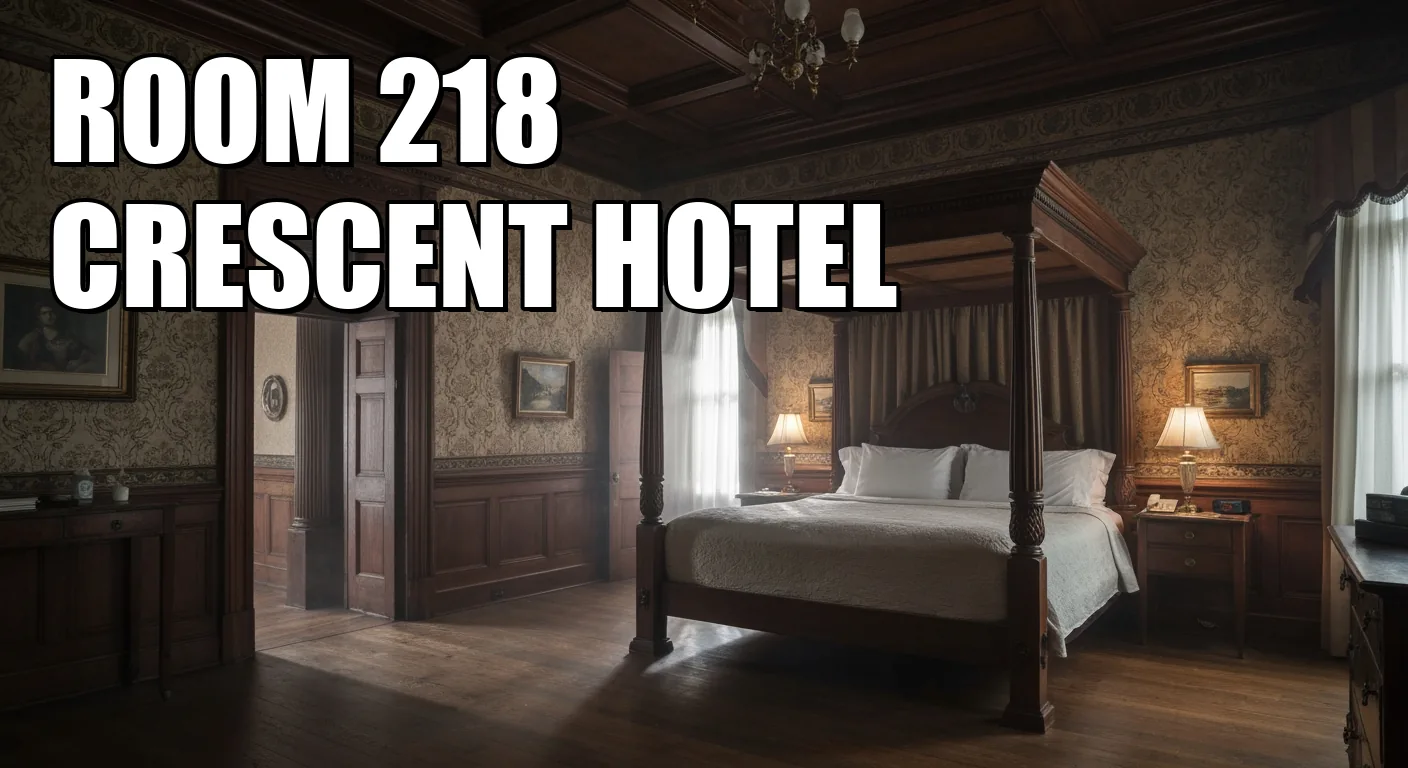
For years, travel guides have lauded Eureka Springs, Arkansas, as a charming Victorian hamlet, a picture postcard of quaint shops and winding streets. Yet, beneath that genteel surface lies something far more unsettling: the 1886 Crescent Hotel & Spa. Now, plenty of historic hotels claim a resident ghost or two, but few possess the sheer density of documented, multi-sensory activity found within the Crescent's limestone walls—and nowhere is that more concentrated, or frankly, more unnerving, than in Room 218.
So, what exactly sets this particular room apart from its spectral neighbors? Is it merely clever marketing, or does a genuine chill cling to the very air? Having wandered through my share of "haunted" locales across the country, I've developed a certain skepticism for hyperbolic claims. But Room 218? This place has a narrative, a consistent performance, that makes even a seasoned cynic pause. The central character in this enduring drama is Michael, a young Irish stonemason whose life tragically ended during the hotel's construction in 1885-1886. He fell from the scaffolding right at the spot where Room 218 now sits, and though official records of his death are scarce beyond site logs—a common oversight for laborers in that era—local lore has ensured his spirit’s permanence. This wasn't some anonymous, forgotten soul; Michael has made sure he’s remembered, often in ways that defy easy explanation.
The Unsettling Truths Michael Whispers from Room 218
If you’re expecting a quiet night’s sleep, let me disabuse you of that notion immediately. Room 218 is not for the faint of heart, nor for those who scoff at tales of the unseen. It’s a stage for what can only be described as persistent, often startling, poltergeist activity. One of the earliest widely publicized incidents occurred in 2005, when the television show *Ghost Hunters*—a program I admit I approach with a healthy dose of critical distance—reportedly captured a full-figure apparition in the bathroom mirror. This wasn't some shadowy blur; it was a discernible form, attributed directly to Michael, lingering in the very spot of his demise. While TV always adds a layer of drama, the sheer volume of independent reports following similar themes lends credence to the idea that something truly is amiss here.
Long before reality TV cameras arrived, a truly compelling piece of evidence emerged in November 2004. Guests staying in the room developed photographs that revealed a translucent, full-figure reflection in the bathroom mirror. What makes this particular image so striking, and harder to dismiss as pareidolia, is the detail: period clothing, rolled sleeves, overalls—a ghostly snapshot of a working man from another century. You don't just *imagine* those details; they're either there or they aren't. And in this case, many attest, they were.
More Than Just Whispers: The Poltergeist's Playbook
It isn't just apparitions either; the room seems to hum with a restless energy that manipulates its environment. In 2022, a YouTube investigation team documented drawers in Room 218 opening on their own, even when no one was near. The investigator specifically noted that merely walking past the dresser would trigger a drawer to slide open, despite the hinges being intact and no discernible drafts. This wasn't a subtle creak; it was a physical interaction with the room’s furnishings, a clear demonstration of unseen force. Such incidents move beyond the psychological and into the realm of the undeniable, for those present.
Think about the sheer psychological toll of spending a night in such an environment. A KATV reporter, on assignment to cover the hotel's paranormal reputation, found herself in Room 218 and recounted a night of incessant creaking, sudden, inexplicable cold spots, and an overwhelming, palpable feeling of being watched. Sleep was impossible. She claimed to hear a distant scream coming from the ceiling, a chilling echo perhaps of Michael’s final moments, before retreating the next morning, utterly unnerved. This speaks to the immersive, unsettling nature of the experience—it’s not just visual, it’s auditory and tactile.
Numerous other guests, whose accounts fill paranormal blogs and forums, describe everything from hands seemingly emerging from the bathroom mirror—a deeply unsettling image—to loud bangs, the cries of a falling man from the ceiling, and doors opening and slamming shut without human intervention. Then there are the subtler, yet equally unnerving, cold spots that defy the HVAC system, and the classic poltergeist antics: bedsheets tugged, clothing tossed onto the floor. It suggests a persistent, playful, yet sometimes mournful energy that refuses to be ignored.
The Hotel's Darker Chapters: Beyond Michael's Tragedy
While Michael might be the star of Room 218, to truly understand the Crescent Hotel's profound spiritual resonance, one must delve deeper into its checkered past. The building began its life as a beacon of luxury, opening as a grand resort in May 1886. But its architectural beauty couldn't shield it from the capricious winds of history. In 1908, it transitioned into the Crescent College & Conservatory for Young Women, which, while seemingly innocuous, surely left behind its own youthful echoes. However, it was the period from 1937 to 1940 that casts the longest, most sinister shadow over the property.
During these years, the hotel was transformed into a fraudulent cancer hospital by Norman Baker. This wasn't merely a misguided venture; Baker was a notorious quack, a con artist who preyed on the desperate, peddling false cures. His "hospital" was little more than a charnel house, complete with a psych ward and a makeshift morgue in the basement. Imagine the fear, the suffering, the dashed hopes of those who entered its doors, many never to leave. This dark chapter infused the very fabric of the building with a different kind of anguish, a collective sorrow that arguably contributes to the hotel’s pervasive paranormal activity. It’s a crucial historical context that typical ghost tour narratives sometimes gloss over, but it’s vital for understanding *why* the Crescent feels so profoundly haunted, far beyond just Michael's tragic accident.
The Geological Amplifier: Does Limestone Hold Memories?
Beyond the human tragedies, some paranormal investigators posit a more esoteric explanation for the hotel's intense activity: its very construction. The entire structure is built from local limestone, a porous material believed by some to possess unique electromagnetic properties. The theory is that limestone can absorb and even emit energy, potentially acting as an amplifier for residual human emotions and consciousness. While it’s certainly not a universally accepted scientific principle, it adds another fascinating layer to the Crescent's mystique. Does the very ground beneath your feet, the walls around you, literally resonate with the past? It’s a thought that lingers, especially when you feel that inexplicable chill or hear a distant whisper in the dead of night.
The individuals who have dedicated significant portions of their lives to the Crescent’s paranormal narrative are also worth noting. Jack Moyer, the general manager since 1997, has personally collected over 5,000 firsthand accounts of unexplained activity, with a significant portion stemming from Room 218. This isn't just hearsay; it's a meticulously compiled record from diverse individuals. Keith Scales, the manager of the hotel's ghost tours, has guided countless investigations and amassed testimonials of physical pokes and touches, often reporting that Michael seems particularly fond of interacting with female guests. These aren't just sensational anecdotes; they are consistent observations from people deeply embedded in the hotel's daily operations.
Planning Your Own Paranormal Encounter: Practicalities and Pitfalls
So, you’re intrigued. You want to test your mettle, to experience Room 218 for yourself. Be forewarned: this isn't a spur-of-the-moment decision. Room 218 is classified as a Premium Historic Room and is, unsurprisingly, the most requested accommodation in the entire hotel. To secure your stay, you’ll need to plan meticulously, often reserving up to 18 months in advance. And yes, if you choose the Advance Purchase rate, be aware it’s non-refundable—a significant commitment for a potentially sleepless night.
Expect the costs to reflect its iconic status. Rates are based on double occupancy, with additional charges for extra guests beyond two. Beyond the base rate, you'll encounter a
14.375% bed & state tax, a
$19.75 + tax Daily Resort Fee, and a
3% voluntary service charge. These aren't minor add-ons; they significantly increase the final tally. Check-in is at 4 PM, check-out at 11 AM, and you must be 18 or older to make a reservation. For those determined to specifically book Room 218, you must indicate your preference in the reservation notes on the official Crescent Hotel website, under "Guest Room Preferences." Understand, though, that even with the best planning, it remains subject to availability. Don't simply show up expecting to walk in; disappointment, rather than dread, will be your primary companion.
My advice? If you’re a genuine paranormal enthusiast, go. Embrace the history, the folklore, and the undeniable atmosphere. But temper your expectations. Not everyone experiences a full-bodied apparition, and a quiet night doesn't necessarily disprove anything—it just means Michael might have been busy elsewhere. The true value lies not just in a potential ghostly encounter, but in stepping into a living, breathing piece of American history, tainted by both opulence and profound human suffering. It’s a journey into the shadows of the past, where the line between legend and reality blurs, inviting you to decide for yourself what truly happened within those ancient limestone walls.