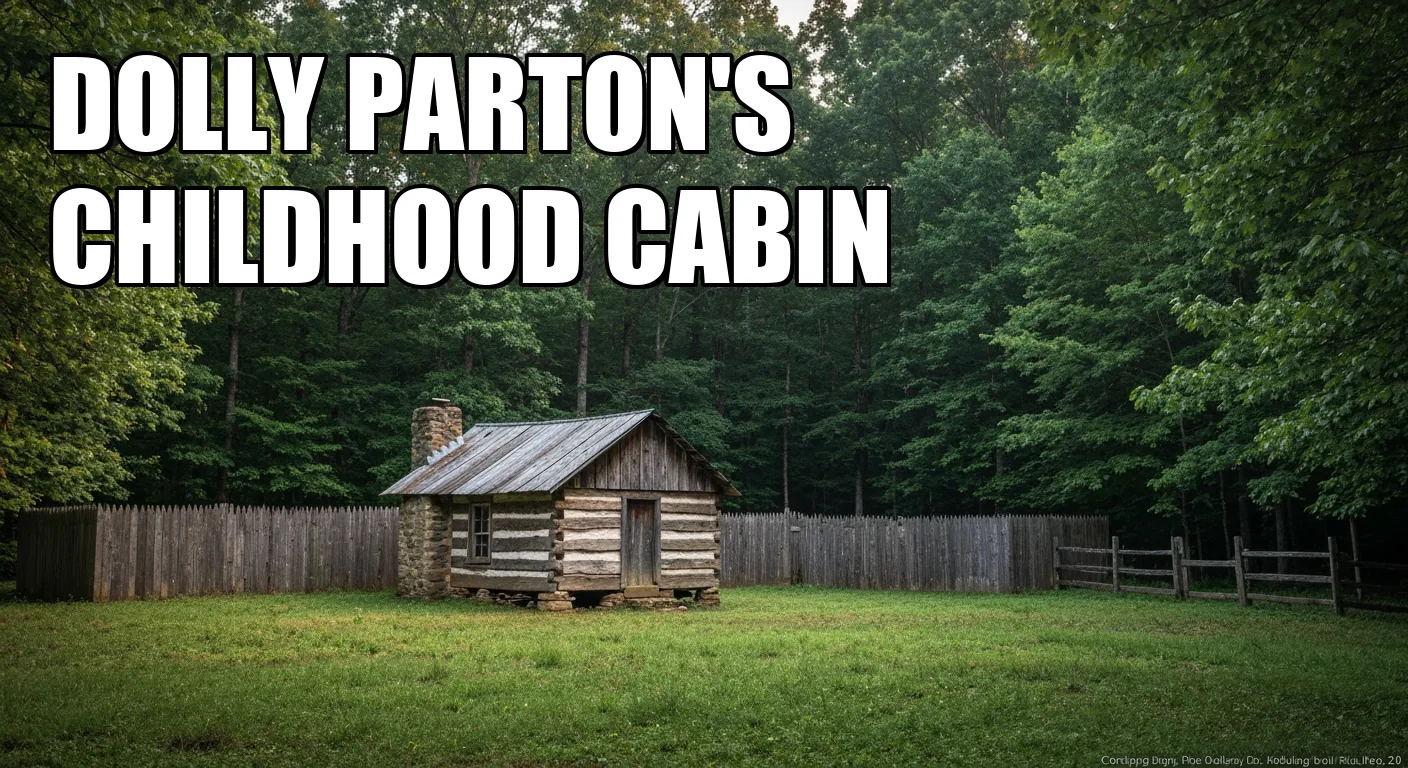
People searching for Dolly Parton's birthplace are usually looking for the wrong cabin — and the right one is closed anyway. She was born in a small cabin near the Little Pigeon River in Pittman Center, Tennessee, on January 19, 1946; the "Tennessee Mountain Home" of the songs is a different house entirely, the two-room cabin on Locust Ridge where she grew up. That cabin still stands, still on Locust Ridge Road, still private property — renovated by Dolly herself and closed to the public. What can be visited is better than most fans expect: the replica her own brother built and her mother furnished, the family's graves on a hillside outside town, and a downtown Sevierville that is quietly full of her.
The honest map: the original cabin is private — there is nothing to see and no reason to drive Locust Ridge Road. What is open: the Tennessee Mountain Home replica in Dollywood's Rivertown Junction, the Dolly Parton Experience in the same park, the free bronze statue at the Sevier County Courthouse (125 Court Avenue), a half-dozen downtown landmarks from her childhood, and the Caton's Chapel and Angel Hill cemeteries where her parents and two of her brothers are buried.
Two Cabins, and Why Everyone Mixes Them Up
The confusion is built into the biography. The birth cabin by the Little Pigeon River in Pittman Center marks where the Partons were living in January 1946. The family later settled on Locust Ridge — a rural stretch of Sevier County in the hills between Sevierville and the national park — and it is that ridge-top cabin, the one from "My Tennessee Mountain Home," that carries the childhood-home title in every retelling. A family that grew to twelve children shared its rooms, without electricity or running water.
The three questions people actually type into search engines have short answers:
| The question | The answer |
| Is the childhood home still standing? | Yes. The cabin still stands on Locust Ridge Road in Sevier County, and Dolly restored it herself. |
| Can you visit it? | No. Sources are uniform: "private and not open to the public." No tours, no grounds access, no viewing. |
| What is the address? | We don't publish it, and neither do the reputable guides — it is a private home on a narrow mountain road. The replica exists precisely so nobody needs the address. |
One more source of confusion worth clearing: Dolly Parton Parkway is not where she lived. It is the name US-411 takes in Sevierville just past downtown, running through the town's main business district — a commercial highway named in her honor, miles from Locust Ridge and unconnected to the cabin.
The Replica Her Family Built From Memory
The substitute is unusually good, because the Partons made it themselves. The Tennessee Mountain Home replica stands in Dollywood's Rivertown Junction, just past Aunt Granny's restaurant — a log cabin built by Dolly's brother Bobby and furnished by her mother, Avie Lee, working from memory.
You view the rooms through a glass partition, and the detail rewards a slow look: floral wallpaper over newspaper, the layering mountain families used for insulation; hand-knit rugs; a table set with plates and aluminum coffee cups; shelves of jars and tins; a bed with a couch pushed against it and photographs of her parents on the wall. A glass case holds the small things a family keeps without meaning to — tinctures, baby powder, a corncob pipe, a jar of buttons. As museum pieces go, it is unusually honest: the curator was the woman who had actually kept the original house.
The Dolly Parton Experience
In May 2024 Dollywood replaced its Chasing Rainbows museum with the Dolly Parton Experience — a complex Dollywood describes as three times the size, spread across several buildings in the former Adventures in Imagination area. Songteller walks her career chronologically, from teenage radio spots through the Porter Wagoner years (staged in a tour-bus-styled room) to a 360-degree finale theater; Behind the Seams shows the wigs, shoes and stage costumes; Precious Memories covers the faith-and-family side. The piece worth planning around is Dolly's Home-on-Wheels, her actual 1980s–90s tour bus, open for walkthrough — kitchen, bunks, private bedroom. It's included in general park admission — no separate timed-entry ticket is required as of 2026, and a one-day adult pass runs about $95 (see ticket options below). The Experience does not contain the cabin: they are separate stops in different sections of the park.
Downtown Sevierville Is the Underrated Stop
Most visitors photograph the statue and drive on, which means they miss the part of the story that is still standing at street level. The bronze — a barefoot young Dolly with her guitar, sculpted by regional artist Jim Gray and unveiled in 1987 — sits on the Sevier County Courthouse lawn at 125 Court Avenue, free and accessible around the clock, with free parking on Court Avenue and Bruce Street. Within a few minutes' walk:
| Landmark | Why it matters |
| The Pines, 108 Joy Street | The 1928 theatre where a ten-year-old Dolly first played to a paying audience; the original marquee is still out front |
| Red's Café building, Bruce Street | The hot-dog counter of her childhood — the building survives two doors from the courthouse, now a law office, with a mural next door commemorating it |
| Red's Soda Fountain, Court Avenue | A 1950s-style homage to the original, a few doors from the statue |
| Cas Walker's grocery site | Where she made her weekly early-career radio and TV appearances; the building now houses part of a church on the Parkway |
| Emery's 5 & 10, Court Avenue | Where she bought her first makeup — the origin story behind "it costs a lot of money to look this cheap" |
| "Wings of Wander" mural, Bruce Street | A butterfly mural near the gazebo, nodding to "Love Is Like a Butterfly" |
None of it is ticketed. An hour on foot covers the whole set, and it gives the childhood a geography that no theme-park exhibit can: the same four blocks where a kid from the ridge came down to sing.
Where the Family Rests
Visitors often ask, and the answer is simple and quiet: the Parton family graves are in the adjoining Caton's Chapel and Angel Hill cemeteries outside Sevierville. Her parents, Robert Lee and Avie Lee Parton, and her brothers Larry and Floyd lie just beyond the old wooden fence that separates the two burial grounds. Both are open, both are working country cemeteries, and the appropriate visit is the obvious one — walk slowly, take nothing, and remember that local families still bury their own here.
Building the Day
The itinerary that matches reality: start at the courthouse statue and walk downtown Sevierville — an hour, free, and the most human hour of the trip. Give Dollywood the rest of the day, treating the cabin replica and the Experience as two separate stops. Skip Locust Ridge; the road is narrow, the cabin is a private home, and the family long ago built the version they wanted people to see. That replica — assembled by a brother, furnished by a mother, filled with the household's own things — is as close to the source as this kind of tourism gets.
The Cornerstone Brief
One historic place, once a week — what it is, why it matters, whether it's worth going. No filler, no paid placements.
Coming soon. Unsubscribe any time.