Expect a transplanted Fasil Ghebbi on a U.S. highway exit. Reality: there is no physical replica of Gondar’s royal castles open to American visitors. The UNESCO fortress-city stays in Ethiopia. What you get instead—and what is worth booking—is diaspora architecture of a different kind: free Smithsonian galleries, Orthodox churches with shoes-off liturgy, Fairfax Avenue injera, and coffee ceremonies where green beans roast at the table.
Echoes of Gondar in America, 2026: Real / Legend / Book. Real is Emperor Fasilides’s 17th-century capital and free African Art in D.C. Legend is the idea that “Ethiopia in America” means a castle ticket. Book means three concrete city itineraries—not fantasy fortress passes.
Real Gondar: Fasil Ghebbi, not a U.S. attraction
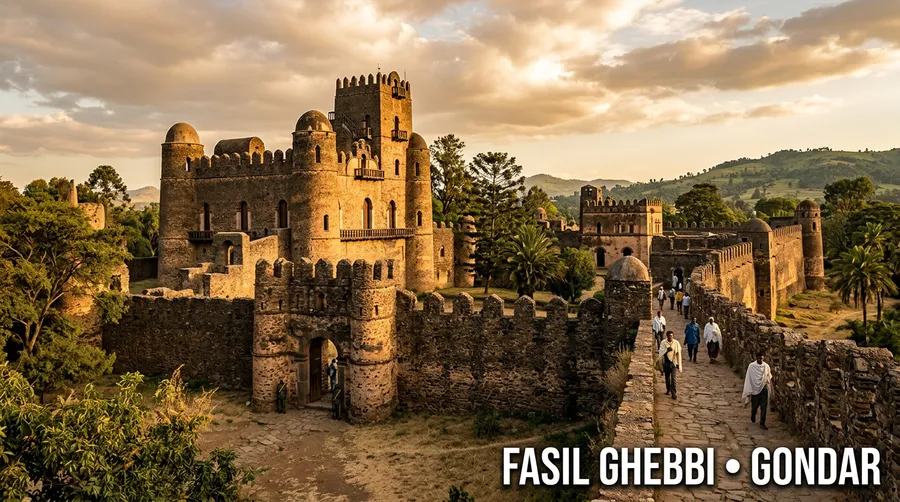
Fasil Ghebbi is a walled royal compound in Gondar, Ethiopia. Emperor Fasilides founded Gondar as permanent capital in the 1630s (sources place foundation around 1636), ending centuries of semi-itinerant royal camps. Successors expanded the enclosure into a cosmopolitan fortress-city. UNESCO listed the site in 1979. Architecture mixes documented Hindu, Arab, Portuguese, and Baroque influences—Ottoman defensive castle culture and Jesuit-carried Western prints meeting local masons (including Beta Israel) and Gujarati and Arab craftsmen.
Local legend inside the complex includes Zobel’s Mausoleum near Fasilides Bath—folklore that Emperor Yohannes I built it for a favorite horse. That is site lore, not a U.S. marketing claim. Timkat at Fasilides Bath—when the bath is filled for baptism reenactment—is an Ethiopian pilgrimage reality. It does not transfer to an American theme-park calendar. Ticket prices at Fasil Ghebbi entrances exist; exact birr or dollar figures were not in our source set—plan to pay on site in Ethiopia, not at a U.S. box office.
Fact vs. expectation: churches, “round” myths, diaspora scale
Expectation: American Ethiopian churches look like Gondar stone castles or ancient circular tukul-style temples. Documented fact: round church exteriors only became common in Ethiopia from the 16th century; earlier dominant forms were basilica (Middle Eastern Orthodox influence) and rectangular synagogue-linked plans. Interiors keep three sacred zones—outermost Qenie-Mahilet, middle Kiddest, restricted Makdas for clergy only. North American Ethiopian Orthodox interiors often follow a modern Addis Ababa standard from the early 1960s, not a copy of Fasilides’s castles.
Diaspora peaks are modern, post-1980s migration—not colonial-era “heritage houses.” Washington, D.C. area is the largest Ethiopian concentration outside Africa (unofficial estimates often 150,000–250,000). Minneapolis–Saint Paul ranks high (~35,000–40,000, strong Oromo community). Seattle ~25,000–40,000 (Rainier Beach, Central District). Los Angeles won official “Little Ethiopia” designation on Fairfax Avenue in 2002. Shaw / 9th & U Street NW and Silver Spring, Maryland, form the East Coast commercial spine.
What you can actually visit (hours and free vs. paid)
Smithsonian National Museum of African Art (Washington, D.C.): open daily roughly 10:00 a.m.–5:30 p.m., closed December 25; admission free. Collections and shows have included Ethiopian Coptic crosses, leather-and-silver shields, and work by Ethiopian and Ethiopian-American artists (e.g. Skunder Boghossian, Aïda Muluneh, Tsedaye Makonnen). Moorland-Spingarn Research Center at Howard University holds a specialized Ethiopian collection (200+ volumes Amharic and English)—research access, not a walk-up castle tour.
Re’ese Adbarat Debre Selam Kidist Mariam (DSK Mariam), 1350 Buchanan St NW, Washington, D.C.—among the oldest Ethiopian Orthodox Tewahedo congregations in the U.S. Services in Amharic and English; remove shoes on entry. Specific tourist open-hours were not published in sources—attend as a respectful guest at liturgy, not as a timed mansion tour. Neighborhood food and buna (coffee ceremony) at places like Sidamo or Harrar Coffee Roastery are the secular public face of the same culture.
Little Ethiopia, Los Angeles (Fairfax Avenue): eat at staples such as Messob (open since 1985), Lalibela, Merkato, Meals by Genet—communal injera platters, optional gursha. Around Ethiopian New Year (Enkutatash, early September), the street festival markets dance, crafts, and coffee to a wider public. Minneapolis hybrids (Seward, Cedar-Riverside, Phillips) sell berbere, teff, and jebena pots alongside home-style plates.
Festivals: pilgrimage vs. diaspora calendar
Timkat and Meskel remain religiously serious in Ethiopia; U.S. versions are community adaptations (e.g. Meskel gatherings documented in Columbus, Ohio). Enkutatash carries Queen of Sheba jewel-gift legend in marketing copy—enjoy the street festival without treating Sheba tourism as archaeology. ESFNA soccer-and-culture festival is a diaspora-built draw (Seattle hosted a major 2025 edition). A named 2026 marker: Ethiopian Day 2026 in Silver Spring, Maryland—Sunday, September 6, 2026, roughly noon–9 p.m. at 1 Veterans Place; ticket tiers were listed high in event materials (sources showed figures starting near $210 for some packages)—verify category before buying, as day-festival pricing can bundle VIP or multi-access products.
Three trip scenarios (book these, not a castle)
1) D.C. & Silver Spring cultural capital: Free morning at National Museum of African Art; respectful service or exterior visit at DSK Mariam if schedule fits; guided Little Ethiopia / U Street food tour; dinner in Silver Spring (Beteseb, Sheger Spring, and peers). Optional research stop at Howard’s Moorland-Spingarn by appointment culture.
2) Los Angeles Fairfax day: Official Little Ethiopia strip—Messob or Lalibela for the communal platter, boutiques, and Enkutatash weekend if your dates hit early September. No Gondar stones; maximum edible architecture.
3) Minneapolis market immersion: Seward / Cedar-Riverside grocery-restaurant hybrids, spice and coffee gear shopping, frankincense-and-jebena ceremony at a local café. Second-city depth without D.C. throngs.
Who yes: travelers who want free museums, real liturgy etiquette, and diaspora foodways. Who no: anyone expecting a U.S. Fasil Ghebbi ticket or “Gondar castle Airbnb.” Bottom line: Echoes of Gondar are living neighborhoods and free Smithsonian walls—not a transplanted UNESCO enclosure. Book the real map; leave the castle where Fasilides built it.