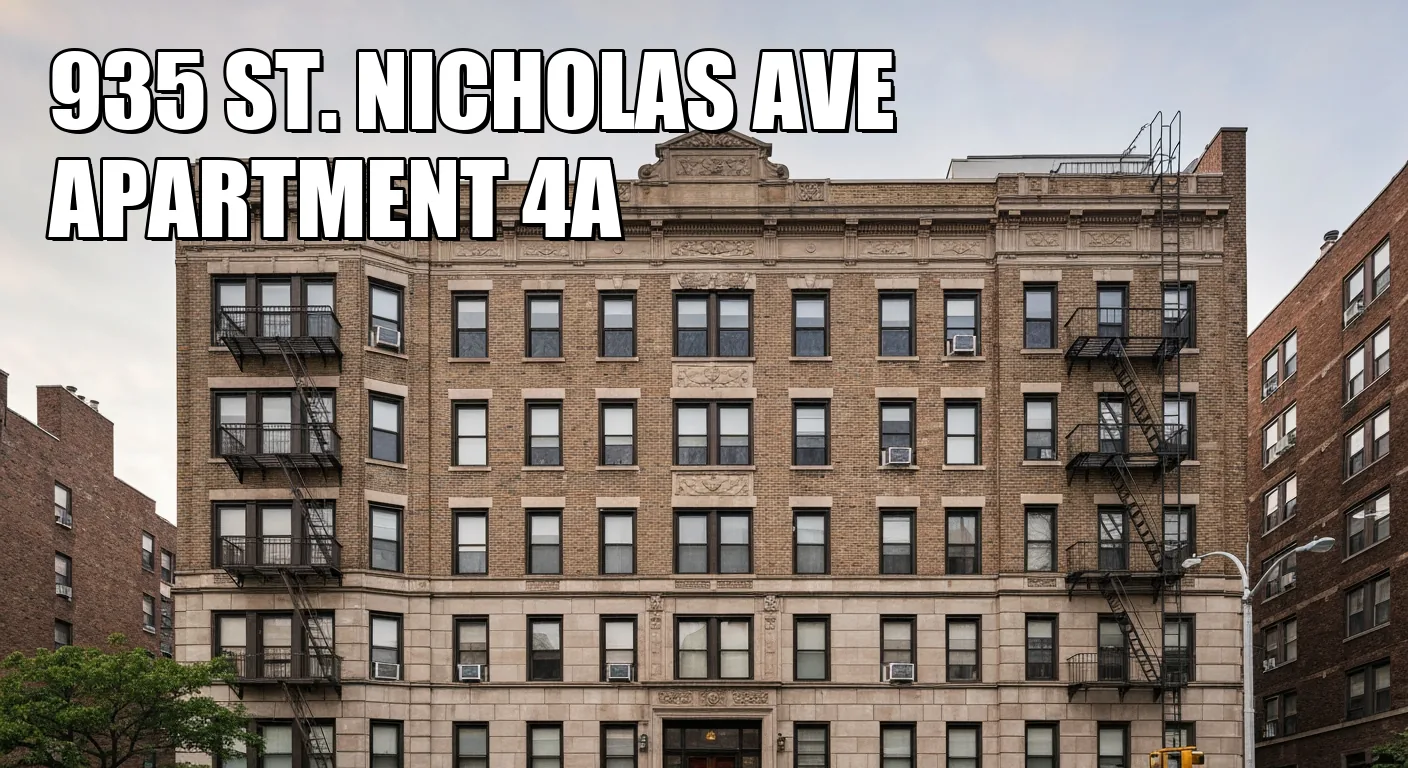
Stepping onto St. Nicholas Avenue in Washington Heights, you might find yourself doing a double-take. This isn't the grand, iconic edifice many imagine when they hear the name Duke Ellington. Instead, at number 935, stands a sturdy, pre-war apartment building, solid and unassuming, a silent testament to a different kind of creative crucible. For 22 pivotal years, from 1939 to 1961, this very address, specifically Apartment 4A, was the anchor for one of America's most profound musical minds, Edward Kennedy Ellington.
My journeys through America’s historic landscapes have taught me that true insight often lies not in the grand pronouncements, but in the quiet details, the places where daily life intersected with extraordinary genius. And here, in what was once a vibrant, self-contained world for Ellington and his orchestra—who, rumor has it, occupied the entire fourth floor when in town—the insights are subtle, requiring a different kind of looking and listening.
Beyond the Brownstone: Why This Address Matters
Many historical sites present themselves as neatly packaged narratives, complete with guided tours and roped-off relics. But the Duke Ellington House, a private residence to this day, challenges that expectation, and frankly, I find it all the more compelling for it. What makes this particular structure so profoundly significant isn't an artifact you can touch, but the sheer volume of groundbreaking music that emanated from within its walls—music that reshaped American culture. This wasn't merely a place he slept; it was a fundamental part of his creative ecosystem, a steady hub amidst his ceaseless touring.
Consider the sheer audacity of "Black, Brown and Beige," Ellington's monumental extended jazz composition for chorus and orchestra. This ambitious work, a "tone parallel to the history of the American Negro" as he famously described it, premiered at Carnegie Hall in January 1943. It was crafted, at least in part, within this very building, representing his fervent effort to elevate jazz to a stature commensurate with European classical music. To stand outside 935 St. Nicholas is to commune with the genesis of such a powerful statement, a place where a profound historical narrative was translated into musical form.
Unpacking Ellington's Creative Lair: Expectation Versus Reality
If you're like me, your imagination might conjure images of a grand piano dominating a high-ceilinged living room, perhaps stacks of sheet music on every surface. The reality of Ellington's compositional process, however, defies such neat categorization, and this building offers a fascinating paradox. While major works like "Black, Brown and Beige" and the commissioned "Liberian Suite" (1947) were undoubtedly incubated during his residency here, Ellington was famously nomadic in his creative habits. He often composed on the road—in the rhythmic sway of Pullman cars (luxurious railroad sleeping cars), in countless hotel rooms, or even on chartered buses between gigs.
This itinerant genius means that while the apartment was his home base, a place for respite and, undoubtedly, focused work, it wasn't a conventional "studio" in the modern sense. Historical records, frustratingly yet revealingly, don't pinpoint a specific "composing room" within Apartment 4A. This absence of a fixed creative sanctum speaks volumes about Ellington himself: his music wasn't confined to a single space; it was a continuous flow, an ever-present companion regardless of his physical location. It's a critical insight that typical biographical accounts often gloss over, focusing on *what* he composed rather than *how* his environment shaped—or didn't shape—his process.
"Harlem Air Shaft" and the Building's Echoes: A Direct Inspiration
While many of his masterpieces emerged during his residency, one particular composition offers an almost cinematic connection to the building itself: "Harlem Air Shaft" (1940). Ellington himself articulated the piece's inspiration in a 1944 interview for The New Yorker, describing it as a sonic tapestry woven from the very fabric of Harlem apartment life. Imagine, if you will, the clamor of arguments, the tantalizing aromas of cooking, the blare of competing radio broadcasts, hushed conversations, and the myriad sounds of daily existence all funneling up through the building’s air shafts. This piece isn't just a composition; it's an auditory snapshot, a direct translation of urban living into jazz, composed right here, in the midst of that symphony.
It's this direct, visceral link to a specific environment that truly elevates 935 St. Nicholas Avenue beyond just another address. It becomes a character in Ellington's oeuvre, an unseen collaborator. Other timeless standards like "Don't Get Around Much Anymore" (originally "Never No Lament," 1940) and "Satin Doll" (co-written with Billy Strayhorn in 1953) also solidified their place in the jazz canon during his time here, even if their precise moments of creation remain elusive. The sheer prolificacy within those two decades is astounding, a testament to the persistent creative energy of its famous resident.
Who Came Knocking? The Unwritten Guest Book
One might naturally assume that Ellington’s apartment, a hub for his orchestra, would have hosted a parade of jazz luminaries. The historical record, however, offers a more nuanced, and perhaps surprising, picture. While the building served as an informal gathering and rehearsal space for his band members when they were in town, concrete documentation of specific, famous visitors to Apartment 4A is remarkably sparse. This isn't a deficiency in research; it’s an insight into the private side of a public figure.
Consider Billy Strayhorn, Ellington’s indispensable collaborator and "right arm." Their partnership, beginning in 1939, ran deep, yet Strayhorn typically maintained his own residence on Riverside Drive. Their creative exchanges often happened via early morning telephone calls, Ellington assigning tasks after his late-night performances. This suggests a professional relationship built on trust and remote collaboration rather than constant in-person visits to Ellington's apartment. It challenges the conventional image of a buzzing salon, replacing it with a more intimate, perhaps even solitary, creative process for the maestro, punctuated by intense, focused work with his band.
Visiting the Vestige: Practicalities and Ponderings for 2025
So, what does a visit to the Duke Ellington House entail for the modern traveler in 2025? It's crucial to understand that this remains a private residential building, not a museum with public access. You won't be able to tour Apartment 4A, or indeed, any part of the interior. This isn't a disappointment; it's merely a different kind of pilgrimage. Your experience will be an exterior one, a chance to absorb the aura of the place and its vibrant Washington Heights surroundings.
To truly appreciate the site, plan your visit during daylight hours, ideally on a weekday morning when the street is alive but not overly crowded. The neighborhood itself is steeped in history and offers a compelling counterpoint to the more tourist-trodden parts of Manhattan. Take the A, C, or 1 train to 157th Street; the walk from the subway station is brief and safe. You might consider combining this visit with a stroll through nearby Sugar Hill, another historic Harlem enclave, to fully contextualize Ellington's world. There are no admission fees, of course, but budget for subway fare and perhaps a coffee from a local cafe while you reflect on the significance of the unassuming brick facade before you. Don't expect grand interpretive plaques; instead, bring a good guide to Ellington's life and music, and let your imagination fill in the sounds and stories.
In a city that perpetually reinvents itself, the enduring presence of 935 St. Nicholas Avenue is a profound anchor to a golden age of American music. It reminds us that genius doesn't always reside in custom-built cathedrals, but often emerges from the very fabric of daily life, from the cacophony of an air shaft, and from the quiet dedication within an apartment, solid and steadfast, just like the jazz it helped create.