Famous Residents

Ennis House: Wright's Flawed Hollywood Icon

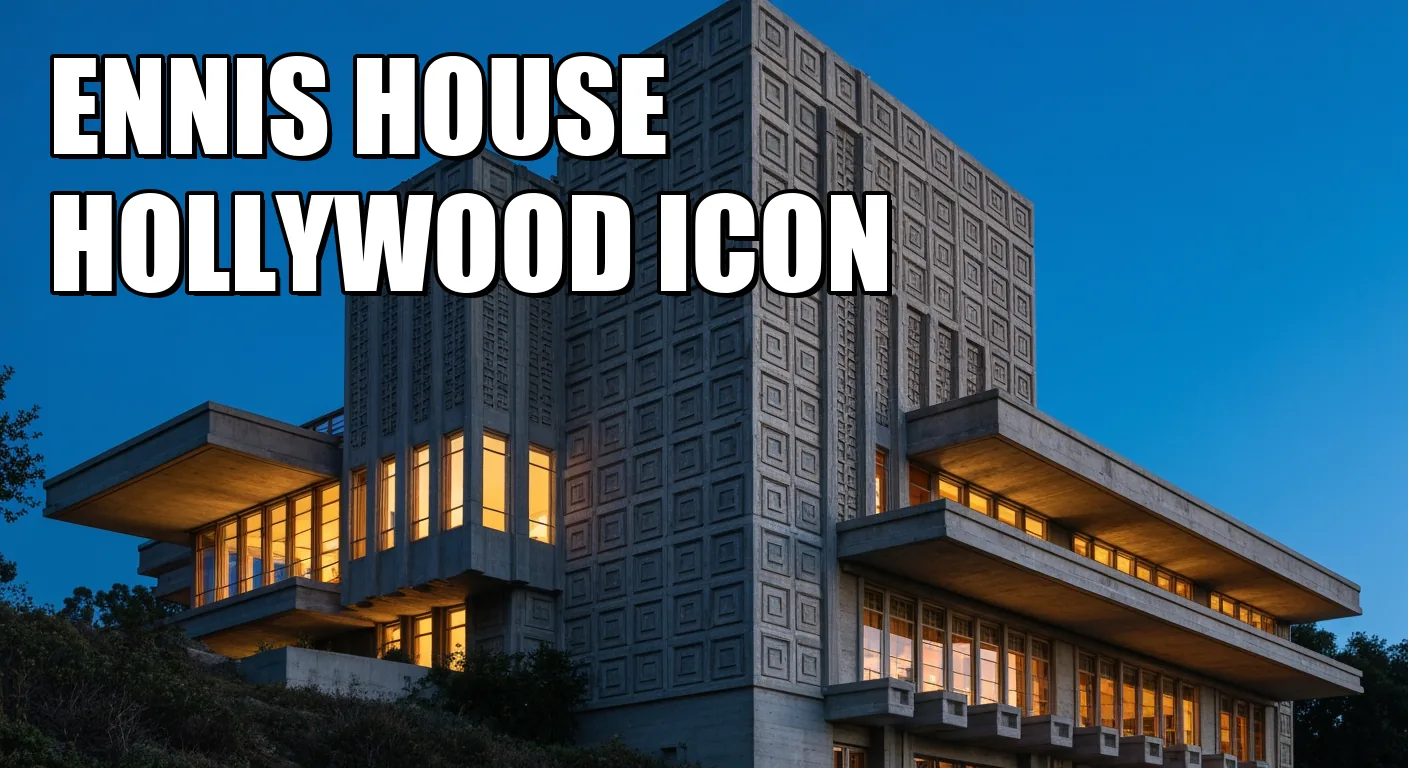
There are buildings that simply exist, and then there are structures that embed themselves into the cultural consciousness, becoming characters in their own right. Frank Lloyd Wright’s Ennis House, perched majestically above Los Angeles, undeniably belongs to the latter. Its towering, geometric facade—a stark, almost brutalist, beauty—has starred in more films and television shows than many human actors. Yet, beneath that celebrated exterior, behind the mythology of cinematic genius, lies a tale far more complex and, frankly, fraught with challenges than most guidebooks dare to admit.

For decades, I've crisscrossed the country, seeking out the architectural marvels that define America’s landscape. The Ennis House always beckoned, promising a masterwork. What I discovered upon digging into its history wasn't just Wright's audacious vision, but a sobering narrative of ambition clashing with the stubborn realities of materials and construction. It’s a building that forces us to question the very definition of "perfection" in design, revealing instead a fascinating mosaic of triumphs and profound, persistent flaws.

The Audacious Dream of Wright’s Textile Blocks

What exactly makes the Ennis House so visually arresting, so unlike its Mediterranean Revival neighbors in Los Feliz? The answer lies in Frank Lloyd Wright’s radical experiment: the "textile block" system. Imagine a building not simply *clad* in concrete, but literally *woven* from it. Each block, a modest 16 inches square and 3.5 inches thick, wasn't just decorative; it was a fundamental unit of structure and ornament, hand-cast on site. Wright conceived of these interlocking concrete pieces, featuring a distinctive Greek key pattern relief, as a means to create affordable, earthquake-resistant homes that merged seamlessly with the Californian landscape.

The ingenuity of this system was in its intended reinforcement. Wright envisioned steel bars running both vertically and horizontally through precisely grooved channels within the blocks, creating a grid. Once these channels were filled with grout—a thin, flowing mortar—the entire wall would, in theory, become a single, monolithic, reinforced concrete slab. The idea was brilliant: a mass-produced, modular system that allowed for intricate patterns and structural integrity, all crafted from local materials like decomposed granite, gravel, and sand mixed with portland cement. It was a bold declaration against traditional construction, aiming for an organic unity of form and function.

Cracks in the Foundation: Unraveling Wright’s Innovation

Despite Wright's grand vision, the reality of the Ennis House’s construction proved far more troubled than the ideal. Almost immediately, the ambitious textile block system began to betray its designer's intentions. The lower sections of the walls started to crack and buckle even before the house was completed. Why such immediate failure in what was conceived as an engineering marvel?

The problems were manifold and deeply practical. On-site casting conditions were primitive; there was no effective batching, no true compaction of the wet concrete into the molds, and crucially, inadequate curing. Think about it: a system reliant on perfectly formed, strong blocks produced under less-than-ideal conditions was doomed from the start. Add to this the very nature of the aggregate—decomposed granite sourced from the site, which contained clay minerals and feldspar. These geological components, while natural, are prone to micro-stresses, shrinking and expanding with moisture changes, effectively tearing the blocks apart from within over time. It was a ticking time bomb built into the very fabric of the house.

Perhaps the most critical structural flaw, however, lay in the actual assembly and reinforcement. The channels for the steel bars, meant to be poured full of concrete, were often incompletely grouted. This wasn’t just a minor oversight; it meant the steel reinforcement wasn't properly encased, leading to a profound weakening of the structural system. Without a complete bond between the steel, grout, and blocks, the walls failed to achieve the monolithic strength Wright had intended. They were, in essence, a stack of heavy, ornamental blocks held together by a prayer and inadequate mortar. This fundamental failure in execution meant the Ennis House was structurally compromised from its infancy, a fact that would plague its existence and require immense preservation efforts throughout its history. In a truly telling detail, the original owners, Charles and Mabel Ennis, were so dissatisfied with these mounting issues they actually fired Frank Lloyd Wright and his son Lloyd, opting to oversee the completion themselves in 1924—a story rarely highlighted in celebratory architectural retrospectives.

Hollywood’s Haunting Muse: More Than Just a Pretty Face

So, how does a building riddled with structural anxieties achieve such iconic status? The answer, as it often is in Los Angeles, lies in Hollywood. The Ennis House’s dramatic, fortress-like appearance, its stark geometry and almost alien facade, proved irresistible to filmmakers. Its cinematic journey began surprisingly early, in 1933, with the film *Female*, though only exterior shots graced the screen. This early appearance hinted at the power of its visual presence, a power that would only grow exponentially over the decades.

It was the 1959 B-movie horror classic, *House on Haunted Hill*, that truly cemented the Ennis House's reputation in popular culture. Featuring it as the titular mansion, the film capitalized on the house's inherent mystery and slightly unsettling grandeur. This movie didn't just showcase the Ennis House; it mythologized it, establishing its eerie, imposing silhouette as a symbol of cinematic dread. However, here's where the reality often diverges from perception: like many early productions, only the exterior of the house was filmed on location. The sprawling, Gothic interiors seen in the film were largely shot on sound stages, a common practice that allowed Hollywood to borrow a building's mystique without grappling with its architectural complexities.

The Celluloid Chameleon: Ennis House’s Shifting On-Screen Identities

The Ennis House’s relationship with Hollywood only deepened, evolving beyond mere exterior shots into more nuanced and, at times, deceptive roles. While *House on Haunted Hill* offered only a glimpse, 1975's *The Day of the Locust* was among the first to truly integrate the actual interiors, using it as a private residence within the film. This marked a significant shift, allowing audiences to experience the unique spatial qualities of Wright’s design, albeit filtered through a cinematic lens.

Then came *Blade Runner* in 1982, the film that forever linked the Ennis House with a dystopian future. For many, its textile blocks *are* Rick Deckard's apartment. Yet, here's an intriguing twist: while the film used a few exterior shots of the motor court, Deckard’s apartment interiors were almost entirely recreated on a Warner Studios sound stage. Production designers meticulously crafted foam molds of the distinctive blocks to replicate the look, proving that sometimes, Hollywood prefers a controlled imitation to the real thing. This raises a fascinating question about authenticity and the power of cinematic illusion – are we truly admiring Wright's genius, or a meticulously crafted facsimile?

Other productions, however, embraced the original. *The Karate Kid Part III* (1989) famously used the actual house for Terry Silver’s extravagant mansion, a refreshing commitment to the location that stood in contrast to *Blade Runner*'s approach. David Lynch, a director known for his distinctive visual style, found the Ennis House particularly compelling. For his cult TV series *Twin Peaks* (1990-1991), he specifically chose the mansion’s concrete-clad interiors to represent the fictional soap opera "Invitation to Love." The stark, geometric environment provided a deliberate, jarring contrast to the series’ natural, Pacific Northwest aesthetic, appearing in at least five episodes and proving Lynch's keen eye for symbolic architecture. The house also served as Angel's mansion in the supernatural drama *Buffy the Vampire Slayer* for at least five episodes.

Even when not directly featured, its influence permeated. Lynch’s *Mulholland Drive* (2001) subtly employed the textile block patterns for the door frame of Club Silencio, a nod to its iconic design. The house's presence extends far beyond these marquee productions, appearing in everything from *Predator 2* (1990) and *Beverly Hills Cop II* to *Black Rain* (1989) and *The Thirteenth Floor* (1999). It even made its way into video games like *Half-Life 2* and was referenced in animated series like *South Park*. The sheer breadth of its appearances underscores its enduring power as a versatile, visually striking character in its own right.

Enduring Legacy, Persistent Questions: A Monument to Both Genius and Flaw

Ultimately, the Ennis House stands as a monument to contradictions: a revolutionary design plagued by fundamental structural issues, a private residence transformed into a public icon through the magic of cinema. It challenges the conventional narrative of Frank Lloyd Wright as an infallible genius, revealing instead the human element of trial and error inherent in even the most visionary endeavors. Its structural challenges necessitated immense and ongoing preservation efforts, a practical issue that has defined much of its later history.

Visiting the Ennis House, even if only from the exterior (as it's a private residence), is a profound experience. It’s not just about appreciating a unique architectural style; it’s about contemplating the layers of history, the ambition of its creator, the compromises of construction, and the powerful, almost alchemical, transformation it underwent on celluloid. It prompts a deeper reflection: does a building's flaw detract from its greatness, or does it, perhaps, make it more compelling, more human? The Ennis House, with its concrete walls whispering tales of both aspiration and imperfection, certainly suggests the latter.

Frank Lloyd Wright's Iconic Houses: Your Complete Visitor's Guide

Can you tour the Ennis House?
The Ennis House is not open for regular public tours, but occasional special tours and events are offered by organizations like LA Conservancy. Tour availability is limited, so check local event calendars or set up Google alerts for tour announcements.
What is special about the Ennis House?
The Ennis House is one of Frank Lloyd Wright's iconic 'textile block' houses featuring over 27,000 interlocking concrete blocks with Mayan Revival design. It has appeared in more than 80 films and TV shows, including Blade Runner, and is designated as a city, state, and national landmark.
Can you tour the Hollyhock House?
Yes, Hollyhock House offers self-guided tours Thursday through Saturday from 11 am to 4 pm. Docents are available to answer questions, and guided group tours can be arranged by reservation.
Is Hollyhock House worth visiting?
Absolutely—Hollyhock House is Los Angeles's only Frank Lloyd Wright residence open to the public and a UNESCO World Heritage Site with excellent reviews. Visitors praise its stunning architecture, beautiful Barnsdall Art Park location, and knowledgeable docents.
What movies were filmed at the Ennis House?
The Ennis House appeared in over 80 films and TV productions, including Blade Runner (1982), Rush Hour, Twin Peaks, Buffy the Vampire Slayer, House on Haunted Hill (1959), The Thirteenth Floor, and The Rocketeer.
What are the Hollyhock House admission prices for 2025?
Admission is $12 for adults (increased from $7 as of April 1, 2025), $3 for seniors and students with ID, and free for children under 12 with a paying adult.
What is the #1 most inspirational film of all time?
According to the American Film Institute (AFI), 'It's a Wonderful Life' (1946) ranks as the #1 most inspirational film of all time.
Who owns the Ennis House now?
The Ennis House is currently owned by a limited liability company tied to cannabis entrepreneurs Robert Rosenheck and Cindy Capobianco, who purchased it in 2019 for $18 million.
Is Netflix's 'Number 24' based on a true story?
Yes, 'Number 24' is based on the true story of Norwegian World War II resistance fighter Gunnar Sønsteby, documenting his heroic efforts to resist Nazi occupation.
Was the Nottoway Plantation featured in movies?
Yes, Nottoway Plantation in Louisiana appeared in films including The Magnificent Seven (2016) and The Loss of a Teardrop Diamond (2008).
What are the Ennis House tour hours and admission prices?
The Ennis House has no regular public hours or standard admission; special tours are occasionally offered by LA Conservancy and other organizations, typically ranging from free to $20 per person depending on the event.
Is photography allowed inside Hollyhock House?
No, interior photography is not permitted inside Hollyhock House, but you may photograph the exterior and exterior spaces within Barnsdall Art Park.
How long does a typical Frank Lloyd Wright house tour take?
Hollyhock House self-guided tours typically last 45 minutes to 1 hour, while special Ennis House tours usually last 90 minutes to 2 hours when available.
What Frank Lloyd Wright houses are in movies besides the Ennis House?
Several Frank Lloyd Wright structures appear in films including the Storer House (featured in The Matrix Trilogy and other Hollywood productions), Hollyhock House, and various other Wright-designed buildings across Los Angeles and the country.
What is the architectural significance of Frank Lloyd Wright's textile block houses?
Frank Lloyd Wright's textile block houses, including the Ennis House, represent innovative early 20th-century architecture using interlocking concrete blocks as both structural and decorative elements, inspired by Mayan temples and demonstrating Wright's experimental approach to affordable, durable residential design.