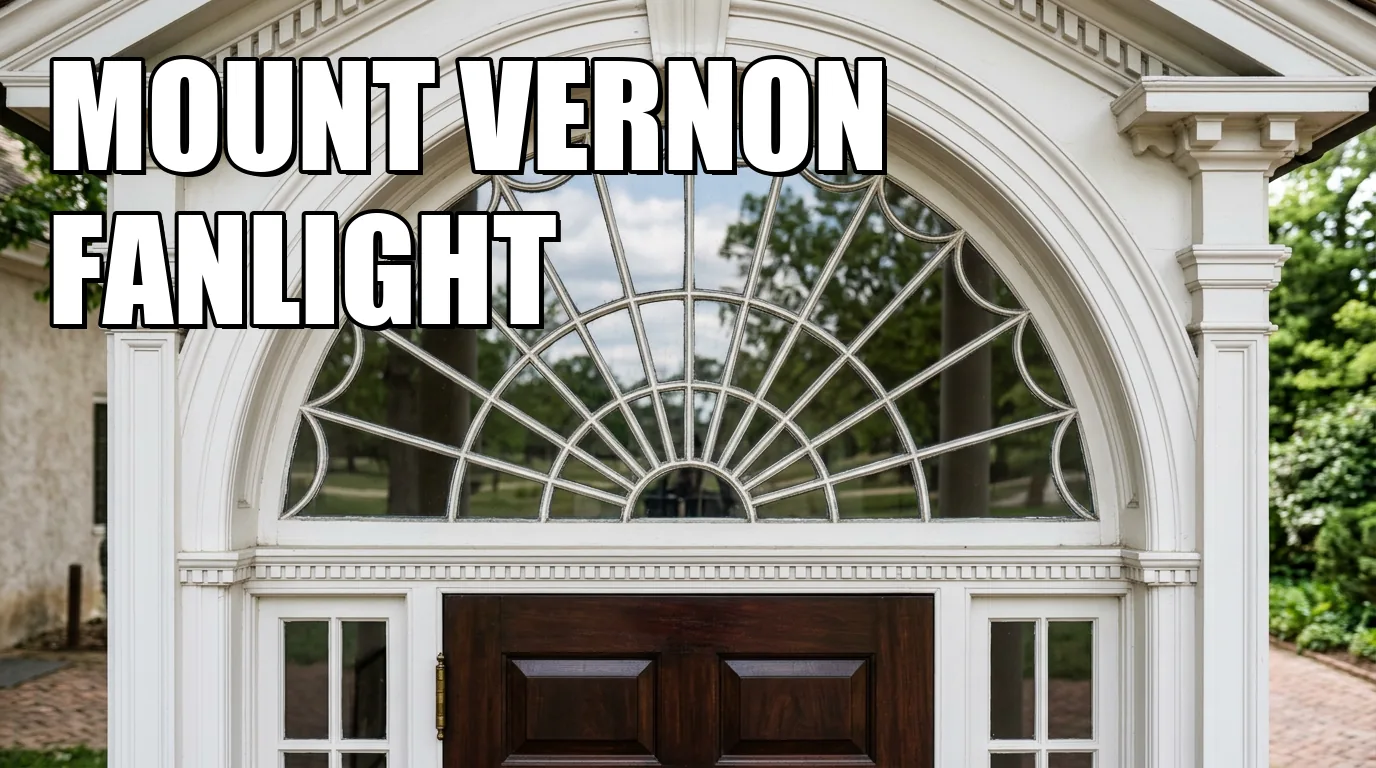
A fanlight is one of the fastest architectural details to recognize once you stop treating it as vague historic charm and start reading it as part of an entrance system. On an American historic house, the feature usually appears directly above the front door as a semicircular or elliptical glazed opening, often divided by muntins that radiate outward like ribs. If it is paired with sidelights and classical trim on an otherwise balanced facade, you are usually looking at a Federal-period doorway or a closely related early American composition.
If you only remember four checks, make them these: over-door placement, a curved top, spoke-like glazing bars, and a full entrance composition that may include sidelights, pilasters, or small columns. That is a much safer test than simply calling any pretty arched window a fanlight.
1780s-1840s the safest national Federal window supported across the official source pack
4 high-value curbside checks: over-door placement, curved top, radiating glazing, and paired entry elements
3 anchor examples worth remembering first: Hamilton Grange, the Octagon House, and the Thomas Perkins House
What a Fanlight Actually Is
The defining point is location. A fanlight is not just a curved window somewhere on the facade. It sits above an entrance door, where it helps light the passage behind it and gives the doorway a more formal, finished shape. In American historic-house reading, the feature is most tightly associated with the Federal style, which liked smooth brick or clapboard walls, disciplined symmetry, and a relatively restrained exterior. The doorway became the one place where that restraint could loosen slightly.
That is why the feature matters so much. Federal houses often look controlled to the point of severity until you reach the entry. There the design suddenly becomes more expressive: curved glazing, leaded or delicately divided panes, sidelights beside the door, and classical framing that turns a flat wall into a ceremonial entrance.
The Fastest Way to Spot One From the Street
The safest sequence is to start at eye level with the door and then move upward. If the curved glazed opening is centered over the door rather than floating somewhere else on the building, you are already in the right zone. After that, check the shape, the muntin pattern, and the side elements.
| Look here first | What you want to see | Why it matters |
| Placement | The glazed feature sits directly above the main entrance door | This is the basic threshold test that separates a fanlight from unrelated curved windows elsewhere on the facade. |
| Top shape | A semicircular or gently elliptical opening | The fanlight reads as a curved cap to the doorway rather than a flat horizontal bar. |
| Glazing pattern | Small panes or muntins radiating outward from a center or lower axis | This is where the "fan" name becomes visually obvious. |
| Side elements | Sidelights, pilasters, or small classical columns around the door | Federal fanlights rarely feel isolated; they usually belong to a larger entrance composition. |
| Whole facade | Balanced massing and relatively restrained ornament elsewhere | The doorway often carries more decorative energy than the rest of the house. |
That last point is easy to underestimate. The fanlight usually reads strongest when the rest of the building is comparatively calm. On a heavily ornamented Victorian facade, the detail may get absorbed into the noise. On a Federal house, it stands out because the doorway is doing more of the visual work.
Why Federal Houses Concentrate the Drama at the Door
Federal architecture in the United States tends to prefer flat wall planes, orderly openings, and a measured classical tone rather than a sculptural temple front. That makes the entrance disproportionately important. If you want to make the house feel refined, urban, and expensive without coating the whole exterior in ornament, the doorway is where you do it.
That logic helps explain why fanlights are so memorable. They bring curvature into facades otherwise dominated by rectangles and straight lines. They also work well with sidelights, which stretch light vertically beside the door while the fanlight caps the composition above. Together, those pieces make the entry read as a designed ensemble rather than a single punched opening.
Good practical rule: if the curved opening is not above the door, or if the doorway lacks any larger compositional role, pause before calling it a fanlight. The feature is about placement as much as shape.
Fanlight, Sidelight, Transom, and Palladian Window Are Not the Same Thing
Readers confuse these terms because they all involve light and glazing around openings, but they do different jobs. A fanlight belongs to the top of an entrance and is defined by its curved form. A sidelight runs beside the door. A transom is a separate over-door opening, but it is usually flatter and more rectangular than a fanlight. A Palladian or Venetian window is not a door feature at all. It is a larger window composition built around a dominant central opening with flanking side lights or side windows.
| Feature | Where it sits | Fastest visual cue |
| Fanlight | Directly above the door | Curved top with a fan-like glazing pattern |
| Sidelight | Beside the door | Tall narrow glazed strip framing the entrance from the sides |
| Transom | Above the door | Usually flatter and more horizontal than a fanlight |
| Palladian window | In the wall as a full window composition | Larger center opening with flanking side lights or side windows, not an entry cap |
If you want the longer comparison for the last category, the clearest companion read on the site is Palladian Windows. The key distinction is simple: a fanlight crowns a doorway; a Palladian window organizes a wall opening.
What Real American Examples Teach You
Hamilton Grange is one of the most useful official examples because the entrance composition is explicit: fanlight above, sidelights at the sides, and a classical frame that makes the doorway feel formal before you notice anything else about the house. It is a clean teaching case for the full Federal entry package.
The Thomas Perkins House in Massachusetts helps because it confirms that the fanlight can be read even when the house is not a grand urban mansion. The official material points directly to the semi-circular fanlight and the Ionic half-columns at the entrance. That is exactly the kind of pairing readers should train themselves to notice.
The Octagon House is useful for a different reason. It shows how entrance emphasis becomes one of the easiest ways to read an early national building when the rest of the facade stays orderly. Once you know to look at the doorway first, these houses stop feeling visually closed off and become much more legible.
| Example | What it teaches best | Why it is useful in the field |
| Hamilton Grange, New York | Fanlight plus sidelights plus classical door framing | Excellent for understanding the full Federal entrance composition rather than one isolated detail. |
| Thomas Perkins House, Massachusetts | Semi-circular fanlight with Ionic half-columns | Shows the feature in a country-house setting and ties it clearly to doorway hierarchy. |
| The Octagon House, Washington, D.C. | How doorway emphasis operates on an otherwise balanced early American facade | Useful because the entry reads as the main decorative release point. |
What Readers Get Wrong Most Often
The first mistake is treating any arched or curved glazing as a fanlight. Shape alone is not enough. You need the over-door position and, ideally, some evidence that the feature belongs to a more formal entry design.
The second mistake is reading the feature in isolation from the house. Fanlights make the most sense when you notice the whole Federal setting around them: balanced openings, restrained walls, and a doorway carrying more of the decorative load.
The third mistake is forgetting that a good doorway can teach you almost the entire style. If the entrance is composed with a fanlight, sidelights, and classical trim on an otherwise disciplined facade, you are learning not just one ornament term but a broader early American design language.
Why the Fanlight Still Matters
Fanlights matter because they give readers a precise entry point into Federal architecture. They are visible, repeatable, and easy to test on real buildings once you know where to look. More important, they teach a good identification habit: do not start with atmosphere. Start with placement, shape, and composition. Historic houses become much easier to read when you do.