Gettysburg has more ghost lore per block than any town in America, which makes "which hotel is most haunted" the wrong question — every inn here claims something. The useful ranking is different: at which of them does the documented history do the haunting? By that test the town sorts cleanly. One inn still carries hundreds of bullet holes in its brick. One was the Confederate headquarters where the battle was set in motion. One belonged to a fifteen-year-old girl who wrote the best civilian memoir of the battle. And the hotel with "1863" in its name didn't exist in 1863.
Booking logic: all five properties below take overnight guests except the Dobbin House, which is dining only. Halloween season books out first — the town leans hard into it — and the properties trading directly on their hauntings (Farnsworth, Cashtown) sell out their signature rooms far ahead. If the point is the battle rather than the brand, the documentary tier at the top of this list is where to spend the night.
The ranking, by weight of evidence
| Property | What's documented | What's lore |
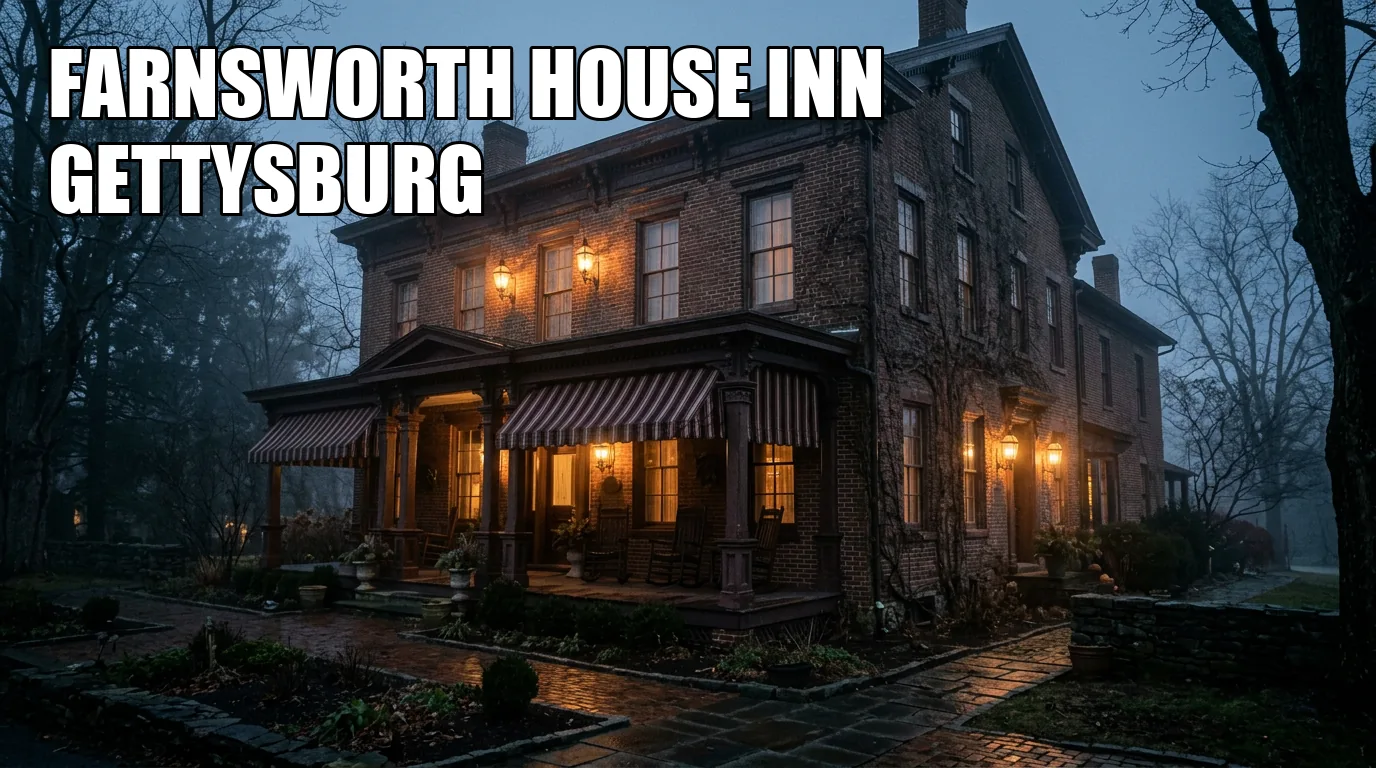
| Farnsworth House Inn | Hundreds of bullet holes in the brick; Confederate sharpshooters fired from the garret | Sniper spirits, cellar apparitions; the claim the fatal Jennie Wade bullet came from here |
| Cashtown Inn | Inn since 1815 in a c. 1797 building; headquarters for Gen. A.P. Hill as the battle opened | Confederate apparitions in guest photos |
| Tillie Pierce House Inn | 1858 home of the girl whose published memoir is a key civilian account | The Blue Room's soldiers, a shadow man on the stairs |
| Gettysburg Hotel | Lincoln Square institution; hospital use after the battle | Rachel the nurse, a lone dancer in the ballroom, a man in the old bank vault |
| 1863 Inn of Gettysburg | A modern hotel on historically contested ground — the building saw no battle | George, a prankster ghost of a hotel handyman, on the fifth floor |
Farnsworth House: The Walls Are the Document
The Farnsworth House on Baltimore Street needs no ghost story to unsettle you — its brick walls carry hundreds of bullet scars from July 1863, when Confederate sharpshooters worked from the garret, firing on Union positions toward Cemetery Hill. Local tradition adds that the stray round which killed Jennie Wade, the battle's only civilian death, came from this nest; that attribution is legend rather than forensics, but the sharpshooters themselves are fact, and you can stand in their attic. The inn runs guided ghost walks that open the attic and stone cellar to visitors, operates a period fine-dining room and tavern with a beer garden, and rents rooms upstairs for guests who want the house after the tours leave. Of every "haunted" building in town, this is the one where the physical evidence outruns the folklore.
Cashtown Inn: Where the Battle Was Set in Motion
Eight miles west on the old turnpike, the Cashtown Inn — a c. 1797 building that has taken in travelers as an inn since 1815 — earned its history before the first shot: it served as headquarters for Confederate General A.P. Hill, whose order sending Henry Heth's division into Gettysburg, famously in search of shoes and supplies, collided with Union cavalry and opened the battle. General John Imboden operated from here as well. The ghost layer — Confederate figures appearing in guests' photographs, unexplained lights — is standard fare; the headquarters provenance is not. Today it runs as a bed and breakfast with a fine-dining restaurant, with rooms in the $145–160 range and suites around $185–200. Note what it doesn't have: none of the town's walking ghost tours come out this far, which is exactly why light sleepers who want the history without Baltimore Street's nightly lantern crowds should consider it.
Tillie Pierce House: Sleep in a Primary Source
The Tillie Pierce House Inn at 301 Baltimore Street is the sleeper pick, in both senses. Matilda "Tillie" Pierce was fifteen when the armies arrived; evacuated to a farm south of town, she spent the battle carrying water to wounded Union soldiers, came home to a street littered with the dead, and later published a memoir of it — one of the most-cited civilian accounts of Gettysburg. The 1858 house she lived in operates as a period-furnished inn. Its lore is vivid — soldiers in the Blue Room, children heard playing in the halls, a caped shadow figure on the staircase, a tour manager's recording of a voice saying "Mama" — but the reason to book is simpler: you are sleeping inside the setting of a book you can read on the porch.
Gettysburg Hotel: The Full-Service Compromise
The Gettysburg Hotel on Lincoln Square is what happens when a battle-scarred institution grows into a 119-room conference hotel: rooftop pool, business center, rates from about $126, and a pub — McLellan's Tavern — whose bar was shipped over from England and whose ghost is said to reside in the old bank vault. The building's hospital service after the battle anchors its spectral roster: Rachel, a nurse who reportedly tidies guests' belongings, and a lone woman waltzing in the ballroom. It is the right base for travelers who want comfort, walkability — the David Wills House, where Lincoln finished the Gettysburg Address, is across the street — and a ghost story held at arm's length.
The 1863 Inn: Read the Fine Print on the Name
The 1863 Inn of Gettysburg, at 516 Baltimore Street, is the town's best lesson in reading hotel names skeptically: the five-story colonial-style building is modern and stood nowhere near the battle it is named for. The ground it occupies was contested — and it neighbors the Jennie Wade House museum — but its resident ghost isn't a soldier at all: George, remembered as a hotel handyman, gets blamed for fifth-floor pranks like moved belongings, flickering televisions and locked-out guests. As a 110-room hotel adjacent to the bus tour center, it is a serviceable budget base. Just know what you're buying: location and lore, not fabric.
Dinner, Tours, and the Honest Itinerary
Two additions complete the trip. The Dobbin House Tavern — the Rev. Alexander Dobbin's colonial homestead — is dining rather than lodging, worth it for the building itself and its small exhibit on the house's role as an Underground Railroad stop. And the town's signature evening activity, the candlelit walking ghost tour, leaves from multiple operators along Baltimore Street; whichever you choose, it will walk you past half the buildings in this article. For a quieter night after the lanterns, the town's smaller historic B&Bs trade ghost branding for breakfast.
The honest verdict on Gettysburg's haunted hotels: the town's supernatural economy is real and cheerfully commercial, but its floor is higher than most, because the underlying history is not marketing. At the Farnsworth you can put your finger in a bullet hole. No ghost story improves on that.
The Cornerstone Brief
One historic place, once a week — what it is, why it matters, whether it's worth going. No filler, no paid placements.
Coming soon. Unsubscribe any time.