At a Glance 1903 Firehouse opening year
Hook & Ladder 8 Working station identity
Los Angeles Interior shoot city
- Hook & Ladder 8 supplied the one-bay New York exterior; Fire Station 23 supplied the much deeper Los Angeles interiors.
- The sidewalk facade is guaranteed. An open bay door is only a sightline into a working FDNY station, never a scheduled tour.
- Treat the stop as a short exterior reading of the film trick and the real emergency building behind it.
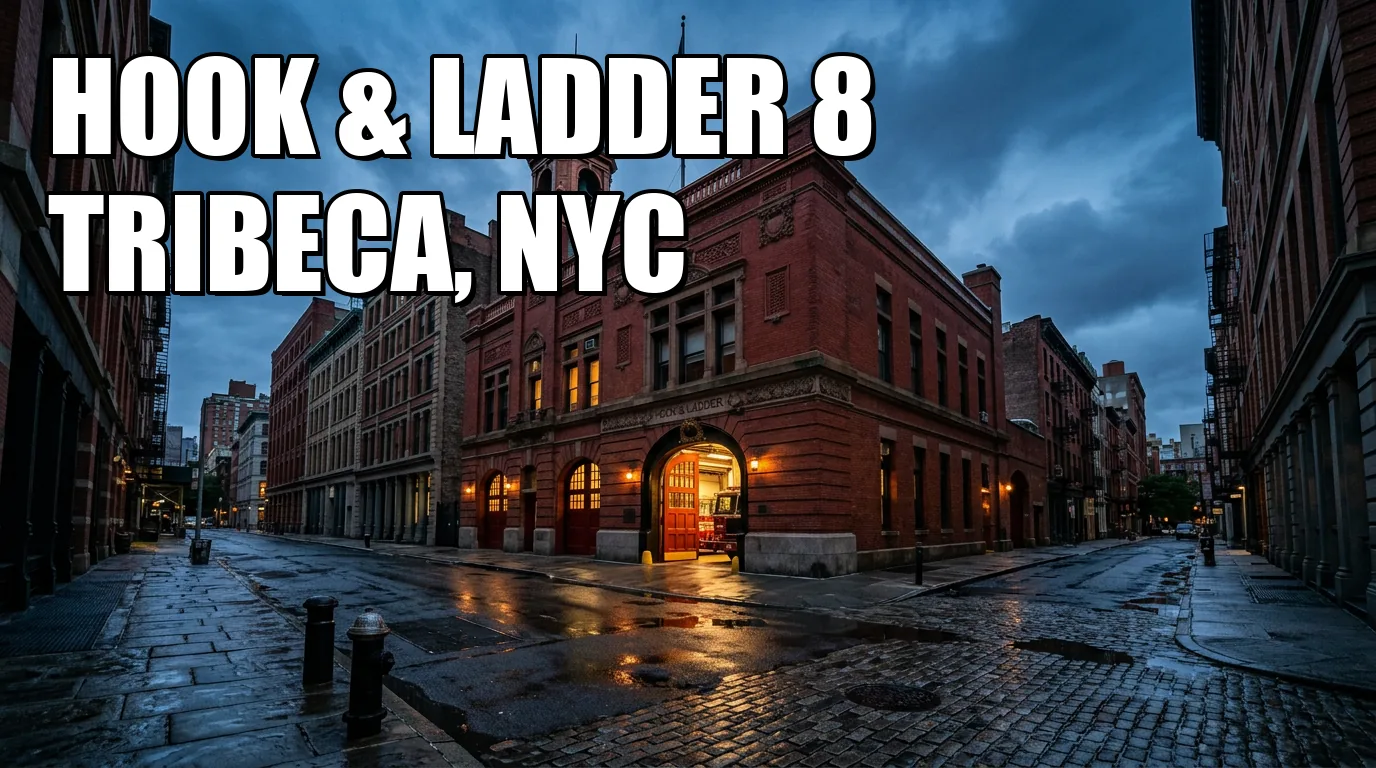
The Ghostbusters firehouse in New York does not contain the firehouse most viewers remember. Hook & Ladder Company 8 at 14 North Moore Street supplied the 1984 headquarters exterior. The familiar pole, upstairs rooms and working interiors were filmed across the country, principally at Los Angeles Fire Station 23. A visit to Tribeca therefore shows one half of a cinematic splice—and because Ladder 8 remains an active FDNY company, that half is an outside-only stop.
Plan for the visit you can actually have: there is no ticket, museum, public tour or visitor schedule. This is a five-to-fifteen-minute exterior stop unless the building itself is your main subject.
The movie headquarters is a cut between New York and Los Angeles
| What appears to be one building | Where the 1984 film made it | What that means for a visitor |
|---|
| Street approach, facade, bay entrance and exterior action | Hook & Ladder 8, 14 North Moore Street, Manhattan | This is the recognizable location you can photograph from the sidewalk. |
| Main working bay, fire pole, offices and upstairs quarters | Decommissioned Fire Station 23, 225 East Fifth Street, Los Angeles | These rooms were never a preserved attraction behind the Tribeca facade. |
Production-location research records three or four days at North Moore Street for the headquarters exteriors while the real company continued responding to alarms. Once the film moved west, Fire Station 23 doubled for the main headquarters interiors. It was a practical choice: the Los Angeles station had been decommissioned in 1960, while Ladder 8 was working city infrastructure that could not be surrendered to a film crew.
The cut also cheats the building’s size. Fire Station 23 is more than twice as long as the New York firehouse and has vehicle openings at both ends. Its four levels once held apparatus and horse stalls, dormitory and assembly spaces, and elaborate rooms for the fire chief. The film places that depth behind North Moore Street’s single arched bay. Even a friendly glimpse through an open door cannot reveal the movie interior because the remembered interior belongs to a different building.
What is reliably visible at 14 North Moore Street
The facade is the attraction. From the public sidewalk you can see the single vehicle bay, arched opening and restored historic front that gave the headquarters its compact silhouette. The best wide reading is from across North Moore Street near Varick Street—the open intersection also gave the 1984 crew room to frame exterior action and add effects.
Look down as well as up. Ladder 8’s company emblem, combining firefighting imagery with the Ghostbusters logo, is painted on the sidewalk. Near the entrance, a plaque memorializes Lieutenant Vincent G. Halloran, a Ladder 8 firefighter killed responding to the World Trade Center on September 11, 2001. The fandom is real, but so is the building’s first-responder history.
The movie sign and the ground-floor collection of fan patches and memorabilia are inside the garage. NYC Tourism describes them as things visitors may glimpse when the bay door is open, not as an exhibit with guaranteed access. A raised door changes the sightline, not the outside-only access rule.
The one-bay shape predates Ghostbusters
Alexander H. Stevens, then the FDNY’s superintendent of buildings, designed the three-story firehouse in 1903 as a double-company building. It originally had two vehicle bays. When New York widened Varick Street in 1914, the city removed 35 feet from the western side rather than relocate the company. The famous narrow facade is the surviving half of a larger municipal building, not a quirky shape invented for the film.
Nor was the station frozen after 1984. During a $6 million city renovation begun in 2016, the facade cornices were carefully removed and restored while the working interior was modernized. The useful continuity is the reduced 1914 street face, not an untouched movie set.
An open door is not a tour
NYC Tourism’s current attraction listing is unambiguous: this is a working firehouse and visitors are not allowed inside. A separate 2024 feature, produced after an FDNY invitation, shows why—the alarm sounded three times during the visit, and the crew moved from routine work to the rig within seconds. Do not knock, stand in the vehicle path or wait on the apron for a door to rise. There is no credible “best morning” that changes emergency operations; conversation with firefighters is a courtesy when time permits, not part of the destination.
Buy the Hook & Ladder 8 Ghostbusters House shirt through the official FDNY Shop; the firehouse does not operate a scheduled souvenir counter.
What makes five minutes here enough
Stand across North Moore Street and the trick becomes visible: the narrow 1914 facade is too small to contain the headquarters in your memory. In the same frame, the sidewalk logo supplies the fandom, Halloran’s plaque restores the civic cost, and the bay remains ready for a real ladder truck. Once those three layers register together, a short pavement stop does not feel like a failed museum visit. It is the complete location.
The Cornerstone Brief
One historic place, once a week — what it is, why it matters, whether it's worth going. No filler, no paid placements.
Coming soon. Unsubscribe any time.