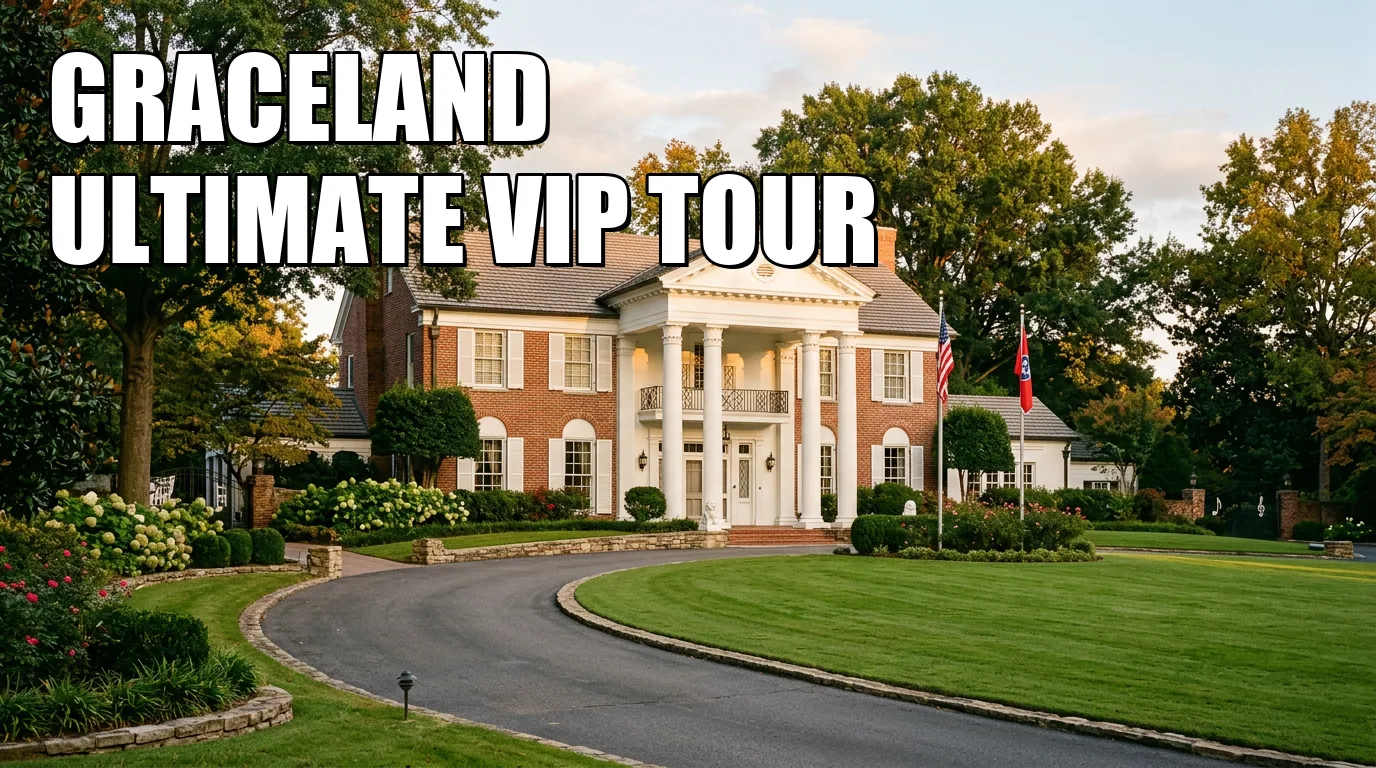
Graceland’s premium tour names an expert guide, a private exhibit and an artifact presentation. It does not name a secret bedroom, an additional mansion floor or a doorway unavailable to the standard house tour. That distinction is the useful answer hidden inside the “Ultimate VIP” label: the official product description upgrades interpretation, but it does not promise more interior historic fabric.
The boundary is not merely commercial. Federal documentation describes a house altered repeatedly from 1957 to 1977. Graceland’s FAQ explains why the second floor remains outside the tour: privacy, respect and the remodeling mass access would require. A premium badge does not erase those categories.
The official benefits stop short of extra mansion rooms
The current official ticket language distinguishes tour products by format. The Elvis Experience and Entourage VIP descriptions call the mansion portion self-guided. Ultimate VIP and Inside the Graceland Archives describe a mansion tour with an expert guide. The premium descriptions also name a private VIP exhibit, an “Elvis Artifact Show & Tell” and, for the archives tier, a question-and-answer session with Graceland archivists.
None of those descriptions states that the guest enters an additional room inside Graceland Mansion. That is not proof that every guide takes every step in an identical order. It is a narrower contract reading: extra mansion-room access is not one of the published benefits. “Show & Tell” also should not be rewritten as permission to handle collection objects. The official wording promises a presentation, not physical contact.
| Claim | What the official source establishes | What it does not establish |
|---|
| Ultimate VIP expands access | Expert-guided mansion interpretation, private exhibit and artifact presentation | Additional mansion rooms or the second floor |
| Archives tier goes behind the scenes | Expert guide, archivist Q&A and artifact show-and-tell | Object handling or entry into private residential rooms |
| The upstairs is “frozen in 1977” | Federal documentation says it is maintained as a private residence and is not open to the public | An untouched room arrangement or condition exactly as left in 1977 |
| The VIP route is identical to every other route | The ticket page names self-guided versus expert-guided formats and names no extra mansion rooms | A permanent, step-by-step route that never varies |
The house was designed for performance before Elvis arrived
Graceland did not begin as an Elvis display. The National Historic Landmark nomination describes a two-story Classical Revival residence built in 1939 by Ruth Brown Moore and her husband, Dr. Thomas D. Moore. The Memphis firm Furbringer and Ehrman designed it; the Graceland nomination renders the second name “Erhman.” The large rooms across the front could be opened together to seat as many as 500 people for a musical event, reflecting the family’s interest in showcasing the talent of their daughter, Ruth Marie.
The name reaches further back. A separate National Register nomination for the S.C. Toof Building traces the property through the Toof family. Ruth Brown Moore inherited part of the family farm from her Aunt Grace and called the house Graceland in her honor. Elvis made it internationally famous, but neither the house nor its name began with him.
Elvis changed the property in identifiable phases
The federal nomination records the Presley family purchasing the 13.8-acre property in March 1957 and moving in during April. It does not give the exact closing day used in many retellings, and the accepted sources do not establish the purchase price. Those details are unnecessary because the physical chronology is stronger.
A kidney-shaped swimming pool and cut-stone patio date to 1957. The Meditation Garden followed in 1964–1965 as a private retreat. In the mid-1960s, the original four-car garage was remodeled as an apartment, while a substantial rear den addition—fourteen by forty feet—created the space later known as the Jungle Room. A large south-side wing initially held a slot-car track and was later remodeled to display awards, becoming the Trophy Building.
The best-known interiors belong to another phase. In 1974, custom mirrors were added along the stair and across the east wall of the living room. Custom stained glass entered the main doorway and the opening toward the music room. The basement TV Room and fabric-covered Pool Room were remodeled that year. The Racquetball Building followed in 1975.
These dates show why “original Graceland” is an imprecise phrase. A visitor encounters a 1939 residence, 1957 landscape work, mid-1960s additions, 1970s interior alterations and later museum use. Premium interpretation can explain those layers more fully; it cannot make every visible surface original to one moment.
The upstairs boundary combines privacy and building fabric
The landmark nomination identifies the second-floor spaces without presenting them as exhibits: Presley’s bedroom in the southwest corner, a dressing room and bathroom in the northwest, Lisa Marie’s bedroom in the northeast and a southeast bedroom used as Presley’s private office. It says the floor is maintained as a private residence and is not open to the public.
That wording is more precise than the common claim that the rooms are “sealed” or preserved exactly as they were left in 1977. The accepted official sources do not make either assertion. The nomination records Elvis’s death at Graceland on August 16, 1977, but it does not connect the death to a particular bathroom. A room list and a property-level death statement should not be fused into a more dramatic scene.
Graceland’s FAQ gives two reasons for the closure. It says Priscilla and Lisa believed the upstairs should remain private and that public access would be disrespectful and inappropriate. It also describes an architectural problem: visitor volume would require another staircase for an exit and remodeling because the connecting hallway is too small for crowds. The FAQ says that work would radically alter the house.
The result is an unusually clear access rule. The closed floor is both a family boundary and a preservation decision about egress, circulation and historic fabric. The official FAQ says the upstairs is not included as part of the tour; the ticket page states no premium exception.
The 1982 opening created a new museum layer
Federal documentation says Graceland opened to the public in 1982. It does not supply the exact June day often repeated elsewhere, so the year is the publication-safe fact in this source set. Opening a residence to mass visitation required changes that belong to museum history rather than Elvis’s domestic period.
The National Historic Landmark nomination counts eighteen contributing resources and two noncontributing resources. The noncontributing pair—a shuttle-bus shelter and an employee support building—date to 1983 and were built to accommodate visitors. Elsewhere, a new plate-glass entrance was added to the Trophy Building for better visitor access, a former bathhouse became accessible public restrooms, the former garage apartment became exhibit space and the Racquetball Building became an additional display area for awards and stage costumes.
A house museum needs circulation, staff space, interpretation and accessible alternatives. The federal inventory separates changes within the 1957–1977 period of significance from work associated with operating the site after 1982.
“Private exhibit” is not the same as “private residence”
Tour language can make two different kinds of privacy sound interchangeable. A private VIP exhibit is a controlled museum presentation available through a product tier. The private second floor is residential fabric withheld from the tour. One is an interpretive benefit; the other is a physical and ethical boundary. Calling both “exclusive access” hides the difference.
The archives tier introduces a similar distinction. An archivist Q&A and artifact show-and-tell can add collection context. Neither phrase says that a guest enters the second floor, visits an unlisted mansion room or touches an object.
This is where the premium product can have real historical value. A guide can distinguish the Moore commission from Presley-era construction, point out which alterations date to 1974 and explain how a domestic racquetball court became exhibit space. That is deeper access to interpretation, not necessarily deeper access to the building.
Read every premium claim in two columns
The useful reader task is simple. Put each advertised benefit in one of two columns: interpretation and service, or named physical access. Expert guide, archivist Q&A, private exhibit and artifact presentation belong in the first column. A specific room, floor, building or part of the grounds would belong in the second—but only if the official description actually names it.
Then test the historic claim separately. Ask which layer produced the space: the 1939 Moore residence, a Presley-era alteration, the 1957–1977 contributing estate or a post-1982 museum adaptation. Finally, identify what remains unproved. “Maintained as a private residence” does not mean untouched. “Show & Tell” does not mean handling. “Expert guide” does not mean secret room.
Graceland’s Ultimate VIP product may offer a richer explanation of the house and closer presentation of selected artifacts. The official evidence does not sell it as a key to more mansion rooms. Its most defensible value lies on the interpretive side of the velvet rope.