Famous Residents

Hearst Castle Pools: Beyond the Gilded Surface

For anyone who has traversed California’s scenic Highway 1, the imposing silhouette of Hearst Castle, perched majestically atop La Cuesta Encantada – "The Enchanted Hill" – remains an indelible image. Yet, for all its architectural grandeur, it’s often the legendary swimming pools that capture the popular imagination, serving as vivid symbols of William Randolph Hearst’s boundless ambition and unparalleled taste. These aren't merely places to swim; they are monuments to an era, meticulously crafted artistic statements, and formidable engineering feats that continue to astound, even decades after their construction. What truly sets Hearst's aquatic fantasies apart from other grand estates isn't just their sheer size, but the almost pathological attention to detail and the relentless pursuit of perfection that drove their creation. You might look at a postcard and imagine tranquil, sun-drenched waters, but the reality of these pools, especially the Neptune, tells a far more complex story of a man whose vision outstripped conventional limitations. Forget the fleeting trends of contemporary design; these structures were meant to evoke classical antiquity, to stand as a personal pantheon reflecting Hearst's profound love for European art and architecture, all while serving as playgrounds for Hollywood's elite.

Neptune's Grand Stage: An Outdoor Epic in Vermont Marble

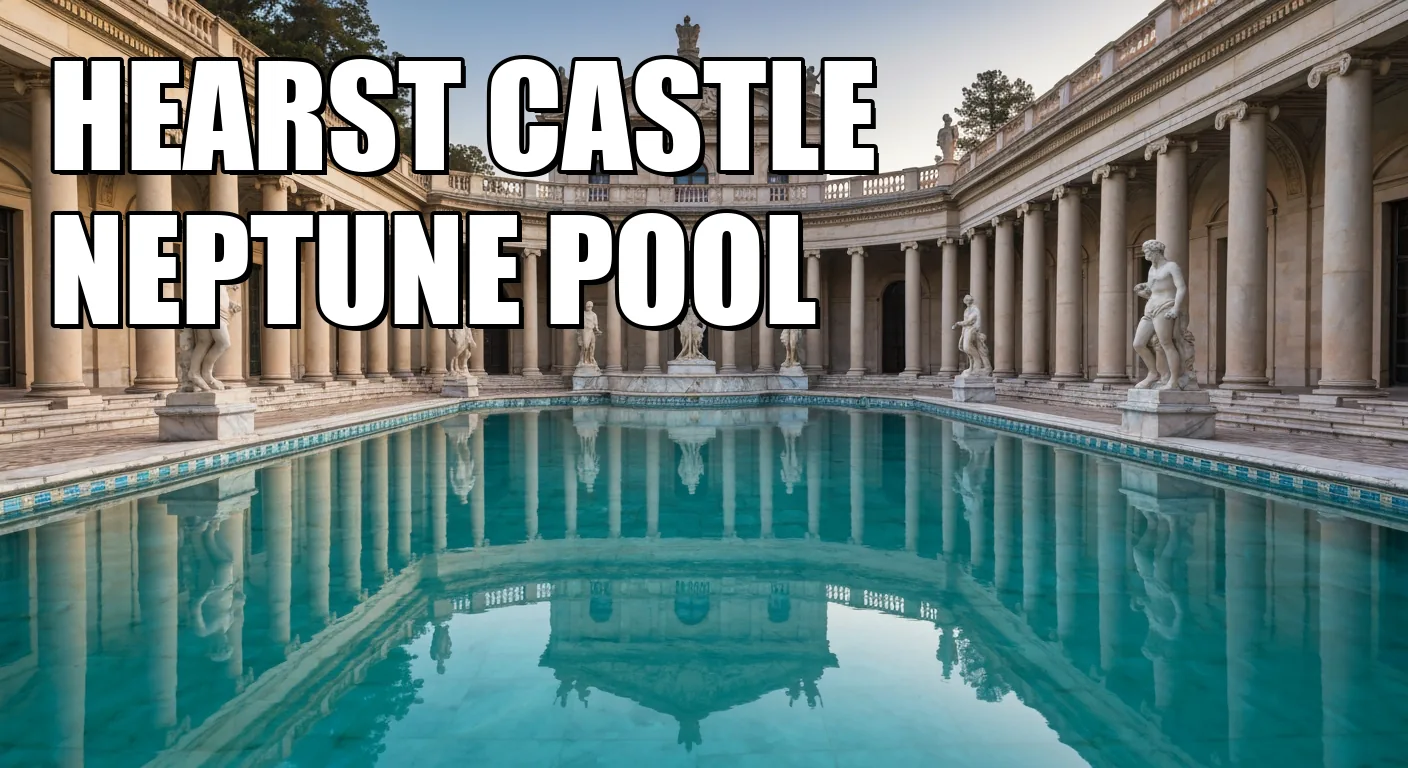
Arriving at the Neptune Pool, one is immediately struck by its colossal scale, a veritable Roman bathhouse transplanted to the California coast. This isn't just a pool; it's an entire aquatic complex, measuring an astounding 104 feet long by 58 feet wide, flaring out to 95 feet at its primary axis fountain-alcove section. The depths vary, from a comfortable 3.5 feet at the west end to a rather serious 10 feet at the main drains, ensuring ample space for both wading and more vigorous aquatic pursuits. Holding a staggering 345,000 gallons of water, it’s a small lake in itself, requiring Herculean efforts to fill and maintain even today. One surprising detail that typical visitors might overlook, lost amidst the splashing fountains and classical statuary, is the origin of the luminous lining. The Neptune Pool is famously adorned with light-veined Vermont marble, covering not just the flooring and side walls, but extending to the ornamental pools and colonnades that frame this outdoor masterpiece. Imagine the logistical nightmare of quarrying, transporting, and precisely installing thousands of square feet of this delicate stone across a continent, all in an era before modern infrastructure. The pool’s comprehensive restoration, completed in 2018, saw more than 9,000 square feet of this original marble painstakingly removed and replaced with new material sourced from the very same Vermont quarry, a testament to the commitment to historical authenticity and an eyebrow-raising cost that underscores the ongoing expense of preserving such grandeur. This outdoor spectacle wasn't built overnight, nor was it a singular design. The Neptune Pool began its life in 1924, but Hearst’s vision, ever-expanding and refining, led to three successive enlargements. After significant redesigns and rebuilds in 1926 and again in 1934, the final, iconic version we see today wasn't completed until 1936. This iterative process reveals a man unsatisfied with anything less than monumental perfection, a constant striving for the ideal that speaks volumes about his character and his collaboration with the pioneering architect Julia Morgan. Guests like the legendary silent film comedian Charlie Chaplin and the formidable actress Joan Crawford frequently cavorted in these waters, their laughter echoing off the marble, cementing the pool's place in Hollywood lore as a backdrop to the gilded age of celebrity.

A Roman Revelation: Diving into the Gilded Depths Indoors

Leaving the sun-drenched expanse of the Neptune Pool, the transition to the Roman Pool, an indoor aquatic chamber located beneath the main house, feels like stepping into a private, subterranean sanctuary. Measuring 81 feet long by 31 feet wide and 10 feet deep, with a shallower 4-foot alcove section, this pool, though smaller than its outdoor counterpart, holds a substantial 205,000 gallons of water. Yet, its true distinction lies not in its dimensions, but in the breathtaking artistry that envelops every surface. Unlike the natural stone of the Neptune Pool, the Roman Pool is a dazzling symphony of glass mosaics. Its walls, ceilings, and floors are entirely sheathed in one-inch square glass mosaic tiles, known as *smalti*. These aren't just any tiles; they are predominantly a deep, resonant cobalt blue, interwoven with clear glass tiles that contain fused gold leaf, creating patterns that shimmer with an otherworldly luminescence. We’re talking about an estimated 2.5 million individual tiles, many imbued with 22-24 karat gold, all imported from Italy. This wasn't merely decorative; it was an artistic statement inspired by the 5th Century Mausoleum of Galla Placidia in Ravenna, Italy, a choice that speaks to Hearst’s deep appreciation for Byzantine and early Christian art. Visual artist Camille Solon worked tirelessly with Julia Morgan to bring this intricate vision to life, crafting a space that feels both sacred and profoundly luxurious. Constructed between 1927 and 1934, the Roman Pool’s genesis coincided with the height of Hearst’s entertaining prowess. While its indoor nature made it perhaps a more intimate, year-round retreat, it still drew the same caliber of celebrity. Imagine the likes of Gary Cooper or Clark Gable, perhaps Cary Grant or Carole Lombard, relaxing amidst these shimmering, golden depths, far from the prying eyes of the public. This wasn't just a functional pool; it was an immersive art installation, a private grotto where the world's most famous faces could momentarily escape and indulge in unparalleled opulence.

The Price of Perfection: What Visitors Seldom Realize

Having walked the polished paths and gazed into these magnificent pools countless times, one insight that rarely makes it into the glossy brochures is the sheer, ongoing burden of maintenance. These aren't static museum pieces; they are complex aquatic systems requiring constant care, especially given their age and the specific materials used. The 2018 Neptune Pool restoration, for instance, wasn't just an aesthetic facelift; it was a crucial structural repair necessary after years of seismic activity and the demands of a high-capacity water feature. The cost of such endeavors, not to mention the daily operation, temperature regulation, and meticulous cleaning, is astronomical, highlighting that the true legacy of Hearst Castle is not merely its construction, but its sustainable preservation. Another aspect often overlooked by first-time visitors is the nature of the experience itself. You might arrive expecting to dip a toe, to feel the legendary waters. The blunt reality? Swimming in either pool is strictly forbidden for general visitors. This can be a genuine disappointment for some, especially those who dream of recreating a classic Hollywood moment. While this restriction is a necessary measure for preservation and safety, it underscores a fundamental difference between expectation and reality: you are an observer, not a participant, in Hearst's gilded fantasy. Knowing this beforehand can temper expectations and allow you to appreciate the pools as architectural and artistic marvels, rather than as recreational facilities.

Experiencing Xanadu: Navigating the Reality of a Gilded Age Fantasy

Planning a visit to Hearst Castle, especially if your primary interest lies in these aquatic spectacles, demands a bit of strategic thinking. While the grounds are breathtaking year-round, timing is everything. The most comfortable months, both for enjoying the outdoor vista and avoiding the notorious summer crowds, are typically April-May and September-October. Arriving first thing in the morning, ideally on a weekday, will significantly reduce your encounter with the masses that descend upon the castle, allowing for a more serene appreciation of the pools’ grandeur. Tickets, which vary in price depending on the specific tour chosen, are required and should be booked well in advance, particularly during peak season or for specific tour times. Parking also carries a separate fee, a detail often overlooked in the excitement of planning. What conventional guides might not emphasize enough is the intellectual journey offered by these pools. They are not simply beautiful; they are windows into the mind of a singular figure, William Randolph Hearst, and the extraordinary talent of Julia Morgan. To truly appreciate them, one must look beyond the spectacle and consider the *why*. Why Vermont marble for Neptune? Because it evoked the classical, and Hearst demanded authenticity regardless of cost or logistical complexity. Why gold *smalti* for the Roman Pool? Because it replicated the awe-inspiring mosaic work of Ravenna, transforming an underground chamber into a shimmering, sacred space. These choices weren't arbitrary; they were deliberate, deeply personal expressions of an aesthetic philosophy, making them far more than just luxurious amenities. Ultimately, Hearst Castle, and particularly its magnificent pools, challenges the notion of a "tourist trap." While it undeniably draws massive crowds and has a well-oiled tour operation, dismissing it as merely that would be a profound disservice. It is a testament to human ambition, artistic collaboration, and an unwavering commitment to beauty and history. These pools, born from one man's almost limitless resources and an architect's brilliant execution, offer a rare glimpse into a bygone era of unparalleled opulence. They are a vivid reminder that sometimes, the greatest treasures are not just seen, but deeply felt, resonating with the echoes of Hollywood legends and the dreams of a publishing magnate who dared to build his own ancient world on a remote California hill.

Discovering Hearst Castle: Essential Guide for Visitors

What is the story behind Hearst Castle?
William Randolph Hearst, a newspaper publishing magnate, began construction of an opulent hilltop estate called "La Cuesta Encantada" (Enchanted Hill) in 1919 with architect Julia Morgan, creating a complex of 165 rooms and 123 acres of gardens, pools, and terraces that remained unfinished when he left in 1947. The Hearst family donated the castle and its contents to the State of California in 1958, and it now operates as the Hearst San Simeon State Historical Monument, attracting approximately 750,000 visitors annually.
What is the history of Hearst Castle?
Hearst Castle's history begins in 1865 when George Hearst purchased 40,000 acres of ranchland; his son William Randolph inherited thousands of additional acres after his mother's death in 1919 and began construction with Julia Morgan that continued until 1947. The estate eventually encompassed 250,000 acres with a legendary art collection featuring Egyptian, Greek, Roman antiquities, Old Master European paintings, and approximately thirty historic carved ceilings from Renaissance Italy and Spain.
Who owns Hearst Castle now?
Hearst Castle is owned and operated by the State of California as the Hearst San Simeon State Historical Monument, though the Hearst family retains ownership of the majority of the surrounding 82,000-acre estate. Under a 2005 land conservation agreement, the family works with California State Parks Department and American Land Conservancy to preserve the undeveloped character of the area.
Is the Hearst family still rich?
Yes, the Hearst family remains extremely wealthy, with more than 50 heirs sharing a combined fortune of approximately $22.4 billion as of 2025. The family's wealth comes from the Hearst Corporation, which operates media properties including 24 daily and 52 weekly newspapers across the United States, 250 international magazines, and 35 television stations.
How did the Hearst family make their money?
The Hearst family's fortune was originally earned in the mining industry during the late 19th century when George Hearst became a successful prospector and businessman. William Randolph Hearst expanded and transformed the family wealth into a massive media empire by building the Hearst Corporation into a publishing and entertainment conglomerate.
What was filmed at Hearst Castle?
Notable films shot at Hearst Castle include "Spartacus" (1960) and newsreel scenes from "Citizen Kane"; numerous television shows have also been filmed there including segments from programs like "California's Gold," "Jack Hanna's Into the Wild," and various documentaries. The iconic Neptune Pool and other features of the estate have been featured in multiple Hollywood productions and documentaries.
What is the oldest thing in Hearst Castle?
The oldest works of art at Hearst Castle are four sculptures of the goddess Sekhmet, carved from diorite (dark granite) dating from the New Kingdom of Egypt, approximately 1550-1070 BCE. These ancient Egyptian statues are among the most prized pieces in Hearst's extensive art collection.
What are the current tour prices for 2025?
Standard tour prices are $35 for adults and $18 for children ages 5-12 (under 5 are free), with specialized tours like the Designing the Dream Tour at $40 for adults and the Julia Morgan Tour at $110 per person. All daytime tour tickets include admission to the Hearst Castle Theater film "Hearst Castle – Building the Dream."
What tour options are available at Hearst Castle?
Seven different tour options include the Grand Rooms Tour, Accessibly Designed Grand Rooms Tour, Upstairs Suites Tour, Cottages & Kitchen Tour, Designing the Dream Tour, Julia Morgan Tour, and Art Under the Moonlight Tour. Each tour is approximately 70 minutes and must be reserved in advance, with tours departing from the Visitor Center via a 5-mile scenic bus ride.
Where is Hearst Castle located and what are the hours?
Hearst Castle is located at 750 Hearst Castle Road in San Simeon, California, approximately halfway between San Francisco and Los Angeles on Highway 1. The castle is open daily starting at 9:00 AM, with the last tour departure typically in late afternoon; reservations are recommended up to 60 days in advance.
How far is Hearst Castle from major cities?
Hearst Castle is approximately 6 hours driving time from both San Francisco and Los Angeles, about 3.5 hours from Carmel, and just 7 miles north of the coastal town of Cambria. The nearest town for lodging and dining options is Cambria, located approximately 7 miles south.
What are the parking and admission requirements?
Parking is free at the Visitor Center, and there is no admission charge to visit the center, view the museum exhibition, or access the outdoor viewing area. Tour tickets are required to visit the Castle itself, and advanced reservations are strongly recommended.
Is photography allowed at Hearst Castle?
Personal photography is permitted inside and outside the buildings, but flash photography is only allowed outdoors. Tripods are not permitted, though monopods may be used; commercial photography and filming require a film permit and prior approval from the Museum Director.
What is the best time to visit Hearst Castle?
Late spring and early fall offer the most pleasant weather and fewer crowds, though summer has fantastic weather with the tradeoff of busier crowds during holidays. Spring and fall evenings are ideal for the special Art Under the Moonlight tour, while winter months have fewer visitors but may include rainy weather.
Is Hearst Castle wheelchair accessible?
Yes, three tours at Hearst Castle are wheelchair accessible, including the Accessibly Designed Grand Rooms Tour; wheelchairs up to 28 inches wide can be accommodated, and additional wheelchairs are available at no charge for special needs visitors. The bus transportation from the Visitor Center includes seating for two wheelchairs, and assistance is available for visually and hearing-impaired visitors.
Who was the architect of Hearst Castle?
Julia Morgan, the first licensed female architect in California, designed Hearst Castle over approximately 28 years in collaboration with William Randolph Hearst. Morgan created the iconic castle complex including the famous Neptune and Roman pools, demonstrating her mastery of residential architecture and historic preservation.