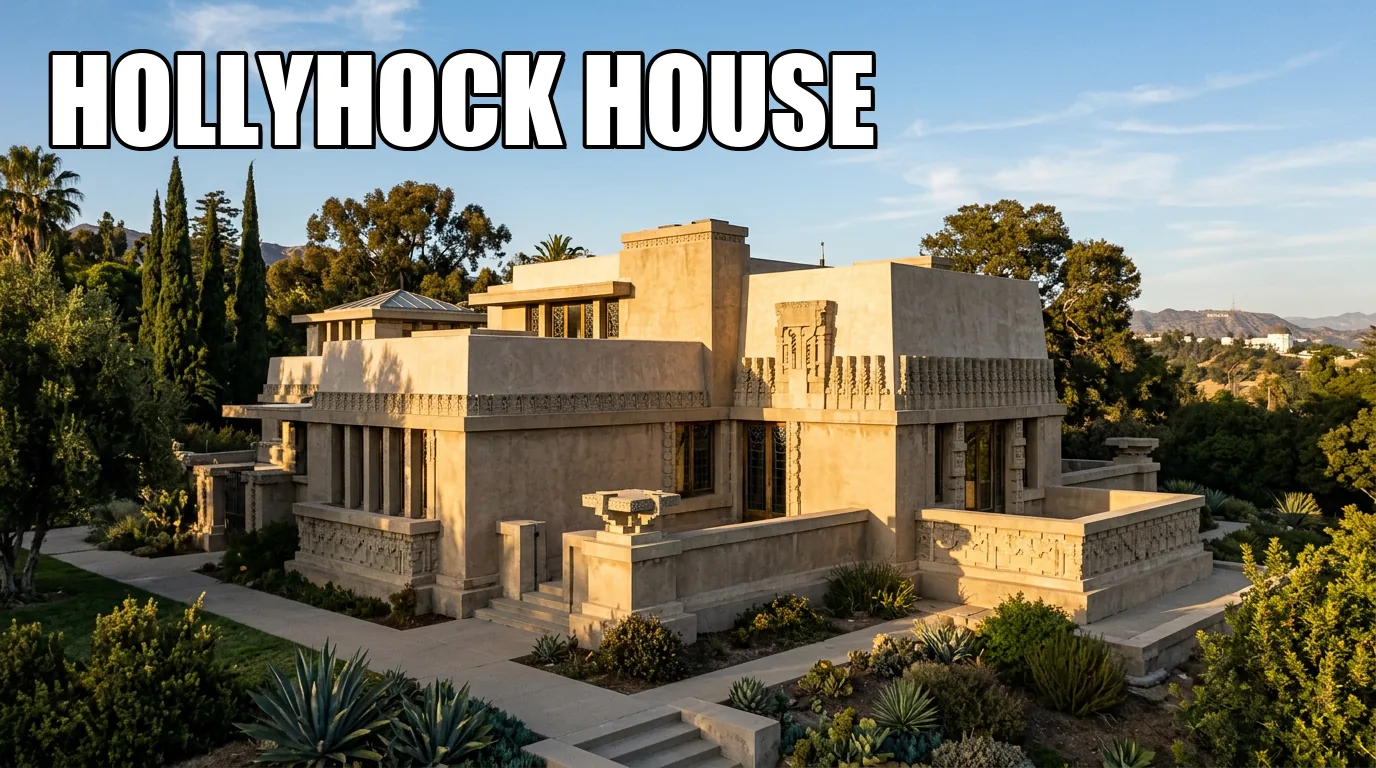
Stepping onto Olive Hill, the sprawling Los Angeles property where Frank Lloyd Wright’s Hollyhock House presides, you feel a distinct sense of arrival—and perhaps a touch of unease. This isn't your typical stately historic home, polished and placid. No, this building pulsates with a history as vibrant and contentious as its original occupants. It's a structure that simultaneously whispers tales of visionary design and shouts about the practical headaches of living inside an architectural statement. Having trekked across countless historic American sites, I can tell you few encapsulate the messy genius of their creators quite like this one.
The story of Hollyhock House begins not with an architect, but with a fiercely independent heiress and arts patron, Aline Barnsdall. She envisioned an arts complex on her newly acquired 36-acre property in 1919, a progressive hub for theatre and art that would challenge Los Angeles’s nascent cultural scene. Barnsdall hired Wright, then riding a wave of fame (and notoriety), to bring this ambitious dream to life. What unfolded, however, was a tumultuous partnership that saw the project’s initial budget of $50,000 balloon to an astronomical $150,000 by its 1921 completion, ending with Wright’s very public firing.
The Olive Hill Anomaly: A Client’s Grand Vision, an Architect’s Folly?
How does a simple request for a residence escalate into such a monumental financial and personal battle? Part of it lies in the sheer scale of Barnsdall's ambition, which perfectly mirrored Wright’s own boundless ego. He wasn't just designing a house; he was crafting a statement, a proto-California Modernist manifesto that pushed structural and aesthetic boundaries. His grand plans for Olive Hill, however, often collided with Barnsdall's practical needs and the inconvenient realities of construction, particularly given Wright's penchant for designing from a distance while preoccupied with his Imperial Hotel project in Tokyo.
Barnsdall, a woman who championed the avant-garde, found herself increasingly frustrated with the architect's frequent absences and the spiraling costs. The initial collaborative spirit withered under the weight of unforeseen expenses and design choices that, while artistically brilliant, proved functionally challenging. This friction, though a constant thorn in Barnsdall's side, ultimately imbues Hollyhock House with a palpable tension, making it far more interesting than a perfectly executed commission. It stands as a testament to the fact that even masterpieces can be born from conflict and compromise.
Decoding Wright's "Hollyhock": More Than Just a Flower
Walk through the house, and you can’t help but notice the repeating, almost abstract, motif of the hollyhock flower. Wright didn't just sprinkle this element throughout; he embedded it into the very DNA of the structure. You'll spot stylized representations carved into the colonnade capitals, cast into the frieze along the second-floor façade, and even rendered in intricate art glass. This wasn't merely decorative whimsy; it was integral to Wright's philosophy of "total design." He believed architecture, furniture, textiles, and even small objects should coalesce into a single, harmonious environment, with the hollyhock serving as a unifying visual anchor.
The ubiquity of the motif underscores Wright’s incredible attention to detail, a signature of his genius. He crafted 130 art glass windows for the house, and around 100 originals still survive. These aren't just pretty panes; they're among his final complete art glass commissions for a private residence, a fact often overlooked. His later Los Angeles projects, like the Ennis House, featured simpler plate glass, making Hollyhock's intricate windows a precious glimpse into a distinct period of his artistic evolution. It’s a quiet detail that reveals a lot about the architect’s changing priorities and the increasing scale of his ambitions.
Inside the Theatrical Core: Living with Fire and Water (and Compromise)
Nowhere is Wright's theatrical flair more evident than in the living room. Your eyes are immediately drawn to the monumental fireplace, a beast of seventeen individual cast concrete blocks. Its elaborate bas-relief sculpture, an abstraction of the hollyhock motif, is considered one of Wright's most significant two-dimensional artworks. But the true genius—and tragic flaw—lies beneath. Wright initially designed an innovative system where water would run through the house via an underground system, surfacing in the living room to create a moat around the hearth.
Imagine the sensory experience: the warmth of the fire, the subtle gurgle of water surrounding it. It was a bold experiment in integrating all four classical elements—fire, earth, air, and water—into domestic space. Yet, like many of Wright’s more ambitious engineering feats, this fireplace pool simply didn't function. It leaked persistently, forcing its disconnection shortly after completion. This failed experiment, however, provides a crucial insight: it directly anticipates Wright's later, highly successful integration of water into his masterpiece, Fallingwater, built in 1935. Hollyhock House, in a way, was his ambitious, leaky dress rehearsal.
The Dining Room’s Subtle Brilliance: Where Form Meets Function (Sometimes)
Move into the dining room, and you’ll encounter another masterclass in Wright’s unified design. Here, high-backed dining chairs feature an abstraction of the hollyhock that eerily resembles vertebrae, echoing the body of the seated person. These unique pieces, along with the hexagonal table, were locally crafted from tropical hardwood by Barker Bros., a prominent Los Angeles manufacturer. The design doesn’t just look striking; it’s meant to create an intimate, almost cocoon-like dining experience, a deliberate contrast to the openness of the living room.
The art glass windows in the dining room are strategically positioned low on the walls. Why? So that seated diners could appreciate the garden views without having to crane their necks. It’s a subtle but brilliant touch of human-centered design, a practical consideration often overshadowed by the house's more dramatic elements. While clearly influenced by Wright’s earlier Prairie style, the room’s warm wood surfaces and hipped ceiling adapt beautifully to California’s climate and indoor-outdoor living ethos, demonstrating his evolving architectural language.
Barnsdall’s Unvarnished Reality: Living in a Leaking Masterpiece
For all its architectural grandeur, living in Hollyhock House proved to be a profoundly frustrating experience for Aline Barnsdall. She occupied the main residence for barely a year, sharing it with her four-year-old daughter, Betty, servants, and a staggering 12 dogs. The irony is not lost: a house designed for an arts patron became, in many ways, an unlivable piece of art itself. Barnsdall constantly battled leaks and flooding, necessitating multiple replacements of the living room carpet. "I need three men and two boys to help me get in and out of my own house!" she famously quipped about the notoriously heavy front doors.
She rarely slept in her elaborate bedroom, preferring other spaces, and often opted to eat outdoors rather than in the carefully designed dining room. Perhaps the most telling incident involved Japanese screens Wright had sold her for $120. When she discovered they were worth only a fraction of that, she accused him of swindling her. Wright, never one to back down, had a sheriff serve her with a summons, search the house, and repossess the screens. Barnsdall, ever the strong character, posted a $100,000 bond to retrieve them. Yet, despite these bitter conflicts, and her ultimate gift of the house to the city of Los Angeles, Barnsdall and Wright remained friends until her death in 1946, a surprising testament to their complex, enduring relationship.
Planning Your Visit: Navigating Olive Hill’s Enduring Legacy
So, is Hollyhock House worth the visit despite its tempestuous history and practical quirks? Absolutely. It’s a UNESCO World Heritage site for a reason, offering unparalleled insight into Frank Lloyd Wright’s transitional period and the birth of a distinctly Californian modernism. To ensure a smooth experience, remember that Hollyhock House currently offers self-guided tours Thursday through Saturday, from 11:00 AM to 4:00 PM. Your best bet is to purchase tickets in advance through hollyhockhouse.org, as capacity is limited and walk-ins are often turned away.
Expect to spend about an hour exploring the main residence and surrounding grounds. While it’s a self-guided experience, knowledgeable docents are usually on hand to answer questions and provide context that even the most comprehensive guidebooks miss. Last admission is typically at 3:30 PM, so don’t cut it too close. Ticket prices are quite reasonable: $12 for adults, $6 for seniors (62+) and students (18+ with valid ID), and youth under 18 enter free with a paying adult. Arriving earlier in the day on a Thursday or Friday might offer a slightly less crowded experience, allowing for more contemplative viewing of this challenging, brilliant, and utterly human architectural marvel.