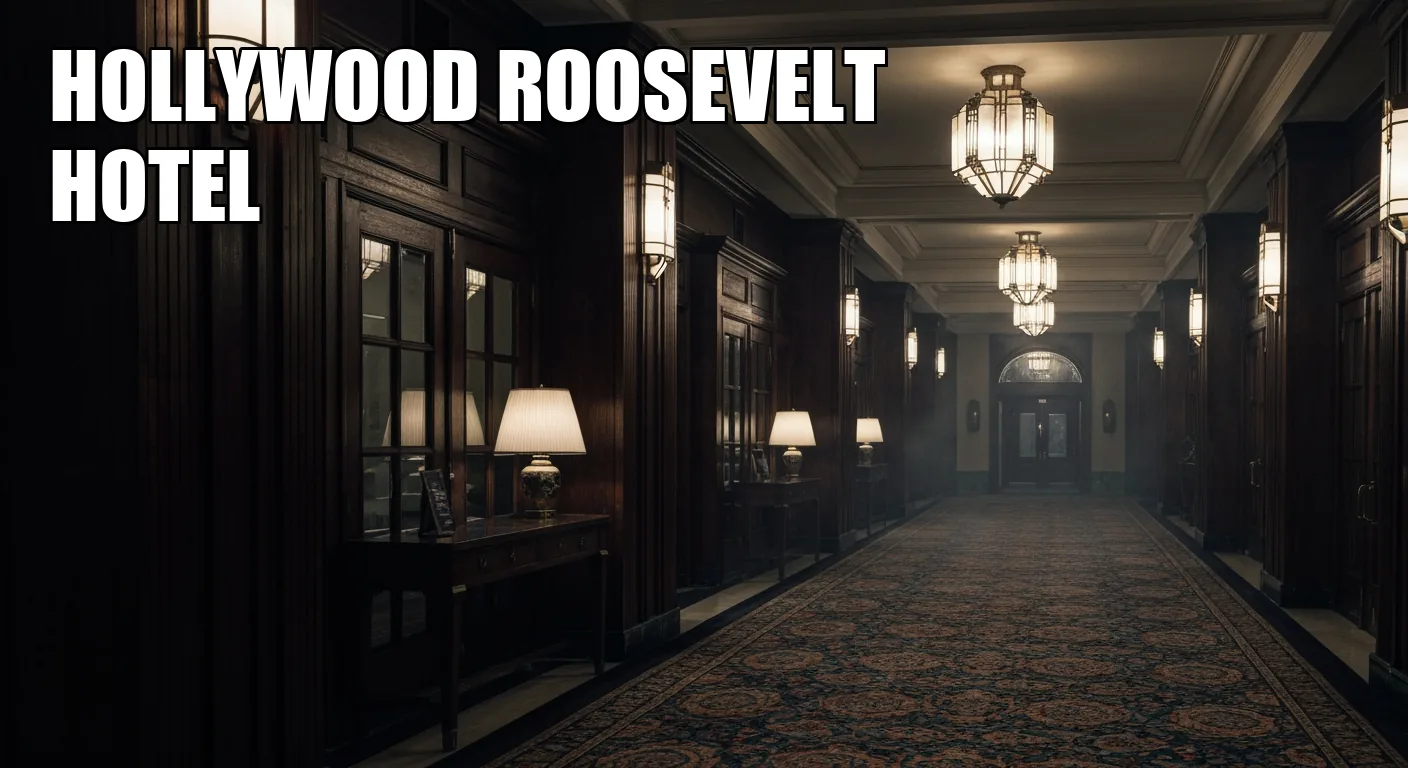
The Hollywood Roosevelt is the rare haunted hotel where the most famous artifacts are in the public areas — no room key required. The mirror associated with Marilyn Monroe hangs in an alcove off the lobby. The ballroom where the first Academy Awards were handed out in fifteen flat minutes is an event space you can walk through. The pool with the painted bottom sells day passes. Even the hotel's most storied haunted room, Montgomery Clift's 928, is a standard request away. For a building that has hosted Hollywood's entire supernatural A-list, the Roosevelt is strangely, wonderfully accessible — if you know which parts are open and which stories hold up.
The access map: lobby and Monroe's mirror — free, walk in. Tropicana Pool with the David Hockney-painted bottom — day passes from $56, loungers from $90, 21-and-over for pass holders, 8 a.m. to 8 p.m. Blossom Ballroom — events permitting. Room 928 and the second-floor pool cabanas — book like any room, ask by name.
The Fifteen-Minute Ceremony That Named an Era
The hotel opened on May 15, 1927 — backed by a syndicate that included Sid Grauman and Joseph Schenck, designed by Fisher, Lake & Traver as a twelve-story Spanish Colonial Revival tower with wrought-iron balconies and Churrigueresque ornament. Two years and a day later, on May 16, 1929, its Blossom Ballroom hosted the first Academy Awards: a private dinner for 270 guests, five dollars a ticket, hosted by Academy president Douglas Fairbanks, with the entire ceremony over in about fifteen minutes. Every bloated telecast since has been an act of penance for that efficiency. The ballroom is still there, and its ghost-lore — flickering lights, the sensation of invisible hands — has the good taste to stay in the room where the industry's ego was born.
Room 928: Three Months of Montgomery Clift
Clift lived in Room 928 for three months in 1953 while filming From Here to Eternity. The reports that attached to the room afterward are unusually specific to that tenancy: phantom trumpet practice, a presence pacing the hallway, the feeling of being watched, cold spots. Whether one credits any of it, the room's lore is at least biographical rather than generic — it describes the actual habits of the actual occupant, which is more than most haunted rooms can say. It books as an ordinary room; ask for 928 by number.
Marilyn's Mirror, Now on Public View
Monroe lived at the Roosevelt for two years early in her career, in a second-floor cabana overlooking the pool. The full-length mirror associated with her — long tied to Suite 1200 — was moved during a 1980s renovation to an alcove off the main lobby near the elevators, where an employee dusting it famously reported a blonde woman in the glass with no one standing behind her. The hotel's handling of the story is the interesting part: rather than sequester its most famous haunted object in a premium suite, it hung the mirror where anyone can stand in front of it. Try it at night, after the lobby quiets down; the worst case is a very good mirror.
The Hockney Pool and the Rest of the Living Hotel
The Tropicana Pool's floor was painted by David Hockney — an actual Hockney, under the water of a working hotel pool. It operates daily 8 to 8 with food and drink service from the Tropicana Cafe and Pool Bar, cabana rooms for overnight guests, and a calendar that runs from Dive-In Cinema screenings to summer pool parties. Day passes from $56 (adults only) make it the cheapest way in Los Angeles to swim over a modern masterpiece. Upper floors carry the quieter lore — phantom footsteps, a little girl in a blue dress — but the Roosevelt wears all of it lightly: this is a busy, renovated, working hotel that treats its ghosts as residents rather than product.
How It Fits the Trip
The Roosevelt works three ways. As a free stop: lobby, mirror, ten minutes, done — pair it with the Walk of Fame outside the door. As a day: pool pass, long lunch, ballroom peek. As a stay: request 928 for the Clift story or a pool cabana for the Monroe geography, and remember that on California's haunted-hotel circuit this is the stop where the evidence is thinnest but the biography is richest — every legend here is anchored to a documented resident, a real room, a real object. In a town built on manufactured mythology, the Roosevelt's ghosts at least have verifiable addresses.
The Cornerstone Brief
One historic place, once a week — what it is, why it matters, whether it's worth going. No filler, no paid placements.
Coming soon. Unsubscribe any time.