Famous Residents

Homer's Prouts Neck: Unlocking a Master's Sanctuary

There are places that speak to you, and then there are places that whisper secrets, inviting you to lean in and truly listen. Winslow Homer’s studio, perched precariously on the rugged edge of Prouts Neck, Maine, falls firmly into the latter category. For decades, it was a near-mythic sanctuary, a testament to an artist’s singular vision, shrouded in the mystique of a recluse. Yet, what I’ve discovered over years of visiting and studying this remarkable site challenges simplistic narratives, offering a richer, more nuanced understanding of both the man and his art. This isn't your average historical house tour; it's a deep dive into the creative process, a testament to architectural ingenuity, and a masterclass in how an environment can shape a legacy.

How a Carriage House Became a Coastal Citadel

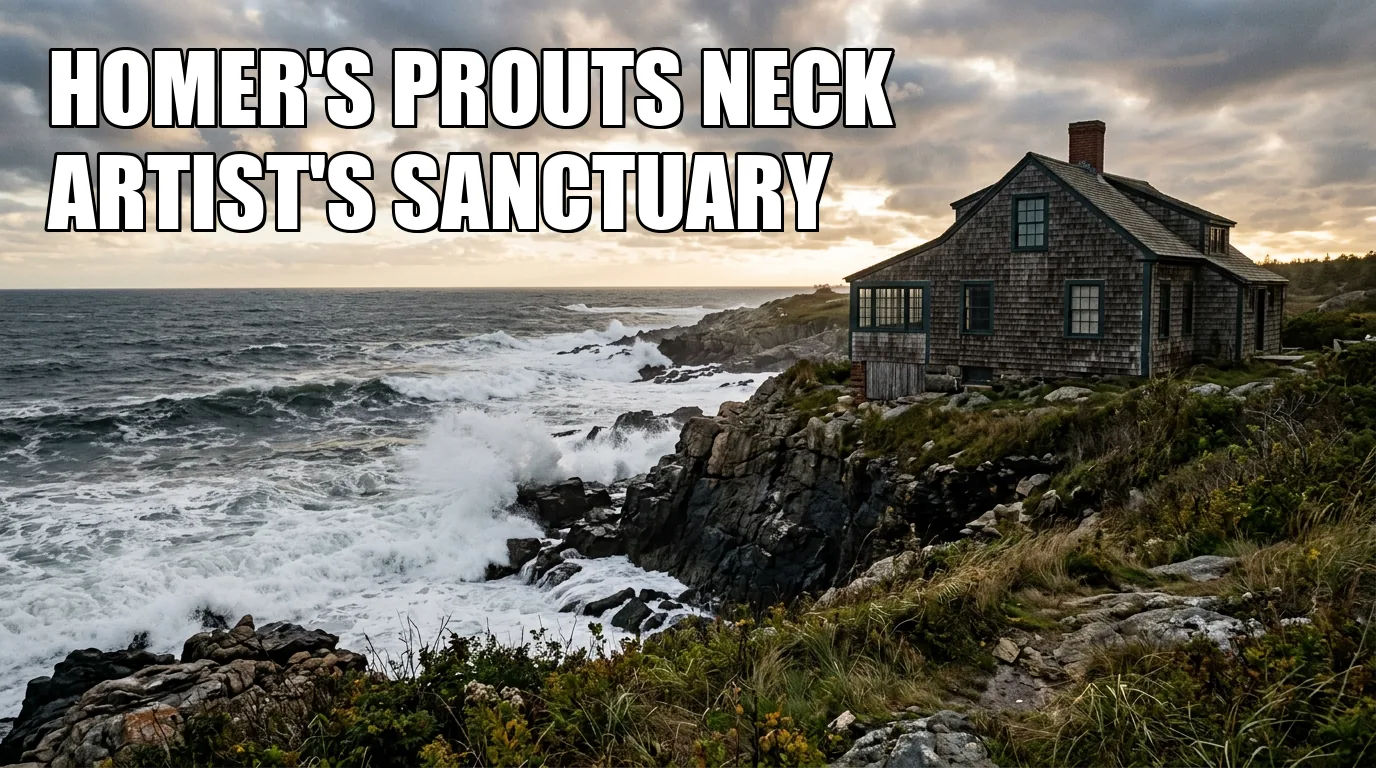
When you first approach the studio, even in the context of a carefully curated tour, you’re struck by its unassuming elegance, an almost defiant simplicity against the dramatic backdrop of the Atlantic. But the building you see today is not what Winslow Homer initially inherited. It began life as nothing more than a humble carriage house, part of his brother's sprawling summer estate. Homer, ever the individualist, wasn't content with a mere renovation. In 1884, he enlisted the talents of renowned Portland architect John Calvin Stevens to execute a complete transformation. What truly highlights Homer’s desire for artistic solitude, however, was his insistence that the building be physically moved—a feat of engineering in the late 19th century—some 100 to 150 feet away from the main house. This wasn't about aesthetics alone; it was a deliberate, almost aggressive, act to carve out a space dedicated entirely to his craft, ensuring an unparalleled level of privacy that few artists of his era could command.

Stevens' design for the new studio was a fascinating blend of practicality and personal request. Homer’s most distinctive demand? A sprawling, covered balcony, which he simply dubbed "the piazza," stretching the entire width of the second story. This wasn't merely a quaint architectural detail; it became the beating heart of Homer's artistic practice, an outdoor studio where he could brave the elements, observing the Atlantic's ever-changing moods through all seasons. Imagine him there, brush in hand, in the depths of winter, shielded just enough to capture the tempestuous beauty of the coast. Below this vital perch, the ground floor was conceived as two workshop-like rooms, austere and functional, paneled in pine, with only essential furnishings: tables, chairs, benches. It deliberately evoked the feel of a sportsman's retreat, not a lavish home, perfectly suiting a man whose focus was relentlessly on his work rather than domestic comforts.

Homer’s Ingenious Imprints: Whispers, Tools, and a Flagpole

Beyond the larger architectural strokes, it's Homer’s unique, often quirky, personalizations that truly bring the studio to life, offering glimpses into his character that standard biographies might overlook. The building itself is an architectural amalgam, sporting a mansard roof—a four-sided gambrel-style hip roof characterized by two slopes on each side with the lower slope being steeper than the upper—paired with Queen Anne brickwork on the chimney, a snapshot of late 19th-century vernacular construction. Yet, one particularly resonant detail lies on the southern wall of the first floor: a horizontal window, perfectly positioned at eye level. This wasn't just any window. It was framed to precisely mimic the aspect ratio of a camera lens, a clear compositional tool designed to frame the tumultuous ocean views exactly as they would appear in his finished paintings. It’s a subtle yet profound insight into his methodical approach, an early form of visual cropping.

What truly challenges the pervasive myth of Homer as a complete hermit are the delightful, almost mischievous, personal touches he left behind. He etched his name, "Winslow," into one of the studio's windowpanes, a quiet, permanent assertion of his presence. He scrawled philosophical reflections directly onto the tongue-and-groove paneled walls, including the evocative "Oh, what a friend chance can be when it chooses." And then there's the infamous "SnakesSnakesMice!" sign, hand-painted and strategically placed at the property's entrance, a clear and humorous deterrent to unwelcome interruptions. But perhaps the most surprising revelation, one that beautifully contradicts his reclusive reputation, was his ingenious meal service system. Homer installed a flagpole on the second-floor piazza. When he hoisted this flag, it signaled a nearby restaurant to deliver his lunch. This wasn't the act of a man cutting himself off entirely; it was the clever adaptation of someone fiercely protective of his time, but not unwilling to engage with the practicalities of daily life, albeit on his own terms.

Unraveling the Layers: A Century of Change and Meticulous Restoration

While Homer’s personal modifications remained largely intact during his lifetime (1884-1910), the studio's story took a less reverent turn after his death. His descendants, undoubtedly with good intentions but perhaps lacking a full appreciation for the building's historical integrity, made significant alterations between 1938 and 1939. They added three bedrooms and a kitchen, fundamentally changing the character of the artist's workspace, blurring the lines between studio and conventional residence. This period represents a critical juncture, where the building began to drift from its original purpose and appearance, making the work of future preservationists all the more vital and challenging.

Fortunately, the studio’s true spirit was destined for revival. When the Portland Museum of Art (PMA) acquired the property in January 2006, they embarked on an ambitious, multi-year restoration project. Commissioning Mills Whitaker Architects and Barba+Wheelock Architects, the goal was clear: return the studio to its exact appearance on the date of Homer’s death in 1910. From 2007, each building season—September through June—saw painstaking work, culminating in the summer of 2012, at a cost of $2.8 million. This wasn't a superficial facelift; it was an archaeological excavation of architectural history. The post-Homer additions, those bedrooms and the kitchen from the late 1930s, were carefully removed. Original colors of dark green with red trim were meticulously researched and reapplied. Architects poured over historical photographs, books, magazine articles, and museum archives, ensuring every detail, right down to the recreation of the original ocean-facing window (which had been replaced in 1939), was accurate. It’s a testament to how dedicated preservation can resurrect not just a building, but a lost moment in time.

Navigating the Journey: Practicalities of Visiting Prouts Neck

So, you’re convinced? You want to experience this windswept sanctuary for yourself? Be warned: this isn't a casual drop-in. Visiting Winslow Homer's studio is a pilgrimage that demands planning and a commitment to the journey, rather than a spontaneous detour. For instance, if you were planning a trip in September 2024—a prime month within the peak season window of May 30 through October 13—you would have faced specific logistics. Admission for non-members was a hefty $70 per person. PMA members received a discounted rate of $40, and students paid $25, but these prices immediately tell you this isn't a budget-friendly outing. It sets a certain expectation, one of exclusivity and high value, which, for a place so intimately tied to a solitary artist, feels somewhat ironic.

The studio, nestled within a private residential neighborhood, strictly prohibits independent visits. Advanced reservations are not just recommended, they are absolutely required. You simply cannot show up and expect to get in. Tours operate regardless of weather, which is fitting given Homer’s embrace of Maine’s coastal temperament, but it means dressing appropriately is critical for the 2.5-hour duration. These intimate tours are capped at a maximum of 12 people per group, departing from and returning to the Portland Museum of Art via luxury van. No private vehicles are allowed at the studio itself, which, while inconvenient for some, reinforces the sense of respectful, controlled access. This highly structured approach might feel restrictive, but it is precisely what protects the fragile integrity of the site, ensuring a focused, almost meditative experience that a free-for-all public access simply couldn't provide. If you’re traveling with a small army, groups of 10 or more did qualify for discounted rates, approximately $60 per person, and importantly, PMA admission was always included in the tour price. Children under seven are not permitted, a sensible policy given the tour's length and historical focus.

Beyond the Canvas: Why This Coastal Sanctuary Still Speaks

What, then, does a visit truly reveal, beyond the architectural minutiae and the quirky anecdotes? It's the profound sense of place, the tangible connection to the rugged beauty that so utterly consumed Homer. Standing on that piazza, feeling the ocean breeze and hearing the crash of waves, you don't just see where he painted; you begin to understand why he painted as he did. The fierce independence, the almost primal engagement with nature, the solitary pursuit of artistic truth – it all makes sense. Typical guides might gloss over the financial commitment or the rigid booking process, but these practicalities are part of the story, too. They underscore the value placed on this legacy and the effort required to engage with it. You expect to see a studio, but you leave with an understanding of a life, a philosophy, and a deep appreciation for the unique challenges and rewards of living and creating on such a formidable coast. It challenges the conventional wisdom that grand historical narratives always unfold in public squares; sometimes, they are etched into a pane of glass, or signaled by a flagpole, in the quiet solitude of an artist's personal domain.

For me, the most surprising insight wasn't a particular object, but the pervasive atmosphere of focused work that still clings to the walls. It’s an antidote to the modern myth of instant gratification, a reminder that genius often brews in quiet dedication, in the patient observation of a shifting horizon. This isn't just about art history; it's about the relentless pursuit of a vision, against the backdrop of an indifferent, yet endlessly inspiring, natural world. Homer's Prouts Neck studio offers a rare glimpse into the alchemist's lab, where raw elements of land, sea, and human spirit were forged into timeless masterpieces.

Discover Winslow Homer's Studio & Artistic Legacy in America

Where can I see Winslow Homer paintings?
Winslow Homer paintings are displayed at the Museum of Fine Arts Boston (the world's largest collection of his watercolors), Portland Museum of Art in Maine (which owns his historic studio), The Metropolitan Museum of Art in New York, National Gallery of Art in Washington DC, and the Clark Art Institute. Many major American museums feature his works across all media including oils, watercolors, drawings, and prints.
How do I ask for a studio visit?
Studio visits must be booked through the Portland Museum of Art by advance reservation. Tours run from May 1 through November 9, 2025, with prices ranging from $25-$70 depending on the date, and are limited to 12 people per tour.
Is Portland Museum of Art worth it?
Yes, the Portland Museum of Art is highly regarded and worth visiting, especially for Winslow Homer's extensive collection. Admission is $20 for adults ($18 for seniors and students 22+), and it's free every Friday from 4-8 p.m., plus free on the third Thursday of each month.
Where is the largest collection of Winslow Homer paintings?
The Museum of Fine Arts in Boston holds the world's largest collection of Homer's watercolors, while the Portland Museum of Art in Maine has one of the most significant collections overall and operates his restored historic studio. The Clark Art Institute in Massachusetts also holds one of the greatest collections across all media.
What is the #1 most expensive painting in the world?
The most expensive painting ever sold at auction is 'Salvator Mundi' attributed to Leonardo da Vinci, which sold for $450.3 million in 2017. However, the Mona Lisa by Leonardo da Vinci, housed in the Louvre, is valued at over $1 billion but is not for sale.
Is the Rijksmuseum or Van Gogh Museum better?
Both museums are excellent but serve different purposes: the Rijksmuseum is much larger with diverse Dutch art spanning centuries, while the Van Gogh Museum offers an intimate, in-depth exploration of one artist's life and work. Choose the Rijksmuseum for broader art history and the Van Gogh Museum for a focused, emotional experience.
Winslow Homer studio visit
Winslow Homer's studio at Prouts Neck in Maine offers guided tours from May 1 through November 9, 2025, departing from the Portland Museum of Art. The 2.5-hour tours include gallery visits, immersive experiences, and access to the Cliff Walk, with tickets ranging from $25-$70 depending on the season.
Which museum has the largest collection of paintings?
The Louvre in Paris is the world's largest art museum with over 600,000 items in its collection and 782,910 square feet of exhibition space. The Metropolitan Museum of Art in New York is the largest art museum in the Americas.
Who bought the $450 million dollar painting?
Saudi Arabia's Crown Prince Mohammed bin Salman purchased Leonardo da Vinci's 'Salvator Mundi' for $450.3 million at Christie's auction in November 2017, though the purchase was made through a proxy bidder to maintain anonymity.
Which is better, the Picasso Museum in Barcelona or Malaga?
The Barcelona Picasso Museum is larger with over 4,000 works and comprehensively covers Picasso's artistic development from his early years through Cubism, while the Malaga museum has around 100 works and offers an intimate exploration of his mature period. Both complement each other well.
When is the best time to visit Winslow Homer Studio?
The studio is open for tours May 1 through November 9, 2025. Late May, September, and early October offer pleasant weather and smaller crowds during peak season.
What are tour dates and ticket prices for 2025?
Tours run May 1 through November 9, 2025 with prices from $25-$70. Full pricing applies May 29 through October 10, while shoulder season dates have reduced rates. Members receive a 35% discount on ticket prices.
How long is the Winslow Homer Studio tour?
Tours last approximately 2.5 hours and include a gallery visit at Portland Museum of Art, a museum van ride to Prouts Neck, and access to Homer's studio, balconies, and the Cliff Walk.
What are the Portland Museum of Art hours and admission?
The museum is open Wednesday-Sunday from 10 a.m.-6 p.m., with extended hours Friday until 8 p.m. General admission is $20 for adults; visitors 21 and under are always free. Admission is free Friday evenings (4-8 p.m.) and the third Thursday of each month.
How many people can join a Winslow Homer Studio tour?
Tours are limited to 12 people at a time to provide an intimate experience and preserve the historic property.
What inspired Winslow Homer to paint at Prouts Neck?
Homer lived at Prouts Neck from 1884 until his death in 1910, where the dramatic rocky coastline, turbulent Atlantic Ocean, and Maine landscape deeply influenced his most celebrated seascape paintings and artistic vision.