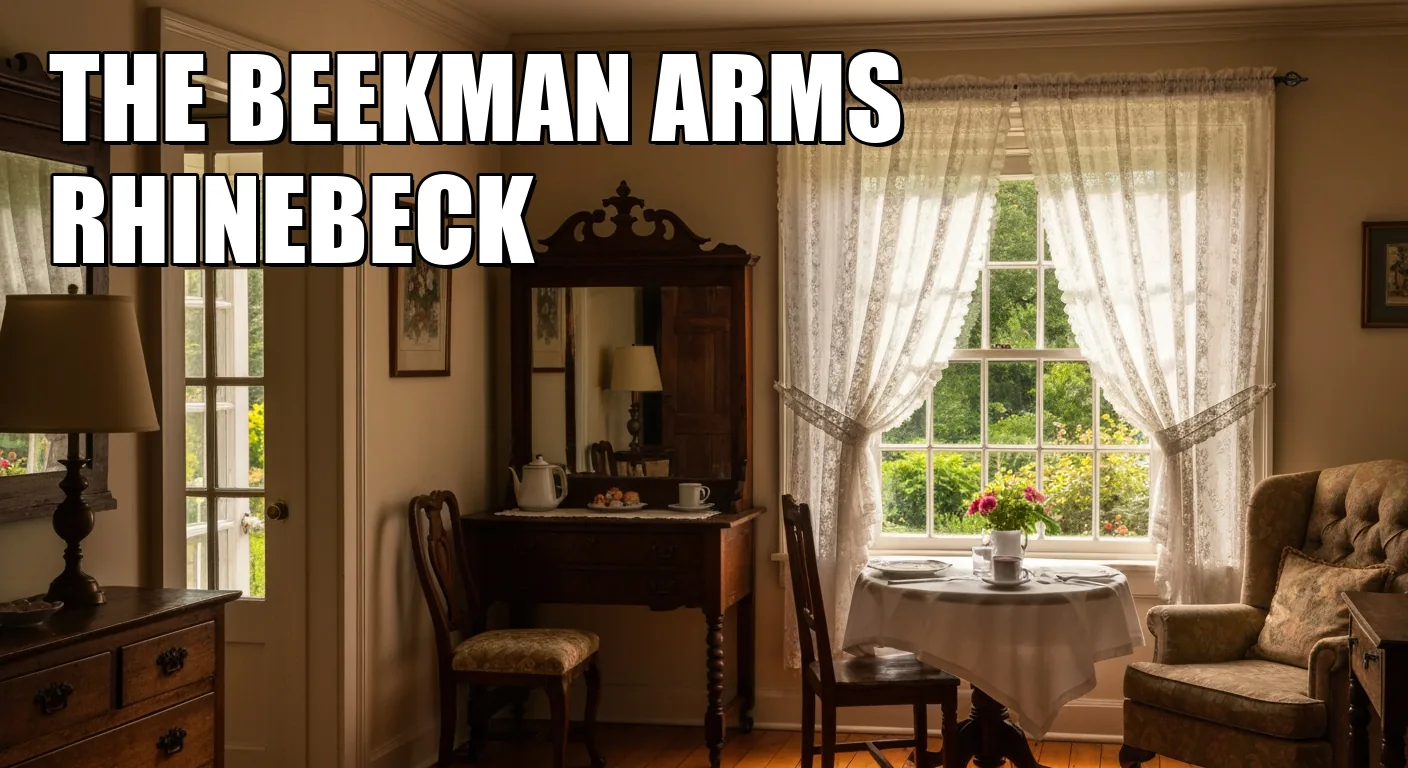
A founding date does not date the room. At Beekman Arms, the first explicit map evidence for a hotel is 1802, while the exact age of the surviving stone core remains disputed. Mohonk began with a small tavern-guest house in 1869, but the National Park Service dates the oldest surviving part of the present hotel to 1879. At Troutbeck, a 1761 house is genuine historic fabric within the compound, not proof that the property was operating as an inn in 1761.
Those differences are not fine print. They separate three kinds of Hudson Valley history: a long-running commercial hotel repeatedly remodeled and rebranded, a mountain resort built in successive campaigns for hospitality, and a private farm-and-country-estate complex later adapted to lodging. “Historic inn” can describe any of the three.
This is a three-property provenance comparison, not an exhaustive directory of every historic lodging business in the region.
| Property | What the early date describes | Firm lodging evidence | What the cited surveys record |
|---|
| Beekman Arms | An uncertain late-eighteenth-century stone core and older property lore | Mapped as “HOTEL” in 1802; a local archival reconstruction traces continuous operation from that point | A layered hotel with an 1810 wing, 1865 third floor and major 1917 Colonial Revival work |
| Mohonk Mountain House | The 1869 purchase of a small tavern-guest house and beginning of the resort | Hospitality was the purpose of the complex from its first development | A serially built hotel whose oldest extant section dates to 1879 |
| Troutbeck | Several separate domestic buildings and building phases beginning in 1761 | The historic survey describes a modern hotel and conference center, not an eighteenth-century inn | Contributing houses and a multi-phase manor beside later lodging and service buildings |
Beekman Arms: the business history is firmer than the 1766 story
The tempting shortcut is to call Beekman Arms a 1766 inn and move on. The preservation record is less tidy. One local chronology says a building existed by 1769 but marks the 1766 date uncertain. Historic Rhinebeck’s detailed discussion judges the surviving stone building most likely Revolutionary War-era, with indications of postwar construction. The source set therefore does not support treating 1766 or 1769 as a precise, settled construction date for the stone core.
The hospitality chronology becomes firmer in 1802. A Salisbury Turnpike map is the first cited document to label the business “HOTEL.” The reconstructed landlord sequence then runs through Asa Potter, Jacques Hotel or Jacques Stage House from 1805 to 1837, and the Rhinebeck Hotel from 1838 into the early twentieth century. The local archival presentation explicitly characterized operation from 1802 through its 2014 endpoint as continuous.
What visitors recognize as historic character was still being made much later. A north wing appeared by 1810, and a third floor was added in 1865. In 1907, proprietor Halleck Welles promoted Reminiscences of the Oldest Hotel in America, helping turn an old commercial hotel into an “oldest hotel” story. In 1917, architect Harry T. Lindeberg gave the property a major Colonial Revival remaking: a two-story columned portico, a south dining wing, second-floor guest rooms and a north porte-cochère. The Beekman Arms name belongs to that campaign; “Inn” entered the signage later still.
Beekman’s strongest claim is not an untouched colonial tavern. It is the documented continuity of a village hotel whose building and public identity kept changing. The 1917 work is not a betrayal of its history. It is one of its most consequential historic layers.
Mohonk: the resort began in 1869, the surviving hotel begins in 1879
The National Park Service nomination makes a distinction that resort histories often blur. Albert and Alfred Smiley began developing Lake Mohonk in 1869 after purchasing a small tavern-guest house. Popular demand led to repeated enlargement. Yet the nomination states plainly that “the oldest extant part of the present structure was completed in 1879.” The business origin and the oldest surviving hotel fabric are separated by a decade.
The present Mountain House is not one 1869 building enlarged beyond recognition in a single campaign. It is a connected sequence. The four-story Rock Building dates to 1879. N. LeBrun & Sons designed the Central Building of 1887–88 and returned for the Grove Building, dining room and kitchen group identified in the physical description as 1893. James E. Ware designed the Stone Building, completed in sections in 1899 and 1902, and the cantilevered Parlor Wing completed in 1901.
The nomination is internally inconsistent about a single endpoint: its description calls 1901 the date of the last major addition, while its significance section dates the Stone Building’s second section to 1902. The component chronology is usable; a single “hotel completed” year is not.
This chronology changes the meaning of “original.” A room or corridor can belong authentically to Mohonk’s nineteenth-century resort history without belonging to its first year. The irregular roofs, masonry, shingles, balconies and linked interiors are evidence of growth, not a single construction date. Mohonk’s historical value lies partly in that accumulated purpose-built resort fabric.
The NPS nomination, prepared in 1985, also described the resort as still run by the Smiley family at that time and treated the surrounding landscape as integral to the hotel’s significance. That is strong period evidence for family stewardship and the resort-conservation relationship; it should not be silently converted into an unqualified claim about every later ownership year or every present guest-room finish.
Troutbeck: old houses first, hotel later
Troutbeck reverses Mohonk’s sequence. Its oldest buildings were not erected as parts of a resort. The Webutuck Agricultural Valley Historic District nomination draft describes a compound of houses, industrial sites and farmland developed by the Benton family and now preserved amid a hotel and conference center.
The John and Mary Delamater House is a separate circa-1761 Dutch dwelling with a bent frame and a brick gable end carrying the couple’s initials and date in burnt headers. The Caleb Benton House, built after the family arrived from Connecticut in 1794, is a separate center-chimney dwelling dated about 1795. Neither date automatically identifies the age or former function of the room a guest may reserve elsewhere in the compound.
The Manor House has its own genealogy. A Dutch-style house built for William Young in 1765 was absorbed into the estate house. Myron B. Benton transformed the family farmhouse into a Gothic villa around 1865 and shaped an ornamental landscape around it. After Joel Spingarn acquired Troutbeck in the early twentieth century, he enlarged and elaborated the building into the English Revival fieldstone manor recorded by the survey.
The modern hotel layer is visible in the same inventory. The draft identifies a Garden House Annex, dated about 1985, as a noncontributing lodging house because of its age. It also records a noncontributing circa-2000 addition to the Caleb Benton House and later pool, service and pavilion structures. The careful statement is not “Troutbeck has been an inn since 1761,” nor even that the hotel opened in a precisely proven year. It is that a later lodging operation occupies and supplements a compound with authentic domestic, agricultural and estate fabric from several periods.
Read the noun attached to the date
- Business: When is paid hospitality actually documented, and does the record show interruptions?
- Building: What is the oldest surviving room-bearing fabric rather than the earliest lost structure or property deed?
- Campaign: Which architect, owner or restoration produced the facade and interiors now presented as historic?
- Campus: Does the property name cover a main hotel, older houses, later annexes and noncontributing buildings?
- Room: Does the reservation identify the physical building, or only the umbrella brand?
These questions do not produce a ranking from “most authentic” to “least authentic.” They identify the experience being offered. Beekman supplies commercial-hotel continuity and a powerful Colonial Revival layer. Mohonk supplies purpose-built resort growth from 1879 onward. Troutbeck supplies older domestic and estate fabric gathered into a later hotel campus.
The useful reader task is simple: ask what noun the date modifies. If it dates the business, it may say nothing about the surviving walls. If it dates one house, it may say nothing about the annex containing the room. If it dates a resort’s founding, it may precede every part of the hotel now standing. That answer is more valuable than the largest year painted on the sign.
The Cornerstone Brief
One historic place, once a week — what it is, why it matters, whether it's worth going. No filler, no paid placements.
Coming soon. Unsubscribe any time.