Jack London's Wolf House: A Dream in Ashes
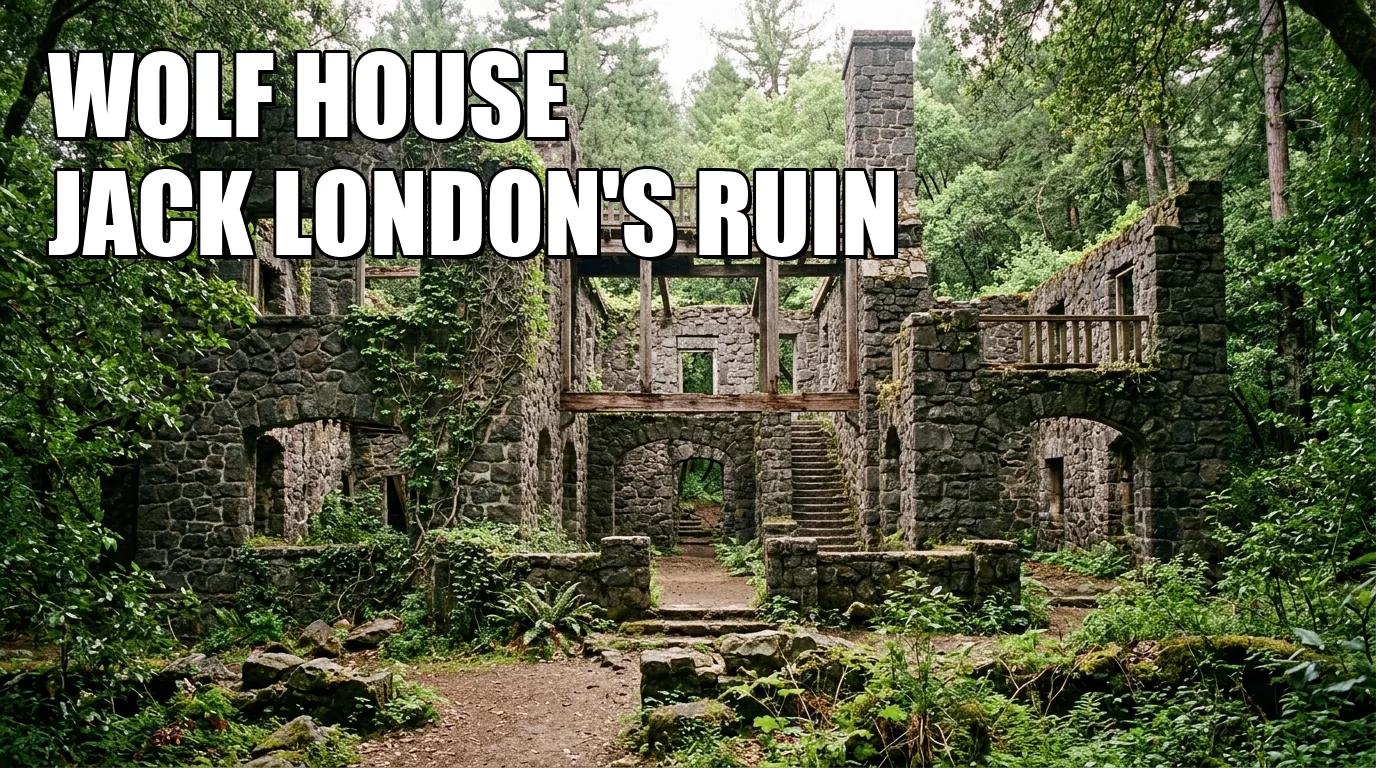
For years, I’ve found myself drawn to places where history didn't quite unfold as planned, sites that challenge our understanding of famous figures. Jack London’s Wolf House, tucked away in the verdant hills of Sonoma, is one such place. It’s not a grand, preserved estate you wander through, but a magnificent skeleton, a ghost of a dream that still looms large. You don't just visit; you confront a monumental "what if."
What exactly was London trying to build out here, far from the bustling literary circles of his time? This wasn’t just a bigger house; it was a deeply personal architectural statement, a synthesis of inspirations that spoke volumes about the man himself. Envisioned by San Francisco architect Albert L. Farr, the Wolf House drew on the sophisticated "ultimate bungalows" of Greene and Greene, blending them with the rustic, grand lodges one might find in the Adirondacks. It was a staggering 15,000-square-foot behemoth, boasting 26 rooms designed not merely for luxurious living, but as a meticulously planned author's workshop and an opulent entertainment venue. It seems London, ever the paradox, sought both complete seclusion for his writing and a grand stage for his robust social life under one enormous roof.
Exploring the remnants today, one quickly realizes the sheer scale and ingenuity that went into its design. Picture this: a two-story living room, an impressive 18 by 58 feet, framed by rough redwood balconies that extended three-fourths of the way around. This wasn't just a space; it was a statement, a natural amphitheater for conversation and camaraderie. London, in his ceaseless pursuit of productivity, also ensured his personal workspace was unparalleled. His library, measuring a substantial 19 by 40 feet, sat directly beneath his workshop—an identical twin, connected by a private spiral staircase. This ingenious arrangement wasn't merely about convenience; it spoke to a deliberate desire for a completely isolated creative sanctuary, a quiet refuge from the house's more public functions.
What makes this place truly unique, and frankly, a bit astonishing for its era, was London’s unwavering commitment to local sourcing. Long before "farm-to-table" became a buzzword, London insisted that the Wolf House be built predominantly from materials found right in the Sonoma Valley. Massive Coast Redwood logs, still clad in their natural bark, formed external elements like the carriage entrance and pergolas, rooting the structure firmly in its environment. The primary building blocks were deep chocolate-maroon volcanic rocks, rich blue slate, hefty boulders, and concrete, all painstakingly extracted from the surrounding land. While the roof tiles, a distinctive Spanish style, were imported from N. Clark and Sons Pottery in Alameda, the overall impression remains one of profound connection to place. Even the intricate details, like rough-hewn natural logs forming rafters and tree trunks in the gables interlaced with fruit twigs for decorative effect, reveal a deliberate, organic aesthetic.
Beyond aesthetics, the Wolf House was an engineering marvel, a testament to London’s foresight and the era's growing understanding of seismic activity. The house rested upon an earthquake-resistant floating slab foundation, engineered to be robust enough to hypothetically support a forty-story building. This wasn't an architectural flourish; it was a direct, pragmatic response to the devastating 1906 San Francisco earthquake, which London and his architect, Farr, would have remembered all too vividly. This innovation underscores their commitment to creating a dwelling that was not only grand but also enduring, a permanent fixture in a region prone to geological upheaval.
Moreover, the mansion was slated to incorporate a suite of modern amenities that would have been exceptionally forward-thinking for the early 20th century. Imagine a house equipped with a water heater, electric lighting, refrigeration, and even a built-in vacuum cleaning system. London also planned for comprehensive laundry facilities, featuring a "steam dryer rotary wringer," and a dedicated wine cellar—because, of course, a man of his stature needed a proper cellar. Perhaps most unexpectedly, an outdoor reflecting pool, designed to be stocked with mountain bass, was to be the centerpiece of the house’s interior layout. These details paint a picture of a man embracing progress and comfort, blending rustic grandeur with cutting-edge convenience.
Construction, a monumental undertaking, finally kicked off in earnest in April 1911, after planning began late in 1910. London brought in Natale Forni, an Italian master stonemason, as the project foreman, recognizing the need for skilled craftsmanship. Interestingly, he also enlisted his older sister, Eliza London Shepard, as his ranch superintendent, tasking her with overseeing the day-to-day construction management. This familial involvement wasn't just about trust; it suggests London's desire for an intimate, highly personalized approach to realizing his ambitious vision, ensuring every detail aligned with his exacting standards. It also highlights the complexity of managing such a vast enterprise, requiring oversight from both a seasoned artisan and a trusted family member.
Then, tragedy struck with a suddenness that still feels profoundly unfair. By August 1913, after approximately three years of relentless work, London had poured an astonishing $50,000 to $75,000 into the project—an amount equivalent to nearly $1.9 million in today’s currency. The house was almost finished, furniture was due to arrive in just days. But at 2:00 a.m. on August 22, 1913, the nearly completed mansion erupted in flames. The fire, consuming all combustible materials with terrifying rapidity, gutted the interior, leaving only the colossal masonry walls standing by morning. It was a swift, brutal end to a dream years in the making.
For decades, the whispers persisted: arson. The idea that someone would deliberately destroy London's magnum opus lent a dramatic, almost cinematic quality to the tragedy. Yet, the truth, as it often does, turned out to be far more mundane, and in its own way, even more poignant. A meticulous 1995 forensic investigation, led by engineering professor Robert N. Anderson and a team of ten forensic specialists, concluded that the most likely culprit was spontaneous combustion. Specifically, linseed oil-soaked rags, left by workers who had been finishing wood floors and trim, ignited. The foreman, who had faithfully collected these oily rags every night, simply forgot that one fateful evening. It wasn't a grand conspiracy, but a simple, human oversight—a devastating testament to the fragility of even the grandest plans. The dining room fireplace, a prominent feature of the structure, is highlighted on tours as the specific point of origin, a stark reminder of how quickly a minor oversight can lead to catastrophe.
Visiting the ruins today is an experience that transcends a typical historical site tour. It’s a contemplative journey. Docent-led tours, offered free on Saturday and Sunday mornings at 11 a.m. and 1 p.m., aren't just recitations of facts; they’re narratives woven with the passion of those who understand London’s enduring spirit. You’ll embark on a half-mile walk from the museum to the ruins, a pleasant stroll that builds anticipation. What you'll find isn't a museum piece, but a raw, emotional testament to what once was. Guides will point out the five still-visible chimneys, stark against the sky, and explain the sophisticated cooling and climate systems that were integrated into the design, systems you can still discern through the surviving masonry. They'll also highlight the "stag party room" in the basement, offering a glimpse into London’s more boisterous side. This isn't just about architecture; it's about the life that was *meant* to fill those spaces, and the profound void left in its absence.
One of the most moving aspects of the tour, and something many traditional guides gloss over, is the side trip to Jack and Charmian London’s grave site. Here, you'll learn that London’s ashes were placed not beneath a grand monument, but beneath a simple, rugged red boulder sourced directly from the Wolf House ruins. This wasn't a random choice. It fulfilled his expressed wish to be buried near the graves of pioneer children on the property knoll, intertwining his final resting place with both the land he loved and the dream that turned to dust. Charmian London herself later wrote that the fire "killed something in Jack," a sentiment echoed by his sister Eliza, who was "scarred to her soul" by witnessing the destruction. Standing at his grave, looking back towards the skeletal remains of his dream house, you grasp the sheer weight of that loss, not just of a building, but of a vision. It makes you wonder: did the fire, in its brutal finality, truly crush his spirit, or did it perhaps, in some strange way, cement his legacy as a man whose dreams were as vast and untamed as the landscapes he explored? Perhaps, like the Wolf House itself, London’s story is best understood not in its triumphant construction, but in its poignant, powerful ruin.
Jack London State Historic Park & Wolf House Visitor Guide
Where is Jack London house?
Jack London's historic cottage is located at Jack London State Historic Park, 2400 London Ranch Road, Glen Ellen, California 95442, approximately 20 minutes north of Sonoma in the Sonoma Valley.
What happened to Jack London's house?
The Wolf House, Jack London's 26-room dream mansion, burned down on August 22, 1913, just days before the Londons were planning to move in. The cause of the fire remains mysterious, and Jack London never rebuilt the home.
Is the wolf house a real story?
Yes, the Wolf House is a true story. Jack London actually built a real 26-room mansion on his 1,200-acre Sonoma Valley ranch, which cost over $75,000 and was meticulously designed with modern amenities including electric lighting, refrigeration, and a library for his 15,000 books.
Where is Jack London located?
Jack London State Historic Park is located at 2400 London Ranch Road in Glen Ellen, California, approximately 1.5 hours north of San Francisco via Highway 101, and about 20 minutes north of Sonoma.
Is Jack London Square walkable?
Yes, Jack London Square in Oakland is a pedestrian-friendly waterfront area with scenic trails, waterfront access, restaurants, shops, and cultural attractions spread across a mixed-use plaza that can be explored on foot.
Was Jack London a millionaire?
Yes, Jack London was very wealthy. He was one of the first American authors to earn over $1 million (approximately $22 million in today's money), and by 1913 he was earning more than $10,000 per month.
What is the jack london house tour?
The park offers guided tours of the Wolf House ruins and historic buildings led by knowledgeable docents on weekends at 11 am and 1 pm. Private group tours are also available Monday-Friday for groups of up to 40 people with advance reservations.
Is Jack London from London?
No, Jack London was not from London, England. He was born in San Francisco, California on January 12, 1876, and grew up in Oakland; his real name was John Griffith Chaney.
What happened to Jack London clothing?
Jack London was an Australian men's fashion label founded in 2008 that closed in September 2025. All physical retail stores had previously closed in August 2021, and the brand operated online until its final liquidation sale in 2025.
What county is Jack London Square in?
Jack London Square is located in Alameda County, in the city of Oakland, California, on the waterfront at the south end of Broadway.
What are the hours of operation for Jack London State Historic Park?
The park is open daily from 9 am to 5 pm. The museum is open 10 am to 5 pm, and the cottage is open Noon to 4 pm (Note: The cottage is closed for renovations on weekdays September 22-October 31, but open weekends).
How much does it cost to visit Jack London State Historic Park?
Admission is $10 per vehicle or $5 per person arriving by bike or foot. General admission to the museum and cottage areas is approximately $4 additional per person.
What is the best time to visit Jack London State Historic Park?
Spring (March-May) is ideal for wildflowers and mild weather with occasional rain, while fall (September-October) offers golden foliage and comfortable temperatures. The park hosts a 'Blooming Now' program February-October tracking wildflower blooms.
How long should I plan for my visit?
Most visitors should plan for at least 3 hours to explore the historic buildings, museum, and grounds. A full day is recommended if you want to hike the trails and visit all sites.
Are dogs allowed at Jack London State Historic Park?
Yes, dogs are allowed on leash in the historic area only. They are not permitted beyond the silos, inside the museum, or on backcountry trails.
Are private group tours available?
Yes, private guided tours for groups of up to 40 visitors are available Monday-Friday only, lasting approximately 2 hours. Reservations must be made at least 7 days in advance by contacting the park.
Is Jack London State Historic Park accessible for people with disabilities?
Yes, the museum has a wheelchair lift, the paved 400-foot route to the museum may be accessible for some visitors, accessible portable restrooms are available, and golf cart transportation can be arranged in advance for those who need it.