The most revealing objects in Le Pavillon’s renovated lobby may be the old paintings deliberately hung upside down. The designers call the gesture “turning history on its head.” It is also a useful instruction for reading the hotel.
Le Pavillon is not a 1907 interior preserved under glass. It is a largely surviving early concrete hotel altered at street level in 1970, an Old World identity assembled with European objects after that rebuilding, a contemporary design installed through 2024, and a body of ghost lore whose names change from one storyteller to another. Separating those layers does not diminish the hotel. It makes its real history more interesting than either “perfect time capsule” or “haunted hotel” can manage.
| Layer | What the evidence supports | What not to infer |
|---|
| 1907 New Hotel Denechaud | A steel-framed, reinforced-concrete hotel opened in January 1907; much of it survived the 1970 reconstruction | That the current façades, entrance, room plan or décor are intact from opening day |
| Le Pavillon from 1970 | New owners created an opulent European identity with imported antiques, art and reclaimed architectural pieces | That those objects furnished the 1907 hotel, or that every spectacular pedigree has independent documentation |
| Tribute Portfolio conversion | A $19 million project remade the lobby, bar, restaurant, guestrooms, event rooms and entrance, reopening in November 2024 | That “historic conservation” meant returning the property to one original period |
| Ghost lore | Named spirits and a paranormal investigation appear in hotel and tour storytelling | That the names are archival identities, that the deaths are documented, or that ISPR investigated this hotel in 1996 |
The 1907 hotel survived, but not untouched
Architects Toledano and Wogan designed the New Hotel Denechaud, built by Milliken Brothers and formally opened in mid-January 1907. A contemporary-minded structure rather than an antique fantasy, it used a steel frame and extensive reinforced concrete and cement. Its 217 rooms were arranged so each had an exterior view.
Even the first name change resists the tidy timeline repeated by hotel histories. A New Orleans historical column places the change to Hotel De Soto in 1910, when La Baronne Hotel Realty Company absorbed the operating company. Later hotel and promotional histories use 1913. The defensible version is simply that New Hotel Denechaud became Hotel De Soto in the early 1910s; choosing the more romantic date does not resolve the conflict.
The larger physical break came half a century later. Danid Inc. bought the declining De Soto in 1963, intending an apartment conversion that never happened. In 1964 the city acquired a 60-foot-deep strip along Poydras Street, including a two-story annex, for street widening. When work on Le Pavillon began in 1970, the Baronne and Poydras sides were removed so rooms and a new Poydras entrance could be made. The local account is equally clear that most of the old hotel remained.
That distinction is the foundation of an honest visit. Le Pavillon possesses genuine 1907 structural continuity, but the approach seen from Poydras and the public identity encountered inside are products of later decisions. Its National Register shorthand needs the same precision: the hotel’s stated status is as a contributing structure within the Lower Central Business District, not as a separately listed building whose every visible feature has individual designation.
The 1970 reconstruction created its own historic layer
The revived hotel did not try to reconstruct the restrained appearance of the New Hotel Denechaud. Its owners renamed the property Le Pavillon and built an atmosphere of accumulated European grandeur. Hotel histories describe crystal chandeliers sourced in Czechoslovakia, marble and reclaimed pieces from Europe, antique furniture, old portraits, carved beds and mantels entering the collection during and after this campaign.
The chronology is more secure than many individual pedigrees. These objects were not part of the 1907 opening, but they have now shaped the hotel for more than half a century. Calling them “fake history” misses what happened: the 1970s installation is itself a historic record of how an American luxury hotel manufactured Old World romance.
The marble tub now displayed in the Napoleon Suite is a perfect test case. The object is real and remains part of the current design. Its connection to Napoleon is consistently qualified by the hotel’s own project coverage as “reputed,” “rumored” or perhaps the emperor’s. The useful fact is not that Napoleon bathed in it; no provenance in the available record establishes that. The useful fact is that Le Pavillon has made the uncertain story inseparable from the object.
The 2024 redesign does not pretend to restore 1907
Premier renovated the property in stages from 2015 to 2019, then began its conversion to Marriott’s Tribute Portfolio in 2020. The hotel publicly reopened after the $19 million project on November 21, 2024. Premier’s April 2025 announcement was a later project retrospective, not evidence of a second reopening.
The documented scope was extensive: the 226 guestrooms, lobby, Bar 1803, restaurant, corridors, meeting rooms, public spaces and exterior entrance all received work. Six themed suites were added, in part by joining multiple smaller rooms. That makes the suites particularly legible examples of the hotel’s method: their historical names and antique anchor pieces occupy newly assembled plans.
The new public rooms make the mixture explicit. Matte white surfaces and gold ceiling accents frame purple upholstery; old and contemporary furniture share the lobby; classical-looking artworks are inverted; Bar 1803 uses red velvet, dark marble, rope lighting and a lenticular Napoleon portrait that changes with the viewer’s position. This is not a restoration to 1907. It is a present-day designer’s commentary on the 1970s version of European opulence.
Even the project language supports that reading. “Reimagined,” “layered” and “turns history on its head” occur more often in the physical descriptions than any claim of archaeological restoration. “Historic conservation” here means keeping a long-lived hotel and selected objects in service while altering how rooms function and how the collection is staged.
The ghosts become less historical as their details become more precise
Le Pavillon’s paranormal stories are easy to describe but difficult to source beyond commercial lore. A ghost-tour account attributes an investigation to “Dr. Montz and his team,” yet supplies no report, date, institutional affiliation or methods. The specific claim that this was a 1996 investigation by the International Society of Paranormal Research does not survive the source audit. In the hotel chronology, 1996 is instead the year attached to its first AAA Four-Diamond award.
The named spirits show the same instability:
- The teenage girl said to haunt Room 930 appears as Ada, Ava or Eva and is assigned an 1840s carriage death on Poydras Street, but no archival casualty record accompanies the story.
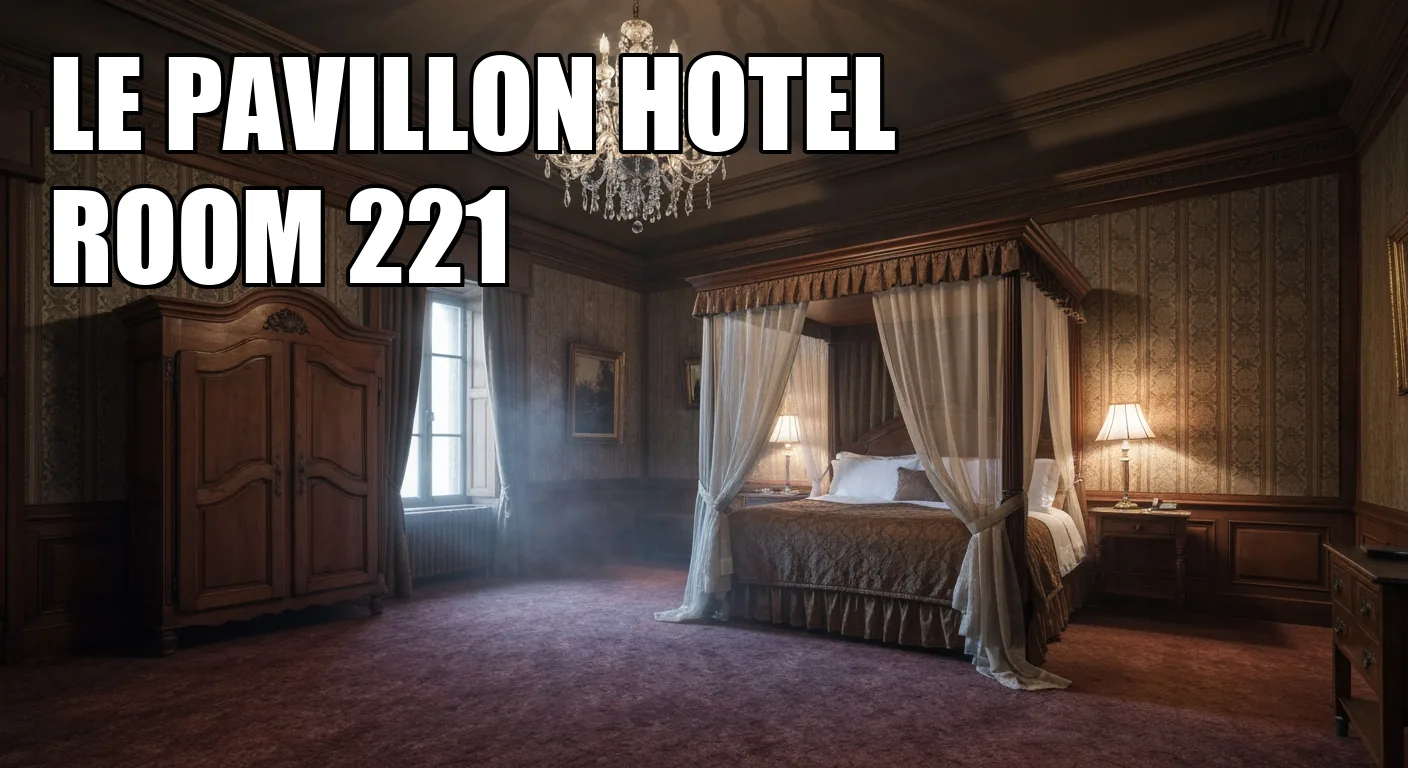
- The elegantly dressed 1920s couple is associated with the lobby, elevators, second floor and Room 221. The tour source repeating the story also concedes that historical records show no couple dying at the hotel.
- A third-floor prankster said to pull sheets and move equipment was named “George” by a hotel sales director in one account. Current hotel lore calls an apparently similar playful third-floor spirit “Phillipe.”
Those conflicts do not prove that no guest ever had an unexplained experience. They establish a narrower point: these are evolving stories, not recovered biographies. No stable dated source was found for the protective nanny sometimes added to the roster. Enjoying the lore requires no false certainty about who these figures were.
Read the hotel in layers, not as a single period room
A useful tour of Le Pavillon begins by asking a different question at each layer. Outside, ask which parts belong to the surviving 1907 building and which were remade for the 1970 entrance. In the lobby, separate architectural scale from movable antiques, then ask when an object entered the hotel before accepting who supposedly owned it. In Bar 1803, look for the deliberately contemporary devices—the shifting portrait, theatrical lighting and color—that comment on the older collection rather than imitate it.
Apply the same provenance test to a ghost: What is the first dated account? Does the name remain consistent? Is there a death record, an investigation report or only a later retelling? At Le Pavillon, that method preserves the pleasure of the story while keeping it in the correct category.
The hotel’s strongest claim is not purity. It is continuity through reinvention: a 1907 commercial building that survived decline, lost and rebuilt portions of its street face, acquired a flamboyant second identity in 1970, and now displays that inheritance through a consciously modern frame. The ghosts are part of that living theater. They are evidence of how Le Pavillon tells its story today, not proof of what happened on Poydras Street in the nineteenth century.