Can you unmask the legend at My Old Kentucky Home? The unexpected fact first: Stephen Foster almost certainly did not write Kentucky’s state song at Federal Hill. Scholars find little to no chance the melody was composed in Kentucky at all. His draft notebook titled the piece “Poor Uncle Tom, Good Night”—an anti-slavery lament tied to Uncle Tom’s Cabin, not a jolly plantation postcard. The desk-in-the-parlor story is 1920s tourism marketing.
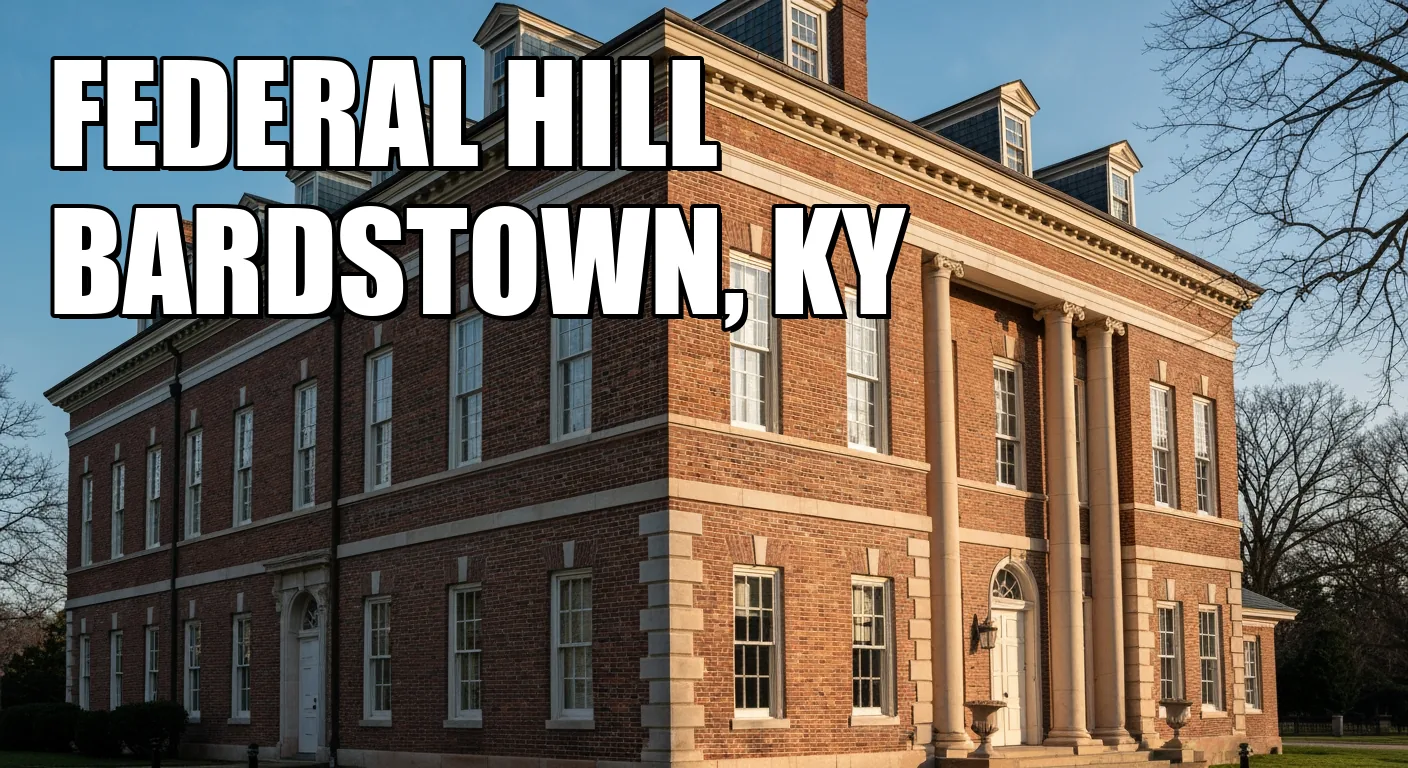
Federal Hill itself is real: a Rowan mansion (1812–18), built largely with enslaved labor, dedicated as Kentucky’s first state park on July 4, 1923. Pay for the house tour; leave the secretaire myth in the gift shop. This guide rates what the visit actually delivers—song truth, house history, tour logistics, amphitheater night, and Bardstown base—with 2026 prices and hard rules.
Fact vs. legend: Foster, Federal Hill, and the song
Marketed legend: Foster visited cousins at Federal Hill and wrote “My Old Kentucky Home” at a specific desk still shown as shrine furniture. Early automobile-era promoters pushed that story hard—scholars note most Foster–Federal Hill tales appear decades after the song’s publication to build a tourist shrine.
Documented fact: Foster was Pittsburgh-born. Hard evidence puts him in Kentucky, if at all as an adult, for little more than a brief Louisville steamboat stop—about fifty miles from Bardstown. Court and estate context around 1852 does not support a cozy furnished residency at Federal Hill. When a collector acquired Foster’s original notebook in the early 1930s, the early draft title was “Poor Uncle Tom, Good Night” (also rendered “Old Uncle Tom, Good-Night!”). The arc lamented family separation and sale “down the river” into Deep South sugarcane labor—abolitionist grief, not happy home-of-slavery nostalgia.
Foster later cut explicit Uncle Tom references, preferring ambiguity that sold sheet music and later allowed white audiences to rebrand the song as romantic Old South. The park still carries the song’s name and hosts the outdoor drama; honest interpretation separates mansion history from composer mythology.
Federal Hill: Rowan house, slavery, state park
John Rowan Sr. and Ann Lytle began with a log house around 1795, then a one-story brick “Federal Hill,” and in 1812 commissioned the large three-story Federal-style mansion completed 1818. Rowan was a lawyer, U.S. Congressman, and judge; he and Ann had nine children. In 1833 a cholera epidemic killed eight family members and eight enslaved workers on the estate. John Rowan Jr. inherited in 1843 and died in 1855 after falling from a second-story window; his widow Rebecca raised ten children there. Last family owner: Madge Rowan Frost. A commission purchased the estate in 1922; on July 4, 1923 it transferred to the Commonwealth as a historic shrine—Kentucky’s first state-owned park—under the name My Old Kentucky Home.
Slavery is not a footnote. The mansion was built mostly by enslaved labor alongside hired tradesmen. Research places at least 54 enslaved people owned by John Rowan Sr. over his lifetime, with a high documented count of 39 in 1830 across nine family groups. A burial ground for enslaved men, women, and children lies southwest of the mansion. John Rowan Jr. is reported to have held anti-slavery political views and to have freed many after taking over—still a site shaped by bondage, not a neutral “heritage house” without labor history.
2026 tour math: prices, hours, hard rules
Address: 501 E. Stephen Foster Ave., Bardstown, KY 40004. Phone: (502) 348-3502. Guided mansion tour about 40 minutes, hourly, last tour at 4:00 p.m. (schedule described as 9:00 a.m. to 4:00 p.m. tour window). Winter season roughly January 2–March 15: Wednesday–Sunday only. Cap: 25 people per tour, first-come, first-served; large groups can reserve ahead, same-day tickets at the Visitors Center. No photography inside the mansion.
Regular admission: adults 18–61 $18; seniors 62+ $15; children 6–17 $12; ages 5 and under free. Veterans with ID $14; active military with ID $10. Park amenities beyond the house: 18-hole golf, outdoor amphitheater, picnic shelter with grills, playground, gift shop, tennis—plus a 39-site campground currently closed for a ~$4 million renovation (water/electric/sewer, modern bathhouse). Original finish estimates pointed to late summer/fall 2025; no firm reopening date was locked in sources—confirm before packing a tent.
Amphitheater night and nearby Bardstown stays
The J. Dan Talbott Amphitheatre hosts the long-running outdoor musical The Stephen Foster Story (since 1959) and other productions. Season pass about $180 covering the Foster show, other park productions (e.g. Annie when scheduled), and Live at the Park concerts. Single drama tickets (verify at stephenfoster.com or box office 502-348-5971): roughly $28 adult / $25 senior / $15 children 6–12 / $9 ages 2–5. Concerts can price separately (examples near $34). The show is Broadway-style Foster music in the park—not proof he wrote at Federal Hill; treat it as entertainment layered on the state shrine.
Stay in Bardstown, not “on the desk where Foster wrote.” Local options include Bourbon Manor Bed & Breakfast, Jailer’s Inn (former 19th-century jail), Log Still Distillery B&B rentals, downtown Talbott Inn, Fairfield Inn & Suites, Bardstown Motor Lodge, and bourbon-themed cottages on short-term rental platforms. Pair the mansion morning with bourbon trail afternoon if that is your trip shape.
Ratings: what the visit actually scores
Song truth / myth-busting — 9/10. If you care about “Poor Uncle Tom” origins vs. plantation postcard marketing, this site rewards a critical visit. The legend is the product; the notebook title is the evidence.
House history & architecture — 8/10. Real Federal-period mansion, Rowan political family, cholera tragedy, documented slavery and burial ground. Forty minutes is short but dense if guides open labor history, not only parlor furniture.
Tour logistics & value — 7/10. $18 adult is fair for a state-park mansion with veteran/military discounts. First-come 25-person caps punish peak walk-ups; no interior photos frustrate Instagram travelers. Winter Wed–Sun only is a real schedule trap.
Amphitheater night — 7/10 for fans of outdoor musicals; 4/10 if you expected “composer’s actual home.” $28-ish singles or $180 season pass; book box office, not gift-shop folklore.
Camping on site — 2/10 until reopen. Closed under multi-million reno; do not plan overnight here without a confirmed open date.
Who yes: travelers who want fact-vs-lore, Federal architecture, Kentucky state-song context, and Bardstown as a bourbon-history base. Who no: anyone seeking verified Foster residency, unrestricted photography inside, or guaranteed camping in the park tonight. Bottom line: Can you unmask the legend? Yes—pay $18, skip the secretaire myth, and read the song as anti-slavery grief rewritten for sheet-music sales, not as proof he sat at Federal Hill.