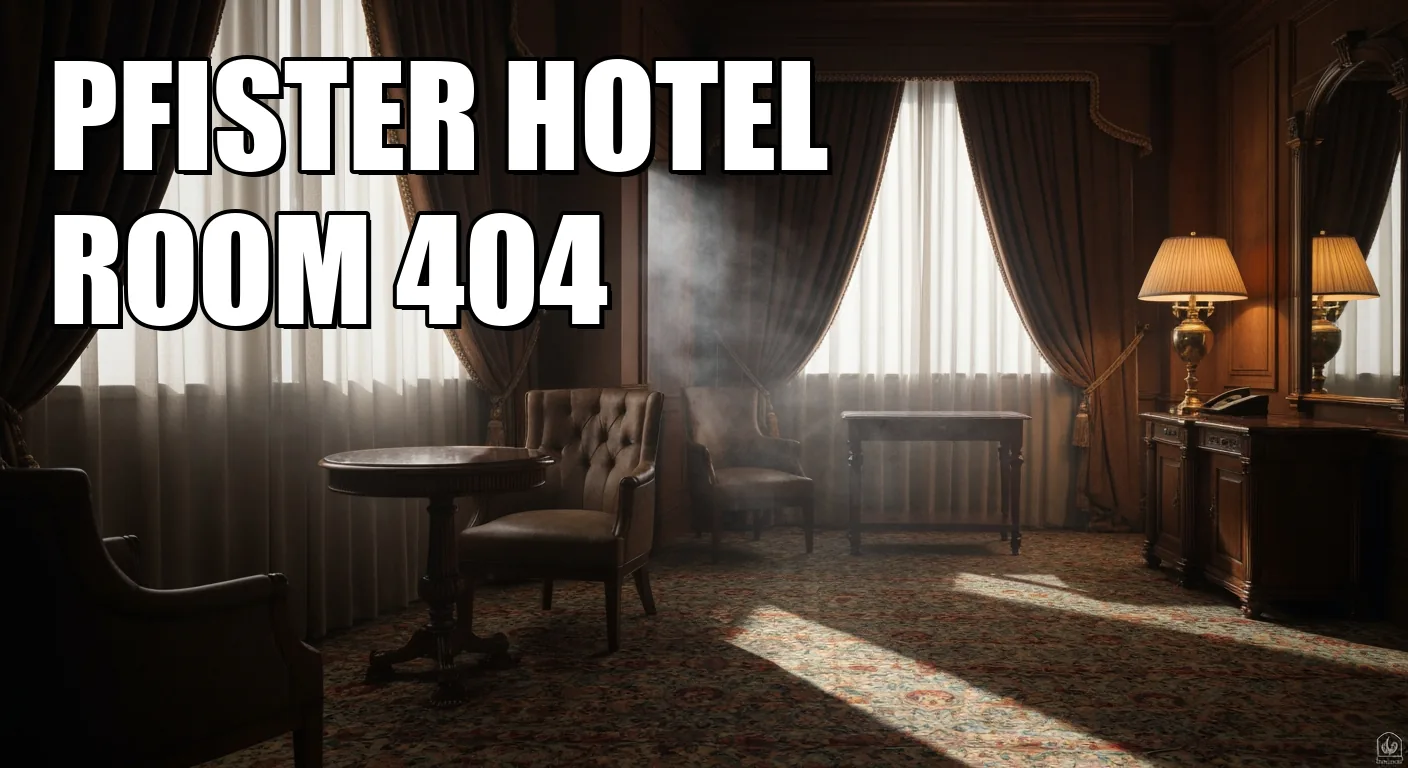
Most haunted hotels are documented by ghost tours and anonymous guest reviews. The Pfister in Milwaukee is documented by the sports press. For more than two decades, visiting Major League Baseball players — public figures, speaking on the record, with no ghost tour to sell — have described the same categories of experience in its rooms: electronics with a will of their own, pounding from inside the walls, and apparitions vivid enough to send a starting pitcher to the team chaplain. In 2018, three St. Louis Cardinals slept in one room for protection. That corpus makes the Pfister something rare: a haunted hotel with a repeating, named, quotable sample of witnesses — and a hotel that, remarkably, doesn't market any of it.
Booking reality: the Pfister is a working luxury hotel — an 1893 landmark with a guest tower added after a 1962 purchase, a lobby newly restored as part of a $20 million renovation plan, and what is reportedly the largest Victorian art collection of any hotel in the world. The player stories cluster in the historic wing — Brent Rooker specified the "old side" — so ask for the original building if the ghosts are the point, and the tower if they aren't.
The Batting Order of Witnesses
| Player | Year | What he reported |
| Adrián Beltré | 2001 | Knocking at the door, TV and air conditioning cycling on and off, pounding from behind the headboard "like a man hitting his hand against the wood" |
| Colby Lewis | 2010 | A "skeletal apparition" around 1:30 a.m.; met the team chaplain the next day and skipped a radio appearance |
| C.J. Wilson | 2010 | Flickering lights and unexplained events the same series |
| Carlos Gómez | — | His iPod played static after being switched off, then changed songs on its own; he fled to the lobby before putting his pants on |
| Michael Young | — | Heavy footsteps in his locked room; negotiated aloud — "make yourself at home... but do not wake me up" — and was left alone |
| Carlos Martínez, Marcell Ozuna, Francisco Peña | 2018 | Both Martínez and Ozuna reported ghosts in their rooms; all three ended the night sleeping in Peña's |
| Jon Gray | 2016 | Inverted the pattern — the paranormal-enthusiast pitcher spent his stay actively ghost-hunting the hotel |
| Brent Rooker | recent | TV in the old wing turning itself on and off and surfing channels — Golf Channel to QVC; he kept the room, "safe enough" |
Why Baseball, of All Things
The roster above is not a coincidence of celebrity; it is a sampling design. Visiting American League and National League teams stay at the same downtown hotels for series after series, year after year — which means the Pfister hosts the closest thing haunted hospitality has to a longitudinal study: the same population of guests, several nights a season, across decades, interviewed by beat reporters whose job is to write down what players say. Some entries are comic (Gómez and the pantless sprint), some are theatrical (Michael Young's negotiated truce), and at least one is genuinely unsettling in its aftermath — Colby Lewis didn't tell a funny story at breakfast; he sought out the chaplain. Veteran Mike Cameron's position may be the most telling of all: he never saw anything, and refuses to stay there anyway, on the strength of what teammates told him. When a legend changes professional athletes' travel behavior, it has crossed out of the ghost-tour economy into something more interesting.
The Hotel That Doesn't Need the Ghosts
What makes the Pfister's sports dossier stranger is that the hotel itself has never leaned on it. Guido Pfister envisioned the "Grand Hotel of the West" and his son Charles put the plan into motion, opening the hotel in 1893 with specifications that read like science fiction for the era: fireproof construction, one of the first all-electric hotels anywhere, and individual thermostat controls in every room. The art was there from the start and never left — at least 80 works of nineteenth- and early-twentieth-century Salon and Genre painting hang on permanent display, reportedly the largest Victorian art collection of any hotel in the world, enough to put the Pfister on Historic Hotels of America's 2022 Most Magnificent Art Collections list.
The building has been maintained like it means to see another century. After a 1962 purchase came the 23-story guest tower; in 2024 the hotel completed the lobby phase of a $20 million renovation plan — the marble of the grand staircase, the chandeliers, the terracotta fireplace and bronze lions all refurbished, and the "Salve" domed ceiling mural, painted for the hotel's centennial, relit. That staircase matters to the lore: the hotel's founding ghost is said to be Charles Pfister himself, described as a "good-natured, portly gent standing on the hotel's grand staircase, observing the lobby, watching the living go about their business." As resident hauntings go, a proprietor eternally checking on service standards is the most on-brand ghost in America.
How to Book It Like You Mean It
The practical read of two decades of player testimony: the phenomena live in the historic wing. Rooker placed his channel-surfing television on the "old side" explicitly, and the older room stock is where the stories concentrate. So the booking logic inverts by guest: if you came for the Victorian art, the restored lobby and a quiet night, the tower is your friend; if you came because a big-league third baseman heard fists inside his headboard, request the original 1893 building and bring patience — the Pfister's own marketing is all art and architecture, not apparitions — and that restraint is precisely why its file of first-person accounts reads more credibly than most. Baseball's other famously haunted road hotel — Oklahoma City's Skirvin, the NBA's equivalent nightmare — makes the perfect double-header for anyone collecting sports-verified hauntings.
The honest summary: nobody can tell you what is happening in the Pfister's old wing. What can be said, on the record, is that for twenty-plus years professional athletes with nothing to gain and some ribbing to lose have kept describing it — and the hotel has responded by restoring its murals and hanging its paintings, as if to say the Gilded Age doesn't need special effects. Book the old side and find out which of them is right.
The Cornerstone Brief
One historic place, once a week — what it is, why it matters, whether it's worth going. No filler, no paid placements.
Coming soon. Unsubscribe any time.