Famous Residents

Robie House: A Deep Dive into Wright's Prairie Masterpiece

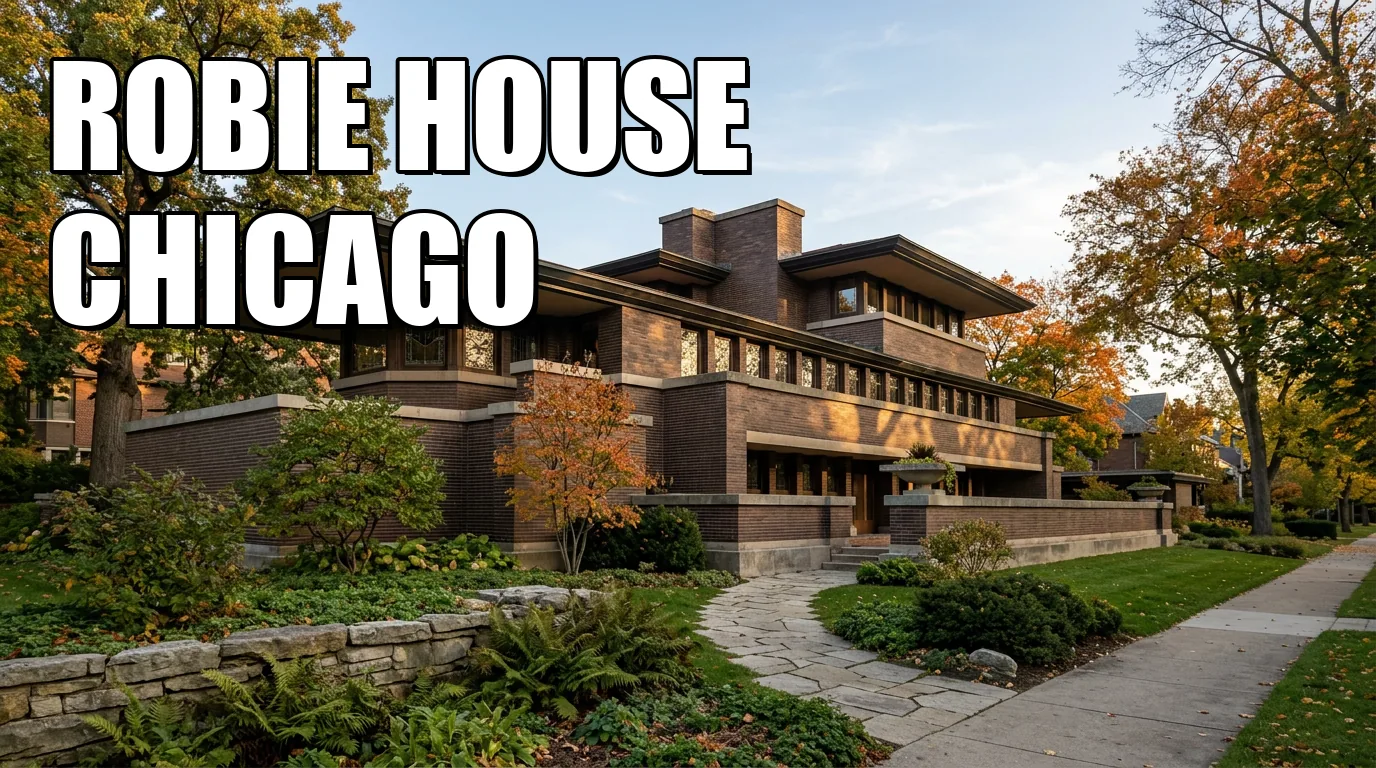
Does any building quite capture the audacious spirit of early 20th-century American modernism like Frank Lloyd Wright’s Frederick C. Robie House? Perched on a corner in Chicago's Hyde Park, it stretches, low and wide, asserting its horizontal dominance against the conventional verticality of its urban setting. Many guides will tell you it's a masterpiece of the Prairie style, a paradigm of open-plan living, but few truly unpack the fascinating saga of its creation—the costs, the timelines, and the sheer nerve required to bring such a vision to life. ### Beyond the Blueprint: What Did It Really Cost? You might imagine a project of this magnitude, conceived by a visionary architect like Wright, would have spiraled wildly over budget. Yet, the financial journey of Robie House tells a different tale, one of surprising fiscal discipline, at least initially. The total outlay for this groundbreaking residence tallied at a precise $58,500. This figure wasn't just pulled from thin air; it meticulously broke down into several key components. How was that significant sum allocated? A full $13,500 was dedicated solely to acquiring the land, a rather generous slice of the pie, indicating the importance of location even in 1908. The lion's share, $35,000, covered the design and actual construction of the building itself, encompassing everything from the foundation to the iconic rooflines. Finally, $10,000 was earmarked for the furnishings – a critical detail for Wright, who believed the interior elements were inseparable from the architecture. What’s truly remarkable is that Frederick C. Robie’s original budget stood at $60,000, making the final cost almost eerily on target. In today's currency, that 1910 expenditure of $58,500 would equate to a staggering $1.4 million to $1.5 million in the mid-2010s, a testament to its luxury and experimental nature. ### The Engineering Audacity: How Wright Truly Stretched the Limits One of the most defining and visually arresting features of Robie House, the dramatic cantilevered roof, often draws gasps from visitors. This isn't just a stylistic flourish; it represents a profound leap in residential engineering, particularly for its era. The twenty-foot cantilever, extending boldly from the residence's west side, created an unprecedented sense of openness and connection to the landscape, blurring the lines between indoors and out. Why was this such a groundbreaking achievement? Unlike traditional homes relying on heavy masonry walls for support, Wright achieved this seemingly impossible feat through innovative steel frame construction. This technique, typically reserved for commercial buildings or skyscrapers at the time, allowed for vast, open interior spaces and those signature overhangs without the need for cumbersome load-bearing walls. The contractor, H.B. Barnard Co., understood the precision involved, famously remarking that the builder "might as well have been making a piece of machinery." This quote isn't just a throwaway line; it speaks volumes about the shift in architectural thinking, treating a home not just as an organic dwelling but as a finely tuned apparatus. Intriguingly, the cost of this revolutionary roof wasn't itemized separately; it was so integral to the structural design that it simply fell under the $35,000 building construction budget, a reflection of Wright's holistic, integrated design philosophy. ### Stained Glass and the Unseen Details: A Testament to Wright's Total Design While the grand gestures of the cantilevers grab immediate attention, a true appreciation for Wright's genius at Robie House demands a closer look at the myriad details. Consider the 174 stained-glass art window and door panels, each featuring one of 29 distinct geometric designs. These aren't just decorative elements; they are essential components of the home's privacy, light filtration, and overall aesthetic harmony. Wright, ever the control freak (in the best possible way, for architecture, at least), designed every single one of these panels himself. What's surprising, and perhaps a little frustrating for architectural historians, is the complete lack of individual cost documentation for these intricate art glass panels. They, too, were simply folded into the overarching $35,000 construction budget. This reinforces a crucial point about Wright's Prairie style: it was a *Gesamtkunstwerk*, a total work of art where every element, from the largest structural beam to the smallest window pane, was conceived as part of an inseparable whole. To assign a separate price to the glass would have been to conceptually detach it from the building, a notion anathema to Wright's design philosophy. ### A Year and a Half in the Making: The Human Drama of Construction Understanding the timeline of Robie House’s construction paints a picture of ambition, collaboration, and even a dash of architectural abandonment. The process began with the acquisition of the land, a two-step dance completed by May 19, 1908, for that aforementioned sum of $13,500. Just under a year later, on April 15, 1909, groundbreaking commenced, with H.B. Barnard Co. of Chicago taking the reins. This was a relatively swift start for such an ambitious residential project. Yet, as the structure began to take shape, a pivotal moment in the Robie House narrative occurred: Frank Lloyd Wright departed for Europe in September 1909. He left the project in the capable hands of Hermann von Holst and George Mann Niedecken, focusing instead on what would become the influential Wasmuth Portfolio. This unexpected departure often gets glossed over in popular accounts, but it's a critical insight. It challenges the romanticized image of Wright as a solitary genius overseeing every nail and beam. Instead, it highlights the importance of his often-unsung collaborators and the robustness of his design principles, which allowed the work to continue in his absence. By early 1910, construction was substantially completed, and the Robie family—Frederick, Laura, Frederick Jr., and Lorraine—moved into their magnificent new home by May 1910. Even then, the house wasn't entirely finished; final details, including the rugs and furniture, weren't fully in place until January 1911, an 18-month saga from groundbreaking to the very last flourish. ### Stepping Inside the Vision: What to Expect from Your Visit So, you’ve read the history, pondered the costs, and marveled at the engineering. What’s it *actually* like to visit Robie House today? Many visitors arrive expecting to walk into a perfectly preserved 1910 home, perhaps even imagining the Robie family still living there. The reality, while still deeply rewarding, offers a slightly different experience. Operated by the Frank Lloyd Wright Trust, Robie House functions primarily as a museum, and its interiors are carefully preserved and presented to tell its story. Expect guided tours, not free-roaming exploration. This isn't a criticism; it's a practical necessity for preserving such a significant structure and ensuring an educational experience. Tours typically run on a schedule, and booking in advance, especially during peak season (late spring, summer, early fall), is highly recommended. Weekday visits often offer a slightly less crowded experience than weekends, allowing for more intimate viewing of the expansive living areas and the ingenious flow of space. Admission fees are standard for historic house museums (check the Trust's website for current rates, but plan on around $20-25 for adults), and while street parking can be found, it’s often limited, so consider public transport or ride-shares. Be prepared for some walking, as the surrounding Hyde Park neighborhood, home to the University of Chicago, is best explored on foot. While the furnishings might not all be original Robie family pieces, they are painstakingly curated to reflect Wright's integrated interior designs, offering a tangible sense of his vision. Don't be surprised if the sheer scale feels smaller than photos suggest; the genius lies in the *feeling* of expansive space within a relatively contained footprint. ### An Enduring Statement: Robie House's Unseen Influence What makes Robie House truly unique, beyond its architectural bravado and financial story, is its ongoing relevance. It isn't just a static monument to a bygone era; it's a living lesson in how radical ideas can permeate and change the way we live. Its influence on residential architecture, particularly the open floor plan and the emphasis on natural light, is undeniable, even if many homeowners today might not realize they're living in a lineage tracing back to this very building. This house, commissioned by an ambitious young businessman and realized by a defiant genius, stands as a powerful reminder that true innovation often comes with a precisely calculated cost, a tight timeline, and the critical support of a dedicated team. For those who visit, it offers a rare opportunity to step inside a moment of profound architectural transformation and to feel the quiet power of a vision that continues to shape our built world. Go, experience it for yourself, and look beyond the obvious; there's so much more to discover within those long, low lines.

Ultimate Guide to the Robie House: Frank Lloyd Wright's Architectural Masterpiece in Chicago

Can you tour the Robie House?
Yes, the Robie House offers guided interior tours Thursday through Monday from 10:00 AM to 3:00 PM, with extended hours on Thursdays until 3:30 PM; the house is closed Tuesday and Wednesday. Tours are limited to 14 people per group, so advance booking is recommended.
What is the admission price for the Robie House?
General admission prices range from $24 to $75 per person depending on the tour type, with the basic guided interior tour starting at $24. The "Inside and Out" tour combining an interior guided tour with a self-guided outdoor audio tour offers excellent value and is available in eight languages.
Is Robie House worth visiting?
Yes, the Robie House is absolutely worth visiting as it's a UNESCO World Heritage Site and considered one of the most important buildings in architectural history. It represents Frank Lloyd Wright's revolutionary Prairie style and continues to influence modern residential architecture.
What is so special about the Robie House?
The Robie House pioneered the Prairie style with its dramatic 20-foot cantilevered roof, horizontal lines, open floor plan, and seamless connection between interior and exterior spaces. Completed in 1910, it revolutionized residential design and is recognized as the "measuring stick" against which all other Prairie School buildings are compared.
Is there a Frank Lloyd Wright tour in Chicago?
Yes, the Frank Lloyd Wright Trust offers guided tours of multiple Wright properties including the Robie House, Wright's Home and Studio in Oak Park, and Unity Temple. Additionally, comprehensive tours combining several Wright sites are available through travel companies like Martin Randall Travel.
What is the best tour in Chicago?
The Chicago Architecture River Cruise aboard the First Lady, operated by the Chicago Architecture Center, is voted #1 boat tour in the United States by USA Today readers and has been Chicago Reader's Best Tour for over 10 years. It starts at $56 and provides expert commentary on dozens of landmark buildings.
Why is Taliesin West closing?
The School of Architecture at Taliesin, founded by Frank Lloyd Wright in 1932, closed in 2020 because the school could not reach an agreement with the Frank Lloyd Wright Foundation regarding a sustainable business model. However, Taliesin West itself remains open for tours and operates as a historic site.
Is the MCA Chicago worth visiting?
Yes, the Museum of Contemporary Art Chicago is worth visiting for contemporary art enthusiasts, offering cutting-edge exhibitions, an outdoor sculpture garden, and constantly evolving shows. General admission is $22 for non-Chicago residents, or free for Chicago residents on Tuesdays.
Which is the best architecture tour in Chicago?
The Chicago Architecture Center offers highly-rated tours including their signature river cruise and walking tours of historic neighborhoods like Oak Park where Frank Lloyd Wright's early works are located. Their expertly-guided experiences consistently receive top ratings from visitors.
How long does a Robie House tour take?
The standard guided interior tour of the Robie House typically lasts 90 minutes, while the "Inside and Out" tour combining the interior tour with a self-guided outdoor audio tour allows you to take them in any order and experience the house in its architectural context.
What should I expect to see inside the Robie House?
Inside the Robie House, you'll experience Wright's innovative open floor plan centered around a main hearth, spectacular art-glass windows, cantilevered spaces, and the seamless integration of interior and exterior design. The tour covers the house's history, design philosophy, restoration efforts, and furnishings.
Can I visit the Robie House without a guided tour?
The Robie House requires advance booking for guided tours; self-guided visits are not available. However, the "Inside and Out" tour includes a self-guided outdoor audio component that explores the surrounding neighborhood and architectural context.
Who is coming to Chicago in 2025 concert?
Paul McCartney is performing at the United Center in Chicago on November 24-25, 2025, as part of his Got Back Tour 2025, marking his first extensive North American tour since 2022.
How do I book a tour at the Robie House?
You can book Robie House tours directly through the Frank Lloyd Wright Trust website (flwright.org) or by calling (312) 994-4000. Advance booking is highly recommended due to small group sizes and limited daily tour slots.
Is the Robie House accessible for people with mobility issues?
The Robie House is a historic 1910 residence with stairs and varying floor levels; visitors should check the Frank Lloyd Wright Trust website or call ahead regarding specific accessibility features and accommodations available for their visit.