Stepping into Norman Rockwell’s Stockbridge studio today, visitors often expect the quaint, perhaps dusty, artistic chaos you might associate with a prolific painter. What they encounter, however, is something far more precise, deeply personal, and surprisingly revealing. This isn't just a building; it’s a meticulously preserved portal into the mind and methods of one of America's most beloved, and often misunderstood, artists. Having explored countless historic sites, I can tell you that few places offer such an intimate, unfiltered glimpse into the creative process, especially one that evolved so dramatically over two crucial decades.
The Unassuming Barn: From Horsepower to Human Insight
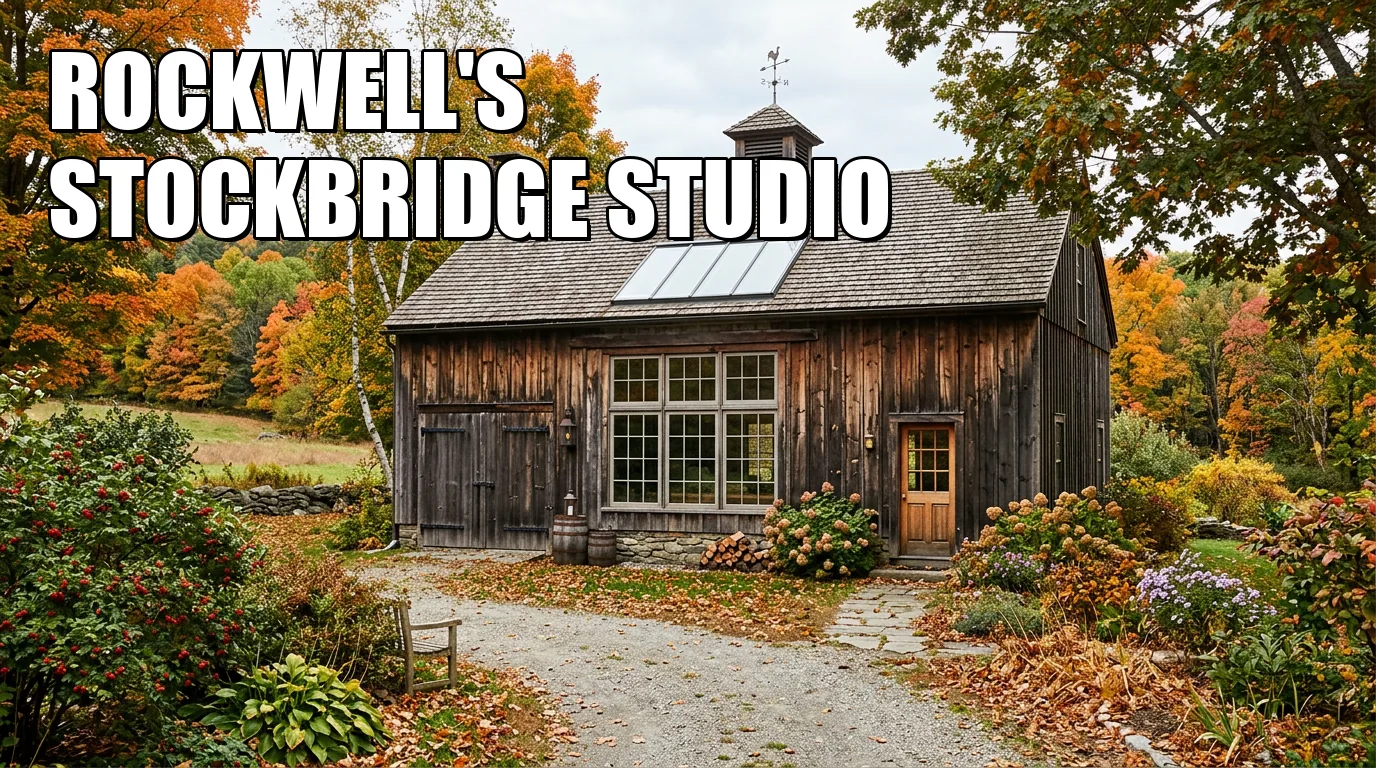
How does a simple 1830s carriage barn transform into the nerve center for an artist who captured the very soul of American life? Rockwell, after moving to Stockbridge in 1953 and initially renting a space on Main Street, found his true creative sanctuary in this dilapidated structure behind his South Street home in 1957. He famously declared it his "best studio yet." This wasn't merely a convenient location; it was a deliberate design choice, a conscious effort to craft an environment perfectly attuned to his demanding work. The transformation was spearheaded by Ejner Handberg, a Danish cabinetmaker known for his Shaker reproduction furniture, working from architect Dean Parmelee's design. Parmelee, incidentally, had also designed Rockwell's New Rochelle studio, highlighting a continuity in Rockwell's spatial preferences.
What truly sets this period apart, between 1957 and his death in 1978, is that this studio became the stage for Rockwell’s most profound evolution. This isn't the Rockwell of quaint small-town scenes alone; this is the artist grappling with the tumultuous social changes of the 1960s and 70s. The studio, therefore, isn't just significant for its architectural lineage, but because it is the only surviving studio among Rockwell's estimated 20 workspaces throughout his long career. Its relocation in two pieces to the Norman Rockwell Museum campus in 1986, mandated by his will, speaks volumes about his understanding of its future historical weight.
North Light, Dual Doors, and a World of Inspiration: Rockwell's Intentional Workspace
Walk inside, and the immediate impression is one of organized purpose. The studio’s split-level layout and specific design elements weren't accidental; they were carefully engineered. Most striking are the expansive north-facing windows on the main level. For an artist, north light is the holy grail—it provides consistent, soft, and shadow-minimizing illumination throughout the day, essential for rendering realistic detail without constantly battling shifting sunbeams. These weren't small panes; they were enlarged in 1961 and expanded again in 1962, a clear indicator of Rockwell’s unwavering demand for optimal light. This commitment to consistent, controlled lighting is something many casual visitors might overlook, but it speaks volumes about his professional rigor.
Beyond the critical lighting, the studio featured a pair of entrances, front and back, facilitating a constant flow of activity. This detail often surprises people who envision an artist toiling in solitary confinement. Rockwell’s studio was a bustling hub where models, local community members, and even famous celebrities would often drop in. Imagine Rockwell, always hospitable, frequently offering a refreshing Coca-Cola to his guests. The loft space above served as a treasure trove: art supplies, models' clothing, a vast array of props, and memorabilia from his global travels, including an actual skull and boxes brimming with discarded sketches. It wasn't just a place to store things; it was a physical manifestation of his creative process, a repository of both success and abandoned ideas. And yes, for those wondering about his technical process, a darkroom within the studio allowed him and his photographers to process reference photos, revealing his reliance on photography as a tool, not a replacement for his artistic skill.
More Than Just Brushes: Artifacts That Fuelled a Master's Vision
What truly elevates this space beyond a mere workspace is the carefully curated collection of artifacts Rockwell surrounded himself with. It tells a story not just of his technical approach, but of his intellectual curiosity and his deep connection to art history. Reproductions of masterpieces by artists like Johannes Vermeer, Pieter Brueghel the Elder, Pablo Picasso, Michelangelo, and Canaletto adorned his walls. These weren’t decorative choices; they were daily inspirations, a constant dialogue with the titans of art. He wasn’t just looking at American life; he was seeing it through a global, historical lens.
Curiously, not every item was a classical masterpiece. Visitors will find a skull, complete with a German spiked helmet and springs that made its jaw snap shut—a macabre, almost whimsical detail that speaks to his playful side and his interest in anatomical drawing. African masks and spears hung alongside a replica of Ben Franklin's printing press. This eclectic mix—from high art to anatomical curiosities, from global cultures to American ingenuity—reveals a mind constantly seeking reference, narrative, and provocation. His extensive library of reference materials and an AM/FM radio broadcasting classical music into the studio underscore this point. He wasn't working in a vacuum; he was working within a meticulously constructed world of his own design, a world designed to spark ideas.
Where Ideas Took Form: Iconic Paintings and Unforeseen Moments
The true magic of the Stockbridge studio lies in the iconic works that emerged from its walls. Perhaps the most striking documented moment occurred in October 1960, when Rockwell was deep into creating "Golden Rule," commissioned for the April 1, 1961, Saturday Evening Post cover. An enthusiastic photographer, hired by Rockwell, captured the unfinished painting on the easel and, crucially, photographed the entire studio environment. These archival images became invaluable years later, allowing the museum to painstakingly recreate the studio *exactly* as it appeared on that specific day in 1960. What many visitors don't realize is that Rockwell rescued a long-abandoned 10-foot charcoal drawing titled "United Nations" from his cellar for this project, realizing it perfectly conveyed his vision of global unity for "Golden Rule." It’s a powerful testament to an artist’s ability to resurrect and repurpose past ideas for new, profound purposes.
Just a few years later, between 1963 and 1964, the studio witnessed the creation of "The Problem We All Live With," one of the Civil Rights Movement's most iconic images. Inspired by Ruby Bridges' courageous walk to school, Rockwell poured his conscience into this powerful illustration. Local nine-year-old Lynda Gunn would walk to the studio daily after school for a week, posing for photographs and sketches. This isn't just a historical anecdote; it underscores how deeply Rockwell engaged with his immediate community for his most significant works. He even saved a New York Times article from July 14, 1964, "A 2nd Body is Found in the Mississippi," which directly inspired his subsequent painting, "Murder in Mississippi," illustrating the tragic slaying of civil rights workers. This progression from "Golden Rule" to "The Problem We All Live With" shows the studio not just as a workplace, but as a space where Rockwell’s moral compass increasingly pointed towards social justice.
The studio floor often bustled with activity, bringing local color directly into his art. Ten-year-old Jeff Csatari, for instance, was recruited directly by Rockwell to hold a flag string from the loft for a Boy Scouts photograph, earning him a princely sum of $25 (which Csatari promptly spent on a Joe Namath football). Massachusetts State Trooper Richard J. Clemens, a neighbor, was spotted by Rockwell and asked to pose for "The Runaway" (1958) over a chance encounter at a local restaurant. And William Obanhein, Stockbridge’s chief of police, became a frequent fixture. These stories reveal a deeply connected artist who found his inspiration not just in grand concepts, but in the everyday faces and lives of his town. It challenges the notion of the isolated genius, presenting Rockwell as an artist deeply embedded in his community.
Beyond the Easel: Rockwell's Habits, His Legacy, and Your Visit
Rockwell’s meticulousness wasn't confined to his canvas. Visitors often wonder about the artist’s daily routines, and the studio provides clues. Despite the constant stream of visitors and models, Rockwell maintained an exceptionally clean workspace, tidying up multiple times a day. This wasn't merely a quirk; it reflected his methodical work habits and the intense, deadline-driven schedule he maintained. In his later years, as the demands of his career mounted, he was also known to take regular naps on a couch within the studio, a humanizing detail that speaks to the sheer exhaustion of his creative output. These aren't details you'll find in every guide, but they paint a vivid picture of the man behind the paintbrush.
What makes this particular studio a must-visit, beyond its storied past, is its powerful resonance today. In 2022, the studio was rightfully inducted into the National Trust for Historic Preservation's Historic Artists' Homes and Studios program, cementing its place in the pantheon of significant American art sites. The interior is faithfully interpreted to appear exactly as it did in late 1960, providing an unparalleled window into the workspace where Rockwell forged some of his most socially conscious and enduring works during a pivotal era in American history. It's not just about seeing where Rockwell painted; it's about experiencing the environment that shaped his transformation into an artist of conscience.
Planning your visit? The Norman Rockwell Museum, home to the studio, is located in the beautiful Berkshire region of Massachusetts. While accessible year-round, I’d highly recommend visiting during the shoulder seasons—late spring (May-June) or early fall (September-October)—to avoid the peak summer crowds and enjoy the stunning New England foliage. Admission typically ranges from $20-25 per adult, and there's ample, free parking on site. To truly immerse yourself, allow at least 2-3 hours for the museum and studio. Arriving shortly after opening on a weekday will often provide the quietest, most reflective experience, allowing you to absorb the studio's unique atmosphere without feeling rushed. Don't just look at the artifacts; consider *why* they were there, and *how* they contributed to the genius of a man who held a mirror to America, even when its reflection was challenging.