A St. Augustine inn can advertise 1790 without telling you whether your room occupies an eighteenth-century house, a 1906 residence or a later conversion. The date may identify the oldest structure on a multi-building property, the first house shown on a map or one milestone in a building that was substantially remodeled.
The useful booking question is therefore not “Which inn is oldest?” It is which building contains the named room, and how clearly does the property disclose that relationship? Bayfront Marin House, The Collector and St. Francis Inn answer at three different levels: component, campus and milestone.
A property date is not a room guarantee
Component-level disclosure identifies the historical building or section containing a room. Campus-level disclosure explains the buildings on the grounds but may not map bedrooms to them. Milestone-level disclosure supplies a sequence of owners, uses and dates without locating today’s room inventory inside that sequence.
None of those levels determines whether the stay is good. A guest may care more about a courtyard, service or modern bathroom than the age of a bedroom wall. The distinction matters only when the history itself is part of what the guest intends to book.
Bayfront Marin House publishes the most useful component map
Bayfront’s history does not support treating 1788 as a construction date for the building a guest sees today. The Roque map from that year showed a wooden house in poor condition on the property. Title to the lot passed to Francisco Marin Jr. in 1806. The surviving Marin house at 47 Marine Street is described more broadly as Second Spanish Period masonry; the reviewed sources do not give that fabric an exact year.
The present downtown inn is a physical combination of three houses. Captain Henry Belknap bought the Victorian cottage later called Hopkins Cottage. In 1893 he bought Andrew Burgess’s cottage, moved it east on the lot and attached it to his home. He then acquired the coquina Marin house and connected the group with wooden additions. After Belknap’s death, the combined building became apartments in 1909, later operated as short-term rentals and reopened after restoration as a bed-and-breakfast in July 2003.
The unusually useful part is that Bayfront names the present rooms inside those components. Its history assigns the Francisco Marin Room, Coquina Suite, Governor White and Lyndsay Michelle to the Marin house. King George, Marie Antoinette, Hopkins Cottage, Bridge of Lions, Robinson Lewis and Captain Henry belong to the Hopkins component. Burgess Cottage, Forrester Suite and Princess Margaret are assigned to the Burgess component; the source also mentions unnamed “Marine Street rooms” and omits the Napoleon Suite from its historical component assignments, so the mapping is not perfectly complete.
That room map establishes location, not untouched fabric. The houses were moved or joined, enlarged with wood construction, converted into apartments and restored. Booking the Coquina Suite places the guest in the Marin component; it does not certify that every wall, finish and room division survives unchanged from the Spanish period.
The brand also extends beyond the joined downtown structure. Rooms 18 and 19 occupy the adjacent Sanchez House at 7 Bridge Street. A separate apartment at 10 Marine Street sits above Chatsworth’s Pub in the Bella Bay Inn. Eight more units are distributed among four addresses on Beachcomber Way in Vilano Beach. Those can all be valid Bayfront stays, but they are not interchangeable architectural experiences.
The Collector explains its campus better than its rooms
The Collector presents nine buildings dating from 1790 to about 1915. Their histories are specific: the Murat House dates to 1790; the Dow and Canova houses to 1839 and 1840; the Star Building and Spear House to 1899; Worcester House to 1906; Rose House to 1907; Howells House to 1909; and The Well, originally a garage for Howells House, to about 1915.
Those structures did not share one original function. The Spear House began as carriage storage, received a second story and later became a rooming house and art gallery. The Star Building began as a general store and now serves as the hotel lobby. The Well is now the cocktail bar. The site subsequently operated as the Dow Museum of Historic Houses before its current hotel use.
This is strong campus history, but it does not tell a guest where most of The Collector’s 30 rooms sit. In the selected official room material, only the Two-Bedroom with Private Balcony is explicitly placed on the first floor of Worcester House. The reviewed sources do not map the other room types to the Murat, Dow, Canova, Spear, Rose or Howells houses, and they do not establish that every one of those buildings contains lodging.
The distinction prevents a tempting but false conclusion. A guest cannot assume a room is in the 1790 Murat House simply because 1790 leads the property timeline. Nor should anyone claim that guests sleep in the 1899 store or 1915 garage: the property identifies those buildings as the lobby and bar.
St. Francis supplies milestones, not a modern room provenance map
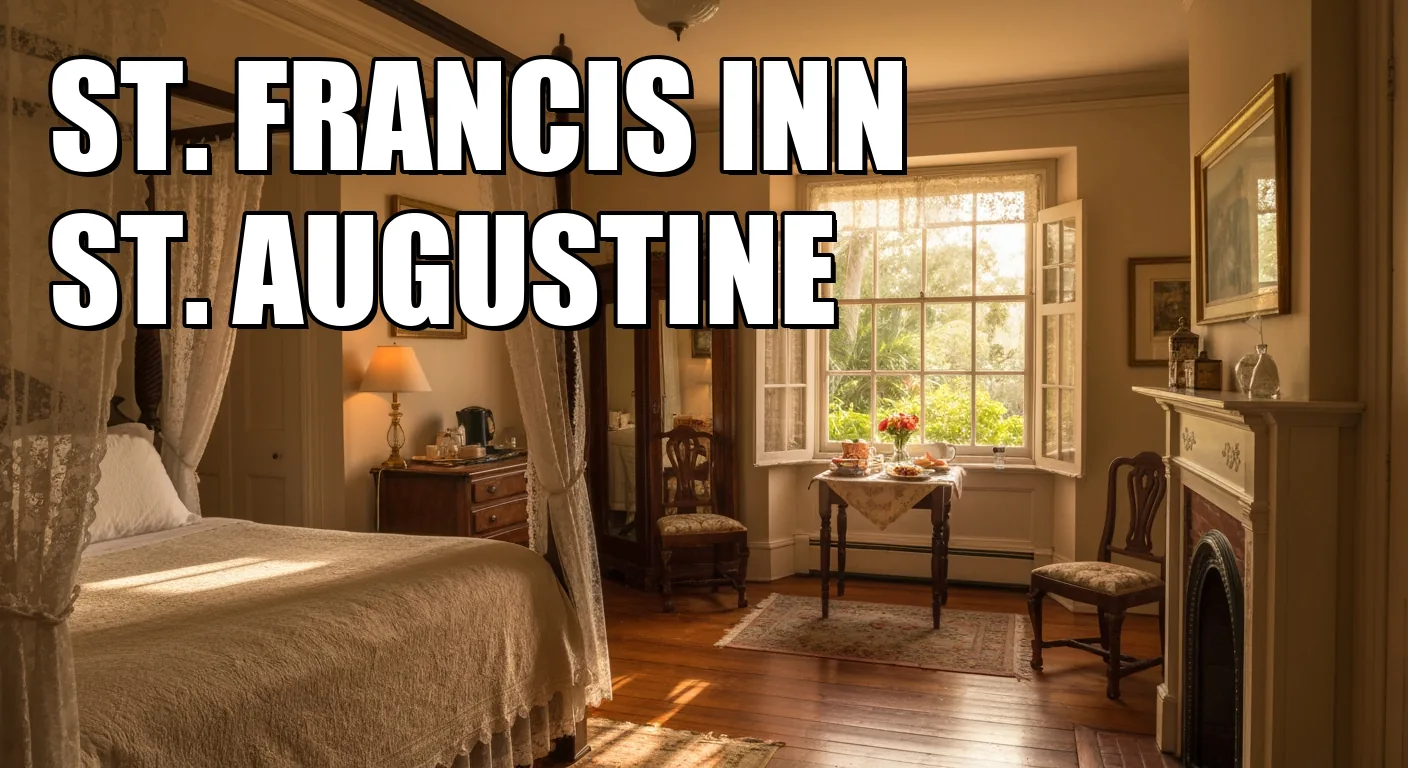
University of North Florida architectural documentation dates the St. Francis building to a private residence constructed for Gaspar Garcia in 1791. Thomas Dummett bought it in 1838; his widow, Anna Dummett, turned it into a boarding house in 1845. The name St. Francis Inn became official in 1948.
The city’s preservation plan adds a layer that a single colonial date misses. It describes 279 St. George Street as a remodeled colonial residence exhibiting Second Empire design during the broader Flagler-era transformation of St. Augustine. The source does not assign an exact year to that remodel.
Together, those records prove an old residence, a later lodging use, a later name and a visible stylistic transformation. They do not prove uninterrupted inn operation from 1845 to the present, and the sources reviewed do not map current guest rooms to the 1791 footprint or later alterations. A room at St. Francis therefore comes with substantial building history but not room-specific architectural provenance.
Choose the level of certainty you actually want
Before booking, write down the exact room name and try to complete one sentence: “This room is in ___, built or substantially altered during ___.” Use the property’s own map or building history, not the oldest year in a search result. If the blank cannot be filled, treat the date as a property-level story rather than a promise about the fabric around the bed.
That is not a reason to reject the inn. It is a way to buy the experience you intended: a particular historical footprint, a layered campus or simply a modern room inside a place with a long past.