Stepping onto Federal Street in Brunswick, Maine, the Harriet Beecher Stowe House doesn’t immediately scream "literary landmark." It's a charming, unassuming dwelling, much like many others from its era. Yet, within its modest walls, a volcano of moral indignation erupted, giving birth to a novel that didn't just sell copies; it ignited a nation. Most visitors come expecting to connect with a legend, perhaps even hoping for a whisper of Abraham Lincoln's famous, likely apocryphal, greeting to Stowe. But the real magic, the true, gut-wrenching origin story of *Uncle Tom's Cabin*, lies not in grand pronouncements, but in the intimate human connections forged right here, in a bustling household brimming with children and intellectual ferment.
Beyond the Myth: What Really Stirred Stowe's Spirit in Brunswick?
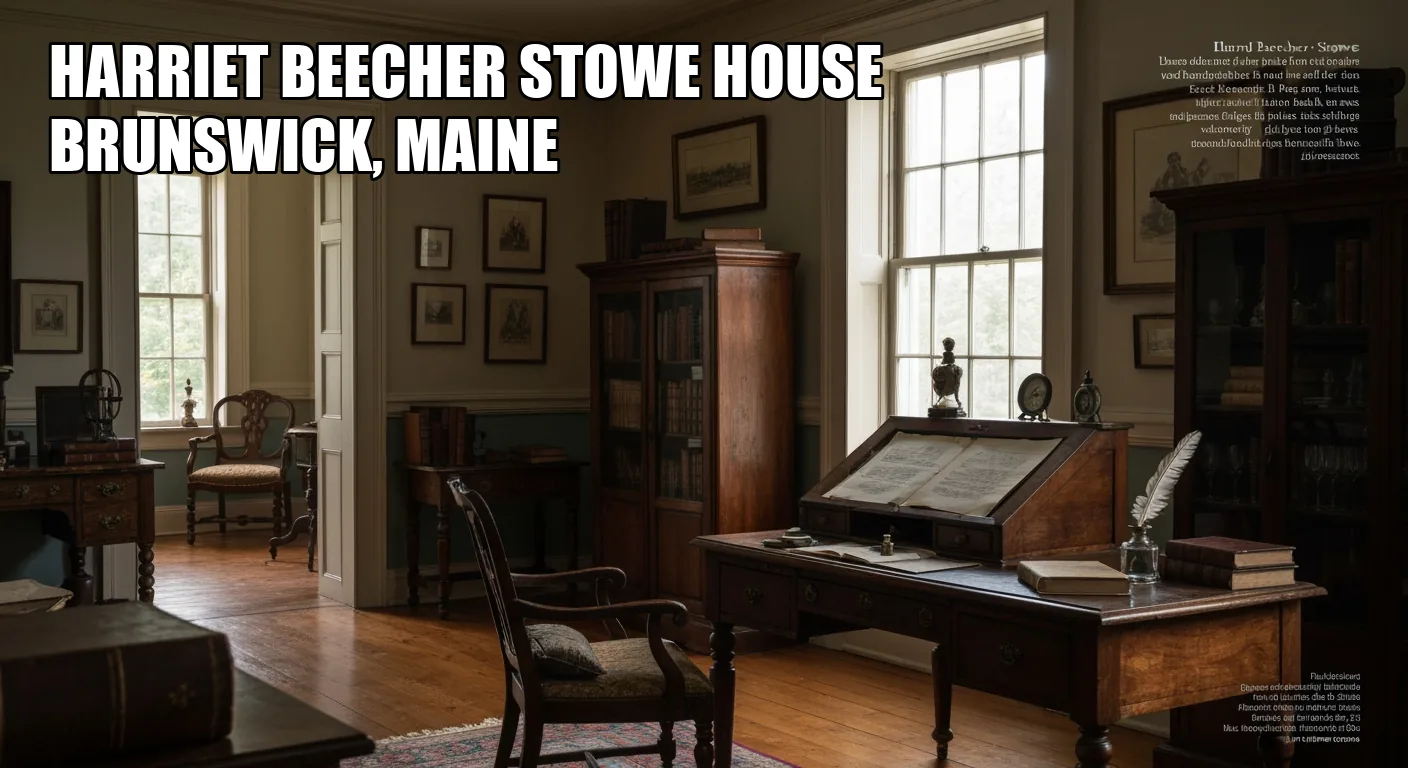
We often romanticize the act of creation, imagining authors cloistered away in serene studies. Harriet Beecher Stowe, however, penned her earth-shattering narrative amidst the chaos of six children, the demands of a small school she co-ran with her sister Catharine, and the incessant rhythm of mid-19th-century domestic life. Her primary literary space, now reverently designated as "Harriet's Writing Room," was in fact the front parlor. This wasn't some isolated sanctuary; it was a communal room, a hub of daily activity, where ideas were debated, children played, and guests were entertained. The sheer audacity of composing a work of such profound social commentary within such a whirlwind of domesticity always strikes me as one of the most remarkable, and often overlooked, aspects of her creative process.
Why this parlor, specifically? Because it was here, within these very walls, that Stowe began to test the waters of her evolving narrative. Before serialization, she would gather a select audience—often eager young Bowdoin College students and close friends—and read aloud successive chapters of what would become *Uncle Tom's Cabin*. Imagine the scene: the gaslights flickering, the hum of anticipation, as Stowe’s voice filled the room, giving life to characters like Uncle Tom and Eliza before they ever reached the printed page. This was a crucial proving ground, an intimate feedback loop that allowed her to refine her language, sharpen her critiques, and gauge the emotional impact of her burgeoning masterpiece.
A Crucible of Ideas: How Young Minds Shaped a Nation's Conscience
Among the rapt listeners in that Brunswick parlor was a young Bowdoin College student named Joshua Lawrence Chamberlain, who would later achieve fame as a Civil War general and Maine governor. Chamberlain's own recollections paint a vivid picture of these gatherings, describing a "chosen circle of friends, mostly young," who were "favored with the freedom of her house." He recounted the frank discussions that followed each reading, a testament to Stowe's willingness to engage with her audience and hone her message. These informal literary salons were more than mere entertainment; they were incubators for a novel that would fundamentally alter the national discourse on slavery, and this small parlor served as its intellectual hearth. Without these early, candid exchanges, would *Uncle Tom's Cabin* have resonated with quite the same power when it debuted serially in *The National Era*, an abolitionist newspaper, starting on June 5, 1851?
The very act of reading aloud to an audience before publication imbued the work with a certain immediacy, a living quality that might have been lost had it remained solely a private endeavor. It forced Stowe to confront her narrative directly, to hear it spoken, to see it reflected in the faces of her listeners. This direct, almost theatrical, presentation style undoubtedly influenced the novel's dramatic pacing and its powerful emotional appeals, qualities that made it so uniquely effective in reaching the hearts and minds of a diverse readership. It’s a stark reminder that even the most solitary creative acts often thrive on communal resonance.
The Lincoln Connection: Debunking a Cherished, Yet Fabricated, Anecdote
Most visitors arrive at the Stowe House, or any Stowe-related site, with a particular quote etched into their minds: Abraham Lincoln's alleged greeting, "So you're the little woman who wrote the book that made this great war." It’s a perfect, pithy summary of *Uncle Tom's Cabin*'s monumental impact, and it’s deeply ingrained in popular history. However, as an experienced traveler to historical sites, I’ve learned to question such tidy narratives. The truth, in this case, is far more nuanced and, frankly, more interesting because it reveals how history is shaped by memory and desire. While Lincoln and Stowe did indeed meet, that famous encounter occurred on December 2, 1862, at the White House in Washington, D.C.—a full decade after Stowe had departed Brunswick. Lincoln never set foot in her Brunswick home.
Furthermore, the iconic quotation itself is considered historically problematic by scholars. It didn’t appear in print until 1911, recounted by Stowe's son and grandson in their biography, more than 25 years after Stowe's death and nearly 50 years after Lincoln's. Crucially, Lincoln himself left no known record of the meeting, nor did any contemporary White House personnel or newspaper accounts document the specific words. This isn't to diminish Stowe's influence, which was undeniably immense, but it highlights the human tendency to invent or embellish stories to elevate historical figures and simplify complex historical causality. The "little woman" quote, while compelling, is largely regarded as apocryphal, a product of family lore rather than documented fact. Challenging such well-worn tales allows for a deeper appreciation of the actual, often less dramatic but more truthful, contours of history.
A Fugitive's Story: The Raw Human Spark Igniting Stowe's Imagination
If the Lincoln quote is a historical embellishment, what, then, was the true crucible of inspiration for *Uncle Tom's Cabin* within this house? The answer arrived on a cold November night in 1850, not in a grand idea, but in the desperate footsteps of a man named John Andrew Jackson. Jackson was a fugitive slave, fleeing the brutal realities of bondage, and he sought refuge at the Stowe residence. He spent just one night under their roof before being guided onward towards freedom in Canada. This wasn't a theoretical discussion or a distant news report for Stowe; it was a direct, visceral encounter with the living embodiment of the institution she abhorred.
Jackson's own 1862 autobiography recounts the profound impact of that night: "I met with a very sincere friend and helper, who gave me refuge during the night, and set me on my way. Her name was Mrs. Beecher Stowe. She took me in and fed me, and gave me some clothes and five dollars. She also inspected my back, which is covered with scars which I shall carry with me to the grave." This isn't just a fleeting anecdote; it's a foundational moment. Stowe didn't just hear a story; she *saw* the physical evidence of cruelty, *felt* the urgency of his plight, and *responded* with direct, compassionate aid. This tangible encounter with human suffering, with the raw, undeniable reality of slavery's brutality, proved transformative. It galvanized her moral conviction and directly fueled her creative vision, pushing her to begin drafting *Uncle Tom's Cabin* in early 1851, mere months after Jackson's visit. This is the authentic, powerful origin story that resonates most deeply within these walls.
Visiting Brunswick's Gem: Practicalities and Profound Reflections
For those planning a visit to this pivotal site, understand that the Harriet Beecher Stowe House in Brunswick, Maine, offers an experience of intimate reflection rather than grand spectacle. The house itself is a relatively modest structure, reflecting the daily lives of a 19th-century academic family rather than a sprawling estate. While specific admission fees can vary, expect a nominal charge for entry, often around $8-12 per adult, which supports its preservation. Parking is typically available on nearby streets or in small municipal lots within walking distance, though during peak tourist seasons like summer (July-August) or Bowdoin College's commencement weekends, spots can be harder to find. A weekday morning visit during the shoulder seasons (late April-May or September-early October) often provides the most serene experience, allowing for quiet contemplation in the parlor without the bustle of larger tour groups.
What sets this house apart from many other historical homes, in my estimation, is the palpable sense of purpose it still exudes. You don't just see period furniture; you feel the weight of a conscience stirred to action. Expect to spend perhaps an hour or two exploring the rooms and reading the interpretive panels, which do an excellent job of contextualizing Stowe's life and work within the broader abolitionist movement. Don't rush through the "Writing Room." Take a moment. Close your eyes. Can you almost hear the whispers of young Chamberlain, or perhaps feel the lingering urgency of John Andrew Jackson's presence? This small, unassuming house, far from the grand stages of Washington or New York, reminds us that the most profound shifts in human history often begin in the quiet, determined resolve of individuals facing extraordinary circumstances. It's a humbling, and utterly essential, stop for anyone seeking to understand the power of literature and the enduring struggle for justice.