Photo by Benjamin Stone for Cornerstone Mansion · January 12, 2026
For years, I've crisscrossed the United States, drawn by the silent narratives embedded in our oldest structures. There’s a particular fascination for me with the earliest wood frame colonial architecture—not just the elegant brick Georgians, but those raw, unvarnished survivors built when the wilderness still pressed close. These aren't just buildings; they're textbooks in timber, revealing the sheer tenacity and practical genius of early American settlers. Often, they stand quietly, overshadowed by more dramatic historical events, yet their very existence is a testament to an era of craftsmanship and adaptation often missed by the casual tourist.
When you strip away the layers of paint, wallpaper, and subsequent additions, you begin to see the core ingenuity. The earliest settlers, many arriving from parts of England where stone was prevalent, quickly learned to harness the seemingly limitless timber resources of the New World. They brought with them medieval English building traditions, adapting them to a new climate and the immediate availability of materials. This often meant using *green wood*—freshly felled timber—without the luxury of seasoning, a practice that actually contributed to the incredible strength of these early frames as the wood slowly dried and hardened in place. What emerged was the *timber-frame* construction: massive oak posts and beams, often 8 to 12 inches square, meticulously joined with *mortise and tenon* connections, then secured not with nails (which were scarce and expensive), but with sturdy wooden pegs. This method created a skeleton that could withstand centuries of New England winters, a silent marvel of engineering.
A Journey into American Beginnings: Decoding Wood Frame Colonial Architecture
What truly sets these structures apart isn't merely their age, but the story of how they were made and how they evolved. You won't find the elaborate ornamentation of later periods here. Instead, their beauty lies in their honest function: thick oak frames, walls often infilled with *wattle and daub* (a mixture of sticks, twigs, mud, and clay) for insulation, then sheathed with hand-split *clapboards*. These practical choices were born of necessity, but they also forged a distinct aesthetic. The enormous *central chimney* found in many of these homes wasn't just for smoke; it was the thermal and structural heart of the house, a massive stone or brick anchor around which the entire dwelling was organized, providing heat to multiple rooms and floors. Understanding these fundamental elements transforms a simple walk-through into a profound connection with the past, allowing you to appreciate the ingenuity that underpins American building traditions.
Fairbanks House: Beyond the "Oldest House" Hype in Dedham
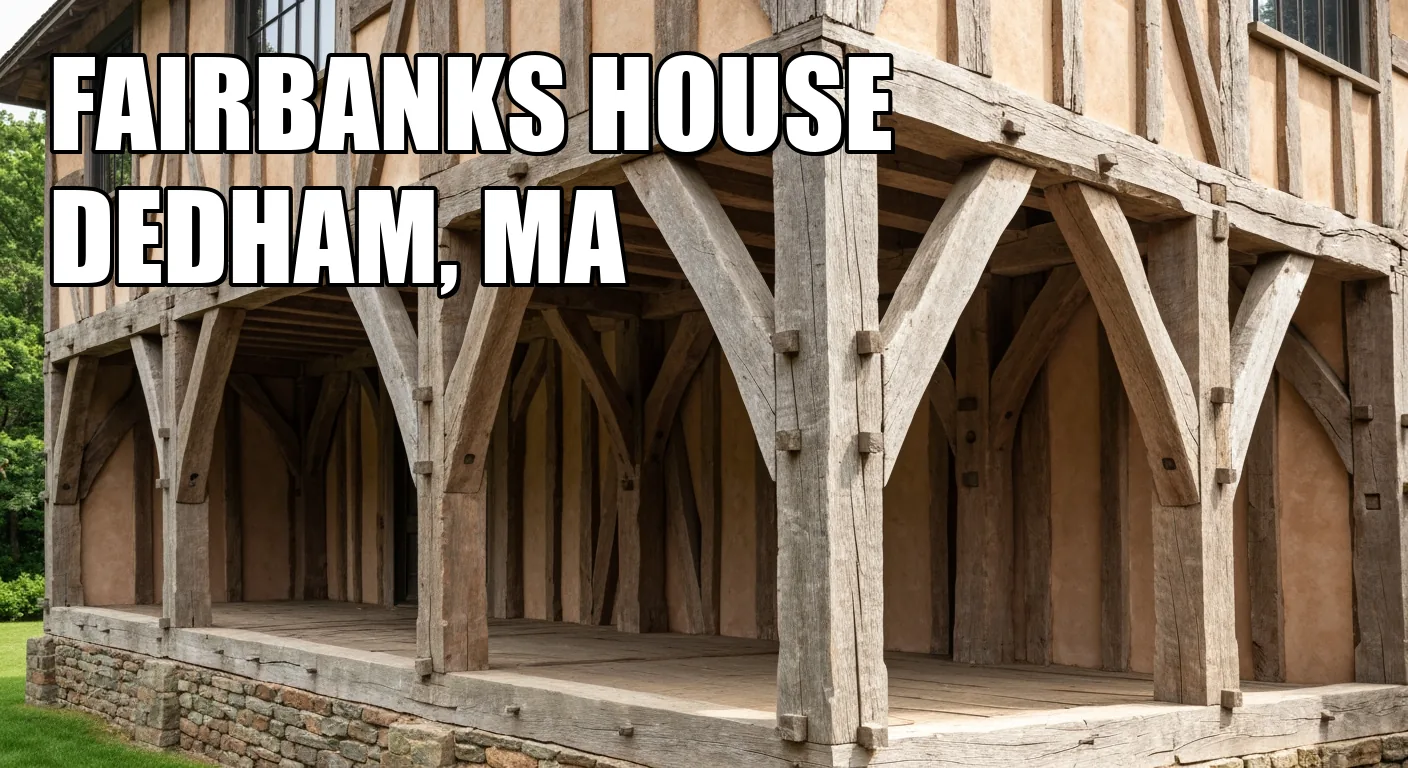
Stepping into the Fairbanks House in Dedham, Massachusetts, is like passing through a time portal. While many historic homes claim "oldest" status, *dendrochronological analysis*—tree-ring dating—has definitively placed its construction between 1637 and 1641, making it North America's oldest surviving timber-frame house. This isn't just a label; it’s a tangible link to the very first generation of European settlers, built barely a decade after Boston's founding. You can almost feel the presence of Jonathan Fairbanks and his family, navigating a new world from within these sturdy oak walls.
The house itself is a masterclass in First Period colonial construction. Look closely at the massive summer beams and gunstock posts; these weren't just cut by any farmer, but by master carpenters and masons, whose expertise ensured the structure's incredible longevity. The original two-story hall-parlor layout, with its iconic *overhanging second story* (often mistakenly believed to be for defense, but primarily a structural and aesthetic feature to maximize floor space on a smaller footprint), tells a story of evolving needs. Later generations added a lean-to, transforming it into a more familiar saltbox shape, a common adaptation that made the house more efficient and allowed for additional living space. Visiting here is less about opulent displays and more about experiencing raw, unadulterated history.
Planning your trip here requires a bit of foresight. The Fairbanks House, at 511 East Street, Dedham, MA, operates seasonally, typically from May through October, and only on Fridays, Saturdays, and Sundays. *Advanced online reservations are essential* for their 50-60 minute guided tours, which depart hourly from 10:00 AM to 4:00 PM. Admission for adults is $15.00, seniors $12.00, and children 7-17 are $8.00. Be prepared for a genuinely historic experience: there's no modern climate control, and the doorways are narrow with varying ceiling heights. Tours stick to the first floor, but even so, the atmosphere of authenticity is unparalleled.
The Revere Residence: More Than a Midnight Ride, a Living Boston Story
The Paul Revere House at 19 North Square in Boston often gets reduced to a single, famous event: the Midnight Ride. But that's a disservice to a building that has seen Boston evolve over 340 years. Built around 1680, it predates the Revolution by nearly a century, offering a fascinating glimpse into Late First Period architecture. Unlike some of its more rural counterparts, this house was always in the thick of urban life, reflecting the city's dynamic changes.
Initially, it was a three-story, L-shaped dwelling with characteristic *hand-split weatherboard clapboard siding* and small, diamond-paned *casement windows*. What many don't realize is that the house underwent significant modifications before Revere even bought it, including raising the street-facing roofline to conform to prevailing Georgian styles. Revere purchased it in 1770 and called it home for 30 years, raising his large family within its walls. After he sold it, the house suffered the indignities of time, becoming a sailor's boarding house and then a tenement with ground-floor shops. It took the foresight of Revere's great-grandson to save it from demolition in 1902, leading to a meticulous restoration that reopened it as a museum in 1908. This layered history, not just Revere's brief moment of fame, makes the house truly compelling.
The Paul Revere House is thankfully accessible year-round, though hours vary seasonally (10:00 AM to 5:15 PM in summer, 10:00 AM to 4:15 PM in winter, closed certain Mondays and holidays). Admission is modest: $6.00 for adults, $5.50 for seniors/students, and $1.00 for children 5-17. While convenient, one important note for history buffs and photographers: photography is strictly prohibited inside the house to protect the fragile artifacts. Don't worry, the exterior, nestled charmingly in North Square, offers plenty of photo opportunities, and the story told within is vivid enough to transcend any lens.
Topsfield's Parson Capen House: Unmasking the Jetty's True Purpose
The Parson Capen House in Topsfield, Massachusetts, dating to 1683, is a superb example of Elizabethan Colonial architecture, often cited as one of the best-preserved. Its distinctive features, particularly the prominent *jetties*—framed overhangs on the front and sides supported by beautifully carved wooden pendants and brackets—immediately catch the eye. And here's where a common myth needs debunking: these overhangs were *not* for pouring hot oil on attacking Native Americans, as many guides (and casual visitors) still believe. Rather, they were primarily decorative, a nod to English building traditions, providing some weather protection and showcasing the carpenter's skill, a subtle display of the original owner's prosperity.
Joseph Capen, a Harvard-educated Congregational minister, commissioned this house, refusing to live in the town's dilapidated parsonage. His ability to build such an elaborate home, complete with chamfered summer beams and carved gunstock posts, speaks volumes about his standing and the town's commitment to its minister. Inside, you'll find four rooms, each with its own large fireplace, and a surprising insulation layer of *clay mixed with straw* between the parlor floor joists—a testament to colonial ingenuity in keeping warm during harsh New England winters. This house doesn't just display architecture; it reveals the social dynamics and practicalities of early colonial life.
Moreover, the Capen House played a quiet but significant role during the tumultuous Salem Witch Trials of 1692. While Topsfield had its own share of accusations, Capen stood as a voice of reason, contributing to "Return of Several Ministers," a document that cautioned against using "spectral evidence" as proof of guilt. It's a poignant reminder that even in the midst of madness, some maintained their convictions. The Topsfield Historical Society, which purchased and restored the house in 1913, currently manages it. While historical archives suggest typical summer hours were 1:00 PM to 4:00 PM on Sunday, Wednesday, and Friday from June 9 through August 30 with free admission, it's *absolutely crucial to contact the Topsfield Historical Society directly* at CapenHouse@TopsfieldHistory.org for current hours and availability for 2025, especially if you're traveling a significant distance. Docents are typically on site to provide invaluable context, making the visit profoundly enriching.
Balch House: A Tale of Two Timelines, Beverly's Evolutionary Masterpiece
The John Balch House in Beverly, Massachusetts, is a prime example of why historical research is never truly "finished." For decades, it was proudly proclaimed as dating to 1636, making it one of the very oldest. Then, in 2006, *dendrochronological analysis* revealed a different story: the earliest portion of the house (the right-hand side) dates to 1679-1680, while the southern part was added in 1721. This isn't a disappointment; it’s a fascinating insight into the evolutionary building practices of early colonists, who often expanded and adapted their homes over generations rather than building entirely new ones.
What you witness at the Balch House is a physical representation of growth and adaptation. It started as a modest one-and-a-half-story, single-room cottage, likely built by John Balch's son. Then, in 1721, his grandson added a two-story section. The two parts were ingeniously joined by raising the roof and creating a central chimney, resulting in the iconic two-room-plan house. You can still see evidence of three distinct phases of roof framing, a kind of architectural palimpsest. This layering of construction over time tells a more human story than a single, perfectly planned structure; it speaks of families growing, fortunes changing, and houses being lovingly (or practically) modified to suit new needs. The fact that the Balch family owned this property for over 260 years, into the early twentieth century, underscores its deep significance to their heritage.
Managed by Historic Beverly (formerly the Beverly Historical Society), the John Balch House at 448 Cabot Street, Beverly, MA, reopens for the 2025 season on June 7th. It’s open *every Monday from June through August*, plus specific weekends (June 21-22, July 19-20, and August 16-17). General admission is $5.00 for adults, $4.00 for seniors and students, and free for children under 16. What's truly commendable is their inclusive access policy, offering free admission to Historic Beverly members, active-duty military, Blue Star families, and various cultural program cardholders (EBT, WIC, ConnectorCare). All tours are guided, which is a blessing here, as the layered history demands expert interpretation to fully appreciate. On-site parking is available, a small but significant detail often overlooked in historic urban areas.
Windsor's Loomis Homestead: Saltbox Secrets and a School's Enduring Legacy
In Windsor, Connecticut, on the sprawling campus of the Loomis Chaffee School, stands the Loomis Homestead, a structure whose oldest section is believed to date between 1640 and 1653. This makes it Connecticut's oldest wood-framed house and a rare survivor nationally. Joseph Loomis, an English woolen draper, brought his family here in 1638, eventually settling on a unique piece of raised land along the Farmington River. This area, known as "The Island," would frequently become isolated by spring floods, offering a fascinating ecological context to its early settlement.
The homestead is a classic *Saltbox* architectural style, a design that defines much of early New England. Characterized by its two-story front and a long, sloping roof at the rear, the Saltbox shape wasn't just aesthetic; it was incredibly practical. Colonial builders found this design provided excellent weather protection, but more cleverly, it allowed families to expand their living space without being assessed for a "double tenement" tax by authorities. It was, in essence, an early form of architectural tax avoidance! Joseph Loomis's son, Deacon John Loomis, built the main section in 1688, expanding on his father's original ell, demonstrating the continuous family presence and adaptation over generations. The oak framework, after nearly 375 years, remains remarkably sturdy, a testament to the initial builder's skill and the inherent strength of timber-frame construction.
Visiting the Loomis Homestead at Loomis Chaffee School in Windsor, CT, requires a slightly different approach than the other sites. Public access is primarily arranged through the Windsor Historical Society, located at 96 Palisado Avenue. They operate Wednesday through Saturday, 11:00 AM to 4:00 PM (last tour at 3:00 PM). Admission fees through the Historical Society are $10 for adults, $8 for seniors, and $6 for students (free for members and children under 12). However, because the homestead is on an active school campus, it’s *highly recommended to contact both the Windsor Historical Society and the Loomis Chaffee School directly* to confirm visiting arrangements and any specific access requirements for 2025. Availability can depend on school events, so a quick call or email will save you potential disappointment and ensure a smooth, insightful visit to this remarkable piece of Connecticut's past.
Ultimately, these five wood frame colonial houses are more than just old buildings. They are palpable connections to America's earliest chapters, demonstrating not only the architectural ingenuity of the first settlers but also their resilience, adaptability, and the surprising ways their choices still echo in our built environment today. Each visit provides a unique opportunity to challenge conventional historical narratives, understand the practicalities of a bygone era, and appreciate the enduring strength of structures that have silently witnessed centuries of change. Plan carefully, approach with curiosity, and you'll find these timbered survivors offer insights no textbook ever could.
Architecture Styles You Can Read From the Street
Use visible details like rooflines, columns, and ornament to identify building styles faster.
Historic Wood Frame Architecture: Your Complete Guide to America's Colonial Heritage
What is the history of wood frame colonial architecture in America?
English settlers in the 1600s brought timber frame construction techniques to North America, utilizing abundant forests to build structures using large wooden beams connected with mortise-and-tenon joinery without nails. This tradition became the foundation of colonial American architecture, with early settlements like Plymouth, Massachusetts and Jamestown, Virginia featuring distinctive timber-framed buildings that shaped the nation's architectural heritage.
What are the key features of colonial architecture?
Colonial architecture is characterized by symmetrical facades, central front doors, double-hung multi-pane windows, steep pitched roofs, classical columns or pilasters on porches, and exteriors made of wood siding, brick, or stone. Common distinctive elements include shutters, prominent chimneys, and proportional design influenced by Georgian and classical architectural principles.
What is the history of timber framing?
Timber framing dates back to the Neolithic era and was refined by ancient civilizations including the Egyptians, Chinese, and Romans, with sophisticated joinery techniques like the mortise-and-tenon joint perfected over centuries. This construction method experienced particular popularity during the Georgian period and became the dominant building technique in colonial North America, where it remains a symbol of traditional craftsmanship and durability.
What is the historical significance of wood in construction?
Wood has shaped human habitation for millennia, providing strength, versatility, and accessibility as a primary building material that allowed civilizations to construct temples, homes, and public buildings. Its historical importance is reflected in enduring structures worldwide, from Japanese temples to European chalets, demonstrating wood's unique ability to combine structural integrity with aesthetic beauty and cultural heritage preservation.
What materials were used in Spanish colonial architecture?
Spanish colonial architecture employed adobe (mudbrick), stucco, clay tiles, wood (for decorative elements and roof supports), and in some regions coquina (a limestone conglomerate containing shells). The style was heavily influenced by locally available materials and indigenous resources, with stucco finishes and terra-cotta clay tile roofs becoming iconic elements of the Spanish colonial aesthetic.
What materials were used in Southern colonial architecture?
Southern colonial homes utilized brick for foundations and siding, wood from native trees for framing and siding, and stone from nearby quarries, often with brick bases to protect against flooding and wood slat cladding. The region's abundance of clay and timber resources heavily influenced material choices, resulting in durable structures adapted to the Southern climate.
What materials were used in Baroque architecture?
Baroque architecture employed stone (including marble and limestone), brick, stucco (made of sand, lime, and cement), and ornate wood for interior decorations such as paneling. These materials were chosen for both functional and aesthetic purposes, enabling the creation of elaborate designs while ensuring structural integrity and allowing for intricate carved and sculptural details.
What architectural style was used during Spanish colonization?
Spanish colonization introduced an architectural style combining influences from Gothic, Baroque, Plateresque, and Mudéjar traditions, adapted to American geography and climate. This style featured single-story adobe structures with flat roofs, parapets, courtyard walls, covered porches, and soft rounded corners that provided shade, reflecting both European and indigenous influences.
What materials are traditionally used to build houses in Spain?
Traditional Spanish construction uses adobe (mudbrick), stone, clay, brick, and wood, with stucco exteriors, red-tile roofs, and wooden exposed beam roof supports that often extend to create outside verandas. Modern Spanish construction employs reinforced concrete and brick load-bearing walls, though traditional methods utilizing natural materials remain popular for their cultural significance and proven durability.
What materials were used in Renaissance architecture?
Renaissance architecture incorporated polished marble floors, carved stone columns, brick for walls and foundations with ashlar masonry, and dark-stained wood (such as chestnut, walnut, and oak) for ceilings, paneling, and furniture. Exterior surfaces featured various combinations of timber siding, stucco, and brick veneer applied to structural frames, emphasizing symmetry and classical proportions.
Where can I visit the best colonial architecture sites in the USA?
Colonial Williamsburg in Virginia (featuring 89 original 18th-century buildings), Savannah Georgia, Boston Massachusetts, New Orleans Louisiana, Philadelphia Pennsylvania, and Charleston South Carolina are among the top destinations for experiencing authentic colonial architecture. Each city offers unique architectural styles reflecting their respective colonial heritage—from British, Dutch, Spanish, and French influences.
What is the best time of year to visit colonial architecture sites?
Fall (September through November) and spring (April through May) offer ideal visiting conditions with pleasant temperatures, lower humidity, and minimal rainfall, while October showcases spectacular foliage and April-May features blooming gardens. Summer months (June-August) are hot and humid with higher visitation numbers, while winter sees fewer visitors but colder temperatures.
What are the typical costs for visiting colonial architecture museums?
Colonial Williamsburg single-day tickets cost $45 for ages 13 and up (or $25 for ages 6-12), with multi-day passes at $55 for three consecutive days, while annual passes cost $75. Private architectural tours of Colonial Williamsburg range from $195-$270 depending on group size and duration, with walking tours typically lasting 1.5 to 4 hours.
What defines a saltbox colonial house?
Saltbox houses are colonial structures with a distinctive long, sloped roof extending much lower on the rear than the front, creating the shape of a colonial salt container, and typically feature two stories in front with one in the rear. These homes include a flat front facade, central chimney, simple colonial design, and were common in New England colonial architecture.
What are the characteristics of Georgian colonial architecture?
Georgian architecture emphasizes strict symmetry, classical proportions, centered paneled doors with decorative fanlights, evenly spaced multi-pane double-hung windows, decorative crown moldings, and exteriors of brick or stone. These homes typically display mathematical ratios in design, featuring two to three stories, hipped roofs, and classical columns reflecting Renaissance-inspired design principles.
How do timber frame joints work in colonial buildings?
Colonial timber framing primarily used the mortise-and-tenon joint, where a projection (tenon) on one beam fits into a hollow (mortise) in another beam and is secured with hardwood pegs, creating strong connections without nails or fasteners. This traditional joinery technique allowed structural stability and flexibility while showcasing craftsmanship, with variations like the Dutch barn through tenon used to resist outward thrust in specific applications.
Why This Page Exists
Maison builds place guides to help readers plan a real visit or understand a real site. When a page makes present-day access, booking, or visitor claims, those details are revised against public-facing source material and editorial review. For the wider standards behind that work, see methodology.
The Cornerstone Brief
One historic place, once a week — what it is, why it matters, whether it's worth going. No filler, no paid placements.
Coming soon. Unsubscribe any time.
We use cookies to enhance your experience. By continuing to visit this site you agree to our use of cookies.