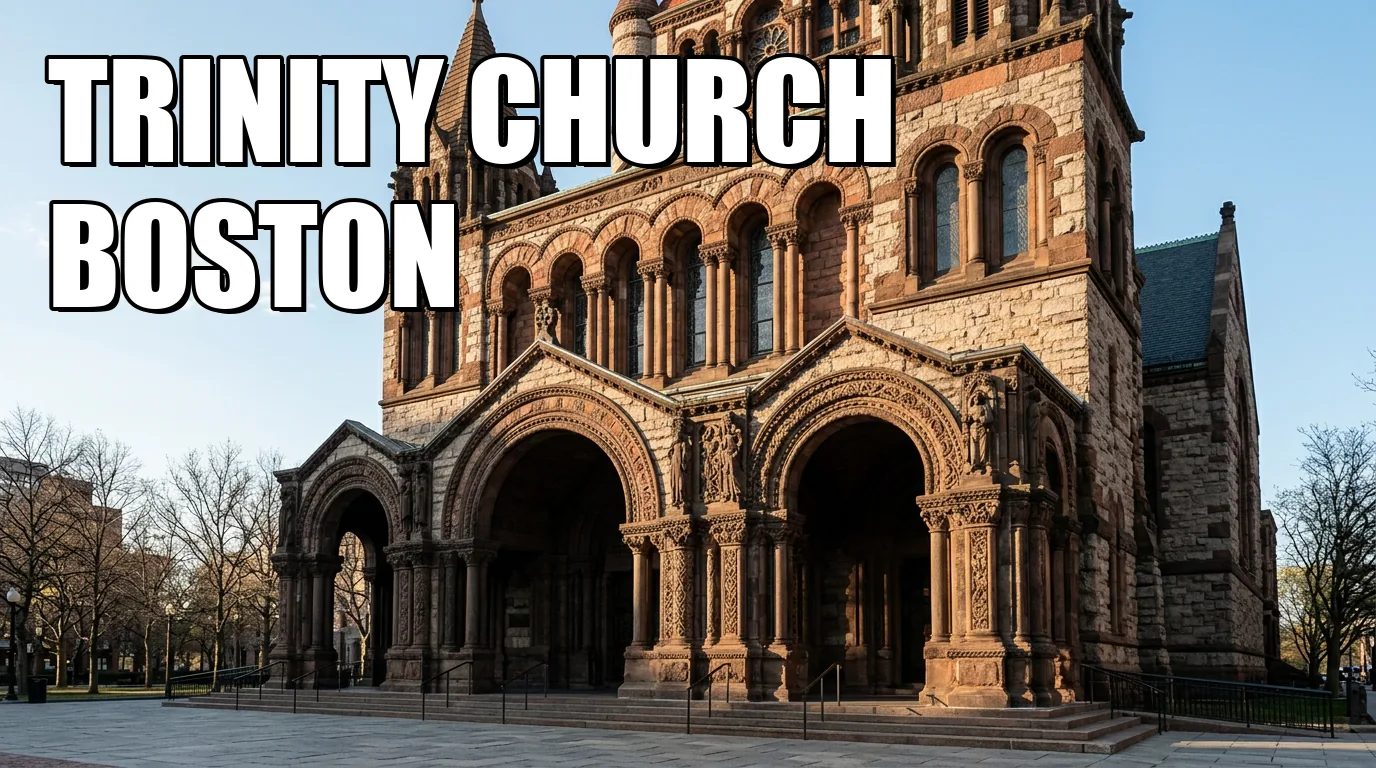
Glessner House looks like a block of load-bearing granite, but its Braggville pink granite is only an eight-to-ten-inch facing over structural brick. Trinity Church looks like a single Richardson composition, but its present west porch and tower tops were completed by his successor firm in 1894–97. The Richardson Olmsted Campus looks like a surviving Kirkbride asylum, but three outer male wards were demolished in 1969, breaking the original sequence.
Those are not minor footnotes. They expose the weakness of the usual Richardsonian Romanesque checklist. Round arches, rough stone and fortress-like mass can identify a promising building, but they cannot establish authorship, explain the plan or tell us which visible parts belong to Richardson. A reliable reading requires four separate questions: who designed each layer, what the building had to do, how structure and circulation answered that program, and what survives from the first campaign.
A round arch begins the inquiry; it does not finish it
Trinity Church established a national model in 1877. Its federal landmark nomination says other American architects were already producing imitations before the church was complete and followed its example over the next twenty years. That influence makes the label useful, but also dangerous: a building can participate in a Richardsonian vocabulary without proving that Henry Hobson Richardson designed it.
| Evidence unit | What the façade suggests | What the record changes |
|---|
| Trinity Church | One finished Romanesque masterpiece | The 1872–77 church and the 1894–97 west front belong to different design hands |
| Allegheny County Courthouse and Jail | Monumental civic stonework | Courtyard, jail wings and connecting bridge organize government, custody and movement |
| Glessner House | A nearly sealed granite fortress | The granite is facing over brick; the street walls contain windows; light is concentrated in the courtyard |
| New York State Capitol | A Richardsonian statehouse | Five architects shaped a composite building; Richardson controlled only particular rooms and phases |
| Richardson Olmsted Campus | An intact picturesque asylum | The medical plan, landscape, later institutional types and 1969 demolitions must be read together |
Trinity Church separates Richardson’s mass from his successors’ façade
Richardson received the Trinity commission on June 1, 1872. Norcross Brothers constructed the parish house and church, and the church was dedicated on February 9, 1877. The program was unusually specific: seating for 1,000 people on the main floor and 350 in galleries, plus a parish building with a 500-seat lecture room, Sunday school and smaller rooms. The compact cruciform auditorium brought those functions beneath a dominant central tower instead of stretching them through a conventional long Gothic nave.
The stone mass was inseparable from the unstable Back Bay site. About 4,500 wooden piles were driven into the filled land. Engineers repeatedly challenged the tower’s weight, and Richardson revised the project until a sixth and final drawing set in 1875. Four solid granite pyramids beneath the crossing carry the tower, while grouped plaster shafts mask that structural reality inside. Even here, apparent masonry and actual support are not the same thing.
The surviving west front also resists a single date. Economy left the front towers incomplete in 1877. Richardson’s successors, Shepley, Rutan and Coolidge, built the present porch and tower tops in 1894–97 under Hugh Shepley. Their work adapted Richardson’s unexecuted ideas, but the federal record calls the result busier and more archaeological than he planned. Trinity remains Richardson’s decisive church, yet its current entrance is also a posthumous interpretation of him.
Allegheny turns mass into a system of custody and public movement
The Allegheny County Courthouse and Jail makes the style’s civic logic visible. Richardson won the commission in January 1884; Norcross Brothers received the construction contract that September. The jail was completed in 1886 and the courthouse in 1888. Richardson died in April 1886, so Shepley, Rutan and Coolidge carried the work to completion. The complex is therefore a direct Richardson design with a documented posthumous construction phase, not a building finished entirely under his supervision.
The courthouse is a hollow rectangle, 301 by 209 feet, around a 145-by-70-foot court. Courtrooms and offices face outward; interior corridors ring the light court. Across Ross Street, the jail forms an irregular cross around an octagonal guard center, with cell wings, reception rooms and service areas kept legible. An enclosed stone bridge joins the two buildings. Calling that arrangement “panoptic” goes beyond the federal source: the nomination documents a radial cross, not a Panopticon.
Richardson also designed for Pittsburgh’s industrial atmosphere. Capitals, moldings, stringcourses and water tables were kept flat so soot would have fewer ledges and crevices to occupy. The apparent aesthetic of restraint was partly an environmental response.
Later work changed the system without erasing it. F. J. Osterling enlarged the jail in 1903–05 as an amplification of the original scheme. More damagingly, Grant Street widening in 1928 removed the west exterior stair. Stanley Roush lowered the arched doorways to street level and inserted smaller interior stairs; the federal nomination says this destroyed much of the original entrance’s character. The courthouse still demonstrates Richardson’s planning, but the surviving entrance no longer presents his original sequence.
Glessner House proves that visual weight is not structural proof
Glessner House converts the same visual language into a private urban house. Richardson designed it in 1885–86, and the Glessner family moved in on December 1, 1887, after his death. Its fortified Prairie Avenue presence is real, but two familiar descriptions are not. The street façade is not windowless: basement openings have granite grilles, and second-floor windows are divided by carved mullions. Nor is the rough granite a massive load-bearing wall. The official house history identifies an eight-to-ten-inch granite facing over common brick.
The plan explains why the exterior is so guarded. The house presses close to the north, east and west lot lines, while doors and windows open generously toward a south-facing courtyard. The exterior contains rough Romanesque signals, but the spatial argument is privacy, controlled light and an inward domestic world. More than half of the house served service functions; family, guest and servant rooms were linked by seven staircases without sacrificing the “cozy” scale the clients requested.
Preservation adds another layer. The Lithographic Technical Foundation used the building from 1946 to 1965, adapting principal rooms as laboratories and the kitchen for platemaking while leaving the original floor plan intact. After the house was saved from demolition in 1966, family objects gradually returned. The museum says a vast majority of the objects now displayed belonged to the Glessners and were donated by descendants, but that does not make every visible object continuously present since 1887. Building fabric, returned collection and later restoration must be labeled separately.
Albany is a composite capitol, not one Richardsonian object
The New York State Capitol is the clearest warning against assigning one architect or style to a whole building. Construction began in 1867. Thomas Fuller was replaced in 1876 by Leopold Eidlitz and Richardson, with Frederick Law Olmsted also hired; Isaac G. Perry replaced them in 1883. Five architects worked on the Capitol before Theodore Roosevelt declared it complete in 1899. The National Park Service classifies the whole as French Renaissance Revival while emphasizing the exceptional interiors created by Richardson and Eidlitz.
Richardson’s Senate Chamber and Executive Chamber were occupied in 1881. The Senate Chamber compressed the room to create flanking lobbies with arcaded visitor galleries. Its material richness is not superficial wallpaper on a conventional hall; stone, wood, leather, glass, galleries and furniture form a legislative setting. Yet even this room is not frozen in 1881. Restoration began in 1977, and the chamber is now presented in an 1881 appearance while accommodating sixty-three senators instead of the original thirty-two.
The Capitol’s five-foot-thick load-bearing masonry walls are documented, but they belong to the construction of the building as a whole, not to a claim that every Richardsonian-looking surface is structural. The 1888 failure of the Assembly Chamber ceiling, the 1911 west-end fire and decades of subdivisions and restorations make the Capitol an accumulated state project. Richardson is essential to it; he is not the sole author of it.
Buffalo makes the medical plan and its losses part of the architecture
The former Buffalo State Asylum for the Insane began with a 203-acre site and an 1872 design. Richardson shaped the buildings, Frederick Law Olmsted shaped the therapeutic landscape, and physicians including John Gray and James White contributed institutional planning knowledge. The resulting Kirkbride arrangement placed an administration building at the center of ten independent wards—five for men and five for women—stepping back through curved connectors to separate patient groups while admitting light and air.
Materials reinforced the hierarchy. The administration building and nearest wards used Medina sandstone; outer wards used red brick while keeping related massing. Roof cupolas participated in passive ventilation. Only Female Ward I is identified in the historic structures report as retaining its original slate roof, copper gutters and flashing, and copper ventilation cupolas.
The present campus cannot be treated as an intact 1872 diagram. Early twentieth-century cottage-plan buildings and specialized pavilions recorded changing treatment theories. In 1969, three outer male wards were demolished, disturbing the original linear plan. The historic structures report therefore uses two different historical frames: the National Historic Landmark period of significance covers 1870–1896, while its broader site analysis extends to 1969 to include the institutional evolution and the decisive demolition. Its own instruction is telling: the site must be walked and the buildings entered to understand the full history. The architecture is the sequence, landscape and change—not the towers alone.
Use four labels before using the style label
Richardsonian Romanesque remains a useful visual family, but it should come last in a serious reading. First label authorship: Richardson, builder, collaborator, successor and later architect are different roles. Then label program: congregation, court, household, legislature and asylum produced different plans. Next label construction: rough stone may be load-bearing masonry, a facing over brick or a visual mask around another support system. Finally label survival: original work, posthumous completion, alteration, returned objects and restoration are not interchangeable.
Those four labels change what the five buildings prove. Trinity is Richardson’s church plus a successor front. Allegheny is a civic circulation system whose original entrance was partly lost. Glessner is an inward house behind deceptive visual weight. Albany is a multi-author capitol containing major Richardson rooms. Buffalo is a medical and landscape sequence preserved only in part. The reader’s task is not to decide whether an arch looks Romanesque. It is to identify what kind of evidence the arch can actually support.