Photo by James Whitfield for Cornerstone Mansion · December 9, 2025
For decades, my travels have led me down forgotten roads and through bustling city streets, always chasing that elusive spark: the precise confluence of environment and imagination that gives birth to art. There's a particular magic in standing within the very rooms where literary masterpieces were penned or revolutionary brushstrokes applied. These aren't just buildings; they're echoes, alive with the spirit of minds that dared to dream differently. Yet, separating the truly transformative from the merely famous requires a discerning eye, a willingness to look beyond the glossy brochure.
This guide isn't about ticking off a list; it's an invitation to experience the unique genius loci—the spirit of place—that defined some of America's most celebrated creators. We’ll uncover not just *what* they built, but *why* it mattered, and *how* it shaped the very fabric of their work.
A Gothic Whimsy in Hartford: Twain's Literary Launchpad
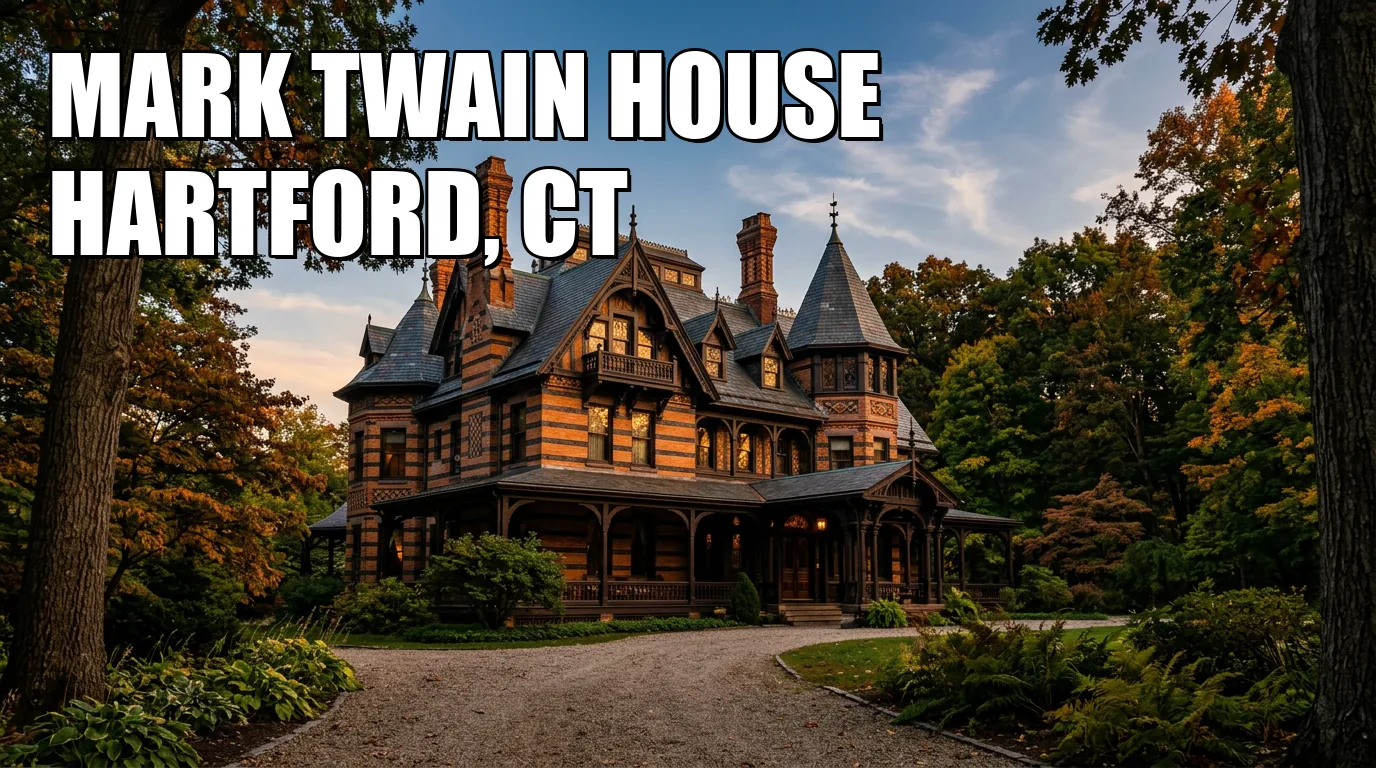
Mark Twain’s Hartford home, a Gothic Revival marvel from 1874, often gets described with a blend of whimsy and awe—"part steamboat, part medieval fortress, and part cuckoo clock" being a particularly apt one. This isn't just hyperbole; step inside, and you'll immediately grasp the sheer exuberance of the place. Designed by Edward Tuckerman Potter, the polychrome brickwork alone makes it stand out, but it's the interior, especially the dazzling 1881 contributions by Louis Comfort Tiffany and his Associated Artists firm, that truly sets it apart. Dark wood paneling, decorative ceilings, and an extraordinary spiraling staircase with *intentionally low railings* to create the illusion of even more stories—it's an architectural funhouse mirror, reflecting the playful, yet profound, mind of Samuel Clemens.
What often gets lost in the marveling is the sheer productivity born within these 25 rooms. This was the crucible for Twain’s most enduring works: *The Adventures of Tom Sawyer*, *Adventures of Huckleberry Finn*, *A Connecticut Yankee in King Arthur's Court*, and *Life on the Mississippi*. The vibrancy of the home, its bustling family life, and perhaps even its architectural quirks, seem to have fueled his inimitable voice. When you visit, don't just admire the Tiffany glass; try to imagine the clatter of a lively household, the laughter, and the quiet hours spent in the billiard room where much of his writing actually happened. Visiting during the shoulder seasons—late spring or early fall—allows for a more contemplative experience, dodging the peak summer crowds. Expect an admission fee around $25-30 for adults, and while street parking is available, the museum has a dedicated lot.
Where Art Dripped & Life Unfolded: Pollock & Krasner's East Hampton Barn
Driving out to East Hampton, you might expect something grander for the titans of Abstract Expressionism. Instead, the Pollock-Krasner House and Study Center presents a stark, almost monastic simplicity. This isn’t a grand mansion; it's a modest, wood-frame fisherman's homestead, purchased for a mere $5,000 in 1945. Yet, within its unassuming barn studio, art history was irrevocably altered. Jackson Pollock, with his wife Lee Krasner at his side, perfected his revolutionary poured-paint technique here, transforming the very act of painting.
The real revelation, the insight that no photograph can quite convey, lies quite literally beneath your feet: the studio floor. It’s not merely a surface; it's a living canvas, bearing the splatters, drips, and whorls of Pollock's iconic works like *Autumn Rhythm* and *Blue Poles*. Conservators, peeling back Masonite baseball game boards Pollock had used, discovered this accidental masterpiece, a powerful testament to his process. Krasner, too, found her voice here after Pollock's death, continuing to work in the studio until her own passing in 1984, creating her powerful *Earth Green* and *Night Journeys* series. This is a place where genius wasn't just cultivated; it stained the very ground. Tours are by appointment only, and given the intimate nature of the barn studio, groups are kept small. This makes for an incredibly personal visit, but you *must* book well in advance, especially for weekend slots, usually available from May through October. The entry fee is modest, typically under $15.
Georgia O'Keeffe’s Home and Studio in Abiquiu, New Mexico, stands in stark contrast to the verdant East Coast. This isn't a pre-existing design she adapted; it's a profound statement of her artistic vision, built over four years of meticulous renovation (1945-1949) of a ruined 18th-century Spanish Colonial adobe compound. O’Keeffe brought a fierce modernist sensibility to traditional regional architecture, insisting on abundant skylights and expansive picture windows—elements virtually unheard of in classic adobe, which favored small openings to keep interiors cool.
The compound unfolds in wings of single rooms, all centered around a plazuela. But the true heart, the image that drew O’Keeffe for years before she could acquire the property, was "that wall with a door in it." She famously declared, "That wall with a door in it was something I had to have." This simple, yet profound, architectural element became the subject of more than two dozen of her paintings, proving how deeply her environment fueled her art. What’s surprising is how sparse and minimalist the interior feels, mirroring the clean lines and vast spaces of the New Mexico landscape she so adored. It’s less a house and more a perfectly calibrated lens through which to view the world. Visiting requires a guided tour, booked through the O’Keeffe Museum in Santa Fe, and pick-up is from their designated location. This isn't a place you can just drop into; planning is essential, as tours sell out rapidly, particularly from spring through fall. Tickets generally run around $40-45 and include round-trip transport from the museum.
Wright's Cantilevered Coup: The Enduring Allure of Fallingwater
Frank Lloyd Wright’s Fallingwater, nestled in the rugged beauty of rural Pennsylvania, is a pilgrimage site for architecture enthusiasts and casual visitors alike. Completed in 1939, it's a masterclass in organic architecture, celebrated globally and even designated a UNESCO World Heritage Site. Most guides will show you the iconic photo: those reinforced concrete cantilevered terraces floating impossibly over Bear Run waterfall. It's breathtaking, undoubtedly. But the conventional wisdom focuses so much on the "floating" aspect that it sometimes misses the *experience* of the integration.
Wright’s genius wasn't just to build *near* a waterfall, but to build *with* it. He rejected the Kaufmann family’s initial request to simply have a view of the falls, famously stating, "I want to bring the falls to the family's everyday life." The sound of the water, the dampness in the air, the dappled light filtering through the canopy—these aren't external features; they are integral to the home itself. Constructed from locally quarried Pottsville sandstone and black walnut from North Carolina, it feels rooted, despite its gravity-defying form. What often goes unmentioned is the sheer volume of visitors the site now handles; over six million since 1964. While tours are meticulously organized, expect crowds, especially on summer weekends. To truly appreciate its serenity, consider a weekday visit in the off-season, like early spring or late fall, though some sections may be closed for maintenance. Booking your timed tickets online, often $35-$45 for a standard tour, weeks or even months ahead, is absolutely non-negotiable.
Edith Wharton's Grand Design: Literary Elegance at The Mount
Edith Wharton, the Pulitzer Prize-winning author, was not merely a resident of The Mount in Lenox, Massachusetts; she was its architect. Designed in collaboration with Ogden Codman Jr., this country estate, completed in 1902, was Wharton’s "first real home" and the very crucible for some of her most acclaimed novels, including *The House of Mirth* and *Ethan Frome*. Drawing inspiration from European classical styles, particularly England’s Belton House, Wharton’s vision was one of restrained elegance: striking white stucco against dark green shutters, rising from a robust fieldstone foundation.
Beyond the architectural sophistication, which is considerable, The Mount offers a fascinating glimpse into the intellectual and social world Wharton inhabited. Henry James, a frequent visitor, called it "a delicate French chateau mirrored in a Massachusetts pond." Here, you can walk through the meticulously restored 113 acres of landscaped grounds, envisioning the leisurely strolls and intense conversations that undoubtedly fueled Wharton’s keen observations of society. Unlike some of the artist studios, The Mount feels grander, a stage for a particular kind of turn-of-the-century American ambition and social critique. Visitors can explore the house and gardens independently, though guided tours are available. Parking is ample, and general admission typically runs around $24 for adults. Check their calendar for special events, particularly literary lectures, which can provide deeper context to Wharton's legacy.
Tracing the Hudson River School's Genesis: Thomas Cole's Cedar Grove
In Catskill, New York, perched on a bluff overlooking the majestic Hudson River and the towering Catskill Mountains, lies Cedar Grove, the former home of Thomas Cole. This Federal-style property, acquired by Cole in 1833, isn't just a house; it's the very birthplace of American landscape painting, the wellspring of the Hudson River School. Before Cole, American artists often looked to Europe for inspiration; he famously declared the American wilderness, particularly this region, to be worthy of grand artistic interpretation.
His painting studio, strategically positioned at the highest elevation on the property, offered the sublime views of the Great Wall of Manitou escarpment that inspired his most iconic works. Cole wasn't just a painter; he was a philosophical observer of nature, and his property, which he cultivated as a *ferme ornée* (ornamental farm), reflects this holistic vision. You don't just see where he painted; you see *what* he saw, *how* he conceptualized the landscape as an integrated work of art. The National Historic Site now has ambitious plans, including the Hudson River Skywalk, which aims to connect Cedar Grove with Frederic Church's Olana property—a poetic and practical bridge between two titans of American art. This connection will undoubtedly transform the visitor experience, offering a comprehensive journey through the Hudson River School’s origins. Admission to the site is generally $18 for adults for a guided tour of the house and studio, and they operate seasonally, usually from May to October.
Poetry Forged in Stone: Robinson Jeffers' Tor House & Hawk Tower
Finally, we journey to the rugged coastline of Carmel, California, to a place utterly unlike any other on this list: Tor House and Hawk Tower. This isn't just a poet's home; it's a monument to an artist's physical devotion to his craft and his land. Robinson Jeffers, the reclusive poet, *built* this extraordinary stone dwelling himself, working as an apprentice stonemason to learn the trade. Beginning in 1918, he hauled granite boulders from the tempestuous Carmel Bay, constructing a modest, Tudor-inspired home designed to withstand the fierce Pacific storms.
The walls of Tor House aren’t merely stone; they are embedded with hundreds of small fragments—stones and ceramics collected from his travels to places as disparate as Angkor Wat, Babylon, Rome, and ancient Egypt. Each pebble is a whisper of history, a physical embodiment of his sweeping, often tragic, poetic narratives. Then, from 1920-1924, he built Hawk Tower entirely on his own, a cylindrical retreat for his wife, Una, and a sanctuary for their twin sons, using only wooden planks and block-and-tackle systems. To stand there, on that windswept promontory, and comprehend the sheer effort and singular vision behind these structures, is to understand Jeffers' poetry on a deeper, more visceral level. He wrote all his major works here, his dramatic narratives echoing "this coast crying out for tragedy." Recent National Historic Landmark status, awarded in 2024, is long overdue. Tours are by reservation only and are highly sought after, reflecting the site's remote charm and unique story. Expect a $15-20 admission fee, and be prepared for limited parking in the residential area. Plan your visit for the cooler, clearer months of spring or fall, as summer can bring persistent fog that obscures the dramatic views.
These creative sanctuaries are more than just stops on a map. They are powerful reminders that genius often thrives in specificity—in a perfectly chosen view, a meticulously designed room, or a self-built stone tower. Each offers a distinct lens through which to understand the complex interplay between environment, ambition, and the enduring human urge to create. They demand more than a cursory glance; they invite contemplation, promising genuine insight into the minds that shaped American culture.
More Film & TV Locations
These guides identify the real building or site first, then explain what visitors can still see in person.
Romantic Charleston: Complete Guide to Notebook Filming Locations
Where is the house from The Notebook located?
The iconic white house with blue shutters (Noah's house) is located at Martins Point Plantation on Wadmalaw Island, South Carolina, approximately 22 miles from Charleston. The interior scenes were filmed at Williams Mansion in downtown Charleston at 16 Meeting Street.
What is the history of The Notebook house?
The house featured in The Notebook is Martins Point Plantation, a historic 900-acre waterfront estate on Wadmalaw Island established as a protected community along the Wadmalaw River and Intracoastal Waterway.
What plantation was used in The Notebook?
Boone Hall Plantation in Mount Pleasant, South Carolina was used as the exterior for Allie's family summer home, and it remains one of the most visited Notebook filming locations. The plantation dates back to 1681 and the Colonial Revival mansion was built in 1936.
Can you visit the house from The Notebook (Noah's house)?
No, the white house with blue shutters at Martins Point Plantation is privately owned and not open for public tours. The property is a gated residential community.
Who owns Boone Hall Plantation now?
Boone Hall Plantation is currently operated under leadership that followed the passing of long-time owner Willie McRae in 2020. The plantation is open to the public for tours and events.
Is the nursing home in The Notebook the same house Noah built?
No, they are different locations. The nursing home scenes were filmed at Rice Hope Plantation (also called Black River Plantation) in Georgetown County, while Noah's house is at Martins Point Plantation on Wadmalaw Island.
Can you visit the Hewitt house?
Hewitt House in Bluffton, South Carolina is a new boutique hotel venue that opened in 2025, but it is not a filming location from The Notebook and is primarily available for private events and guest accommodations.
Can you visit John B's house in Charleston, SC?
John B's house from the Netflix series Outer Banks is located in the Secessionville Historic District on James Island but is private property and not open to the public. Owners request visitors respect their privacy due to excessive trespassing.
Can you get married at the house from The Notebook?
Yes, you can get married at Boone Hall Plantation, which served as Allie's summer home exterior. Boone Hall offers wedding ceremonies, receptions, and elopements on their extensive grounds.
What is the notebook house location history?
The Notebook house (Martins Point Plantation) has a rich history as a historic Lowcountry estate protected by conservation easement with the Lowcountry Open Land Trust to preserve its rural character and 350,000-acre ACE Basin sanctuary location.
How much does it cost to visit Boone Hall Plantation?
General admission is $30 for adults, $27 for seniors and military, $12 for children ages 6-12, and free for children 5 and under. The admission includes access to all tours, exhibits, and the grounds.
What are Boone Hall Plantation's hours of operation?
Boone Hall Plantation is open Monday through Saturday from 9 AM to 5 PM and Sunday from 12 PM to 5 PM. The plantation offers guided tours and self-guided experiences daily.
What can I see inside Williams Mansion?
Williams Mansion offers guided tours of the first floor featuring antique furnishings, or a Grand Tour for the entire mansion. Regular admission is $17 per person for a 45-minute tour, and the Grand Tour is $75 per person for 90 minutes.
Where can I see the romantic boat scene from The Notebook?
The swamp boat scene was filmed at Cypress Gardens in Moncks Corner, a 175-acre nature preserve located about 30 minutes from downtown Charleston. Visitors can rent boats to paddle through the same cypress swamp.
What are the hours and admission for Cypress Gardens?
Cypress Gardens is open daily from 9 AM to 5 PM (no admission after 4 PM). General admission is $10 for adults 18+ and $6.50 for seniors 65+. Swamp boat rentals and walking trails are available.
Why This Page Exists
Maison builds place guides to help readers plan a real visit or understand a real site. When a page makes present-day access, booking, or visitor claims, those details are revised against public-facing source material and editorial review. For the wider standards behind that work, see methodology.
The Cornerstone Brief
One historic place, once a week — what it is, why it matters, whether it's worth going. No filler, no paid placements.
Coming soon. Unsubscribe any time.
We use cookies to enhance your experience. By continuing to visit this site you agree to our use of cookies.