There's a curious expectation we carry when visiting a presidential birthplace. We anticipate grandeur, perhaps a sprawling estate, or at least a home that hints at future eminence. But Herbert Hoover's birthplace in West Branch, Iowa, challenges every one of those preconceived notions. Stepping onto the grounds of the Herbert Hoover National Historic Site, you don't find ostentation; instead, a profound sense of authenticity settles in, revealing insights into the man that no grand monument ever could.
My first visit to the Hoover cottage left me genuinely surprised. This wasn't just another stop on a historical checklist; it was a portal into a specific, challenging, and often overlooked facet of 19th-century American life. What does a 14 by 20-foot structure, built in 1871, truly tell us about the 31st President of the United States? Quite a bit, it turns out, especially when you dig past the surface of what’s simply "on display."
What the Modest Walls of a Frontier Home Reveal
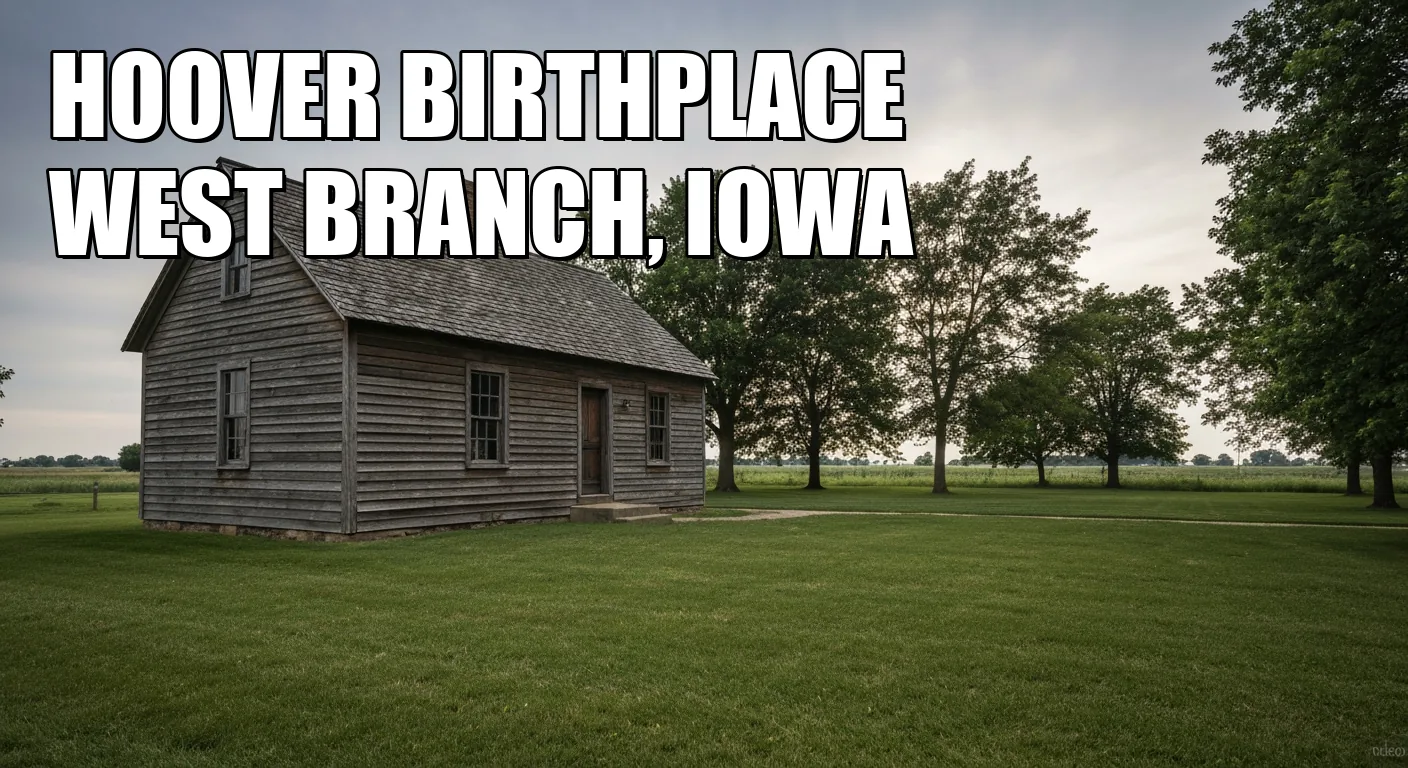
How small can a president's first home actually be? The Hoover birthplace, a three-room board and batten house, measures a mere 14 by 20 feet. Imagine that: an entire family, Jesse and Hulda Hoover and their young children, living, eating, and sleeping within walls that would barely constitute a modern living room. The birthing room itself, where Herbert arrived on August 10, 1874, was a snug 13-1/2 by 7 feet, with its single window looking out onto a world of burgeoning prairie settlement.
Its construction speaks volumes about ingenuity born of necessity on the Iowa frontier. The foundation isn't brick or stone from a quarry; it's boulders, painstakingly hauled by wagon from the vast, open prairie stretching to the west. Timber for the walls made a journey of its own, rafted down the mighty Mississippi from as far north as Wisconsin or Minnesota, processed at Muscatine's sawmills, and then transported overland by ox teams to West Branch. Even the front door, fashioned from vertical boards and secured with a simple thumb latch, faced Downey Street, a subtle nod to the community life that was slowly taking shape around them. This wasn't merely building a house; it was literally carving a life from the land.
Pioneer Domesticity: Life Beyond Our Modern Comforts
To walk through the cottage is to confront the stark realities of 1870s domestic life. The bedroom, for instance, wasn't equipped with a plush mattress and box spring. Instead, you'd find a rope bed, its frame strung with tightly woven ropes that supported a feather tick—a large, cloth bag stuffed with feathers. Beneath it, a trundle bed, designed to slide out like a drawer, offered sleeping space for the children. This ingenious design maximized precious floor space, a constant concern in such confined quarters.
Perhaps the most poignant piece in the bedroom is the wooden cradle, said to have been made by Jesse Hoover himself. While its journey to display was not without historical debate—some claimed ownership and disputed its authenticity—it was ultimately authenticated and now rests in the Visitor Center, with a replica taking its place in the cottage. This small detail, the question of provenance and the meticulous effort to verify, underscores the dedication to historical accuracy at the site, challenging visitors to consider the layers of interpretation inherent in any historical display. Warmth on chilly Iowa nights came from humble, yet beautiful, sources: patchwork quilts and wool bedspreads, often woven on family looms, proving that utility and artistry could coexist even in the simplest homes.
Every step across the floor reveals another layer of resourcefulness. Rag rugs covered the floors, not just for aesthetics, but for warmth and insulation. These weren't store-bought; they were born of necessity, created from old clothes and fabric scraps, painstakingly cut into strips, wound into balls, and then woven by Hoover’s grandmother. Hulda, Herbert’s mother, would then sew these long strips together and tack them down. What typical guides might not mention is the added layer of old newspapers placed underneath, and how tightly the rugs were fitted against the walls, all designed to combat the brutal Midwestern winters. It’s a testament to a time when nothing was wasted, and every shred of material served a purpose.
The Hearth's Central Role: More Than Just a Kitchen
The main room, stretching across the cottage's remaining footprint, truly functioned as the heart of the home, a combined parlor, kitchen, and dining area. A simple drop-leaf table and a cupboard occupied the western section, serving the family’s needs. The focal point, particularly in colder months, was the wood-burning cook stove, which performed double duty: heating the entire house while simultaneously allowing for food preparation. It wasn't just an appliance; it was the engine of survival and comfort.
What's often missed by casual visitors is the ingenious seasonal adaptation of the "summer kitchen." When the Iowa summers grew stifling, the Hoovers would simply move the stove to an enclosed portion of the back porch. This practical arrangement made the main living space significantly more comfortable during the hot months, transforming the confined area into a breathable environment, rather than a sweltering oven. It’s a vivid illustration of how pioneers creatively managed the challenges of their climate, a detail that speaks volumes about daily life struggles beyond romanticized notions of frontier living. A small high chair with a rounded back, a replica of young Herbert’s own, further punctuates the domestic scene, grounding the future president in the tangible echoes of childhood.
The east side of this versatile main room served as a sitting parlor, complete with a settee or day bed and a few chairs for visitors. A small corner table held a kerosene lamp, the primary source of light for reading or evening tasks after the sun went down. This was where the family gathered, where stories were told, and where community connections were forged, reminding us that even in the humblest of settings, human connection and intellectual curiosity found their space.
Echoes of a Rugged Childhood: Stories Etched in Place
Beyond the furnishings, the cottage and its immediate surroundings are steeped in specific, human anecdotes. Consider the night of Herbert's birth on August 10, 1874. Jesse Hoover, his father, dispatched E. D. King, a helper from his blacksmith shop who was sleeping in the cottage's rear shed room, to summon assistance for the delivery. This detail isn't just a historical footnote; it paints a picture of reliance on neighbors and the close-knit community in a time when medical professionals were not always readily available, highlighting the raw vulnerability of frontier life.
Perhaps one of the most vivid and personal stories connected to the site involves a childhood accident. Herbert Hoover himself recounted in his memoirs, "Playing barefoot around the blacksmith shop, I stepped on a chip of hot iron and carry the brand of Iowa on my foot to this day." His older brother Theodore's account is even more dramatic, describing "an inch wide brown scar across the bottom of my foot which hurt and smelled abominably." Their father, Jesse, not a doctor but a practical man, held the injured foot close to the forge's fire before applying linseed oil from his carpenter's shop across the street. This isn't just a tale of childhood mischief; it's a powerful vignette of a rugged upbringing, a father's resourceful care, and the indelible marks left by a blacksmith's world.
Lou Henry Hoover's Vision: A Meticulous Quest for Accuracy
The cottage you see today is not just a weathered remnant; it's a testament to a meticulous, passionate restoration project spearheaded by Lou Henry Hoover, Herbert's wife, in 1938. Under the supervision of architect Bruce McKay, Lou Henry embarked on a remarkable journey of historical detective work. She painstakingly consulted with every surviving family member who remembered the cottage in the 1870s and 1880s, compiling their memories into a manuscript titled "Memories of a Little House." This deep engagement with oral history ensured an unparalleled level of accuracy.
Lou Henry and her son Allan didn't stop at recollections; they actively sought to recover original furnishings. Relatives like Mattie Pemberton and Cora Hoover contributed period pieces, helping to recreate the cottage's appearance as it would have looked around 1875. Even seemingly minor architectural details were scrutinized. Microscopic and chemical testing on the exterior boards definitively determined that the cottage was originally neither painted white nor brown, but rather unpainted wood that had been *whitewashed*. This subtle distinction is crucial, reflecting the true aesthetic of the era and challenging assumptions about how such homes were maintained. The foundation itself, rubble stone exterior walls with a battered brick interior wall, was insulated with strips of cotton fabric stuffed between the seams, a practical measure against the unforgiving Midwestern climate that reveals the constant battle against the elements.
Planning Your Own Journey to West Branch: What to Expect
So, should you make the pilgrimage to West Branch? Absolutely, but manage your expectations. This isn't a flashy, high-tech museum; it's an intimate, reflective experience. Plan to spend a minimum of two hours exploring the cottage, the visitor center, the blacksmith shop, and the surrounding grounds, which include Hoover's gravesite and the Presidential Library and Museum.
I always recommend visiting in the spring or fall. The Iowa summers can be stifling, making the small cottage less comfortable, and the winters, while historically authentic, can be bitterly cold. Weekday visits generally offer a quieter, more personal experience, though even on weekends, crowds are rarely overwhelming due to the site's compact nature. While admission to the cottage and grounds is typically free as part of the National Park Service, do check their official website for current hours and any potential changes, and be prepared for limited, but usually free, parking onsite. What you'll gain here isn't just a few facts about a president; it's a tangible connection to the resilience, ingenuity, and simple dignity of pioneer life, a powerful lens through which to understand a man who rose from the humblest of beginnings to lead a nation.