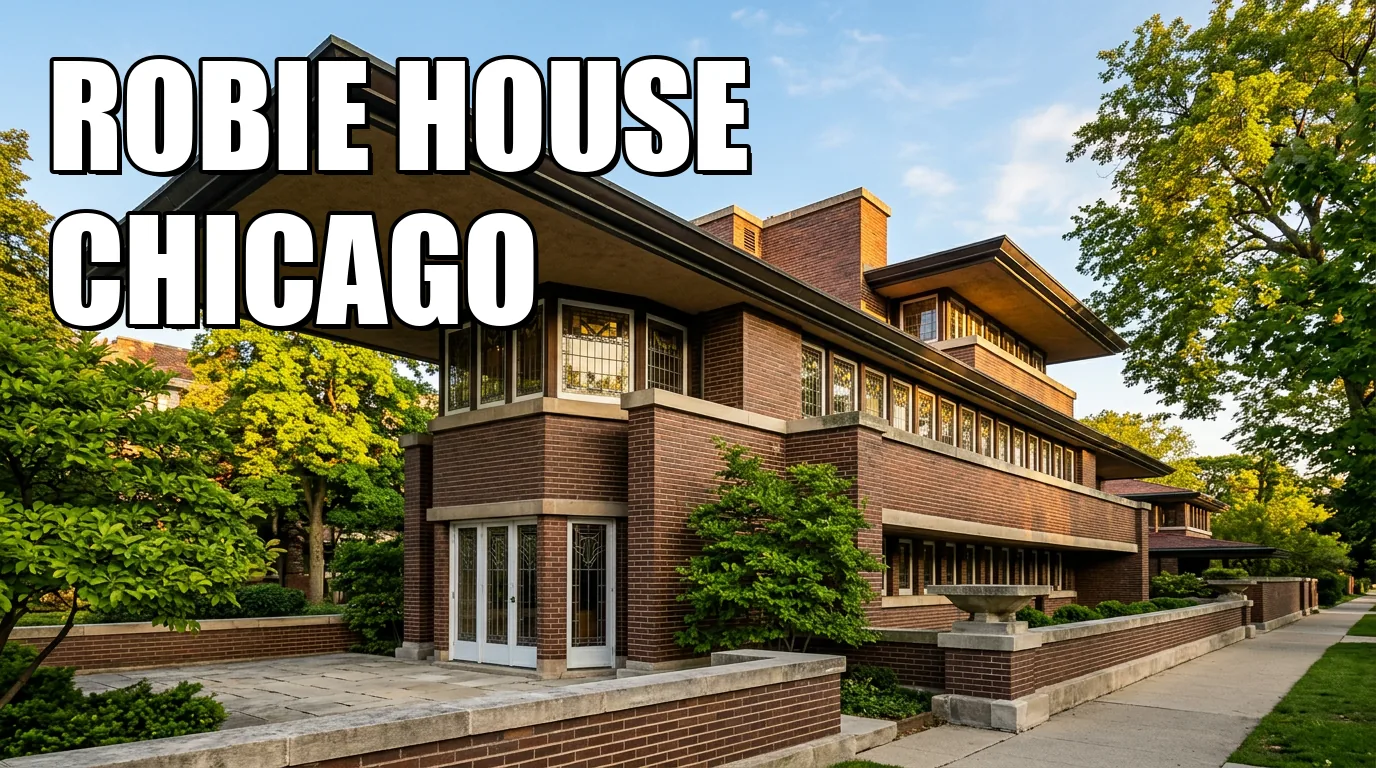
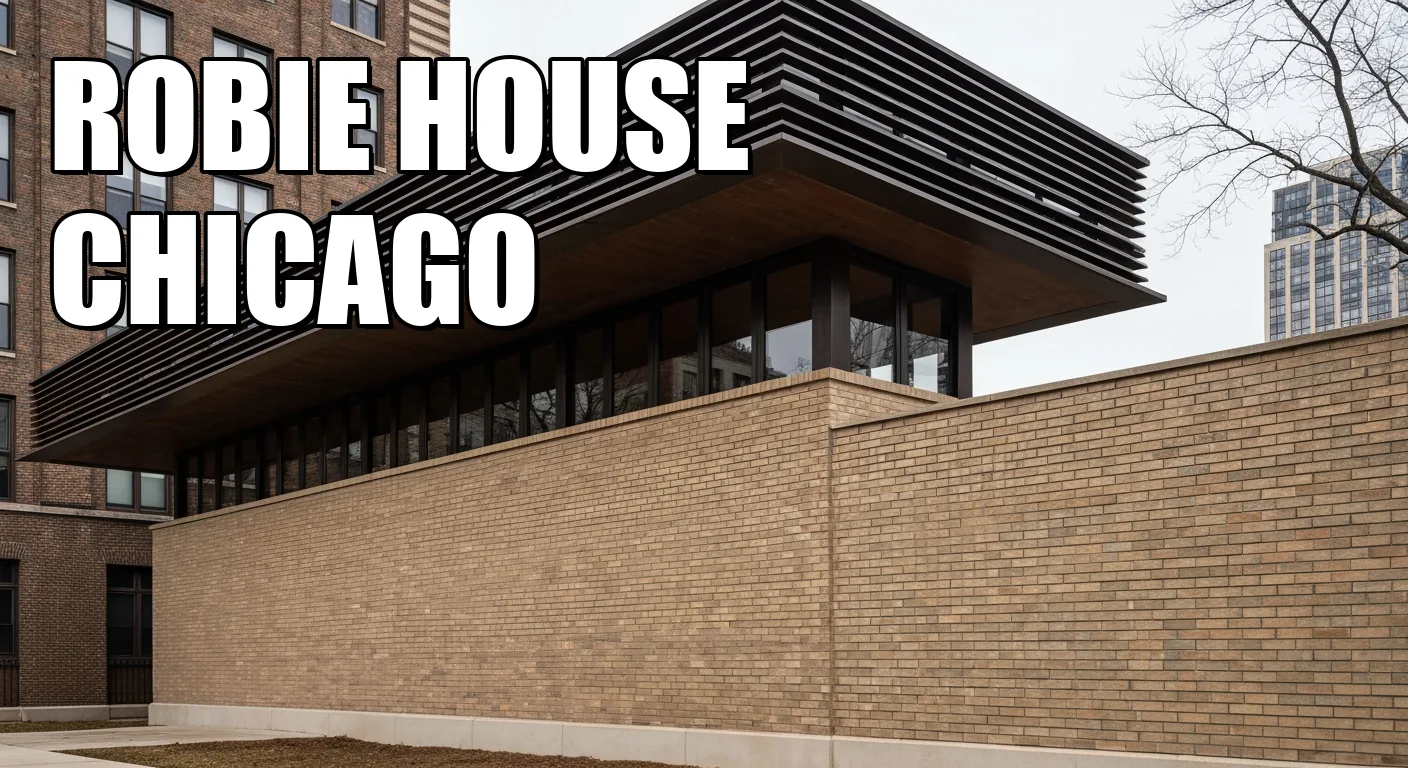
The cheapest honest Prairie lesson in Chicago still costs a number: $24 for a 60-minute guided interior at the Frederick C. Robie House — or $18 if you only want the outdoor audio. That is not a free sidewalk selfie of a low hip roof. Prairie Style is a short American movement (roughly 1900–1920s), not every horizontal Midwest ranch with a brick wainscot sticker.
For 2026 the practical question is sharper: Oak Park and Hyde Park — which tickets, which days, and what are you actually learning? Robie runs Thursday–Monday; Home and Studio daily; Unity Temple expands summer hours; Meyer May in Grand Rapids is free with reservations. Here is the maverick’s map without the myth that Wright invented every long eave alone.
What Prairie Style is (and is not)
Documented DNA: long horizontal mass “married to the ground,” low-pitched hipped or flat roofs with deep cantilevered eaves, ribbon windows and geometric art-glass “light screens,” open cross-axial plans around a central hearth, earthy materials (Roman brick, stucco, wood, stone) with little applied Victorian ornament. Chicago-area Prairie School peers of Wright include Walter Burley Griffin, George W. Maher, Barry Byrne, and landscape minds like Jens Jensen — not a one-man brand.
Not Prairie: Craftsman bungalows with exposed rafter tails and porch pedestals; postwar ranch houses that borrowed the low silhouette for mass housing; modern “Prairie appliqué” on standard builder boxes. Horizontal alone is not enough.
Quick street test: if the front is dominated by a gable porch with chunky tapered columns and decorative beams, you are usually in Craftsman territory. If the mass stretches sideways with continuous window bands, a low hip or flat roof plane, and little “gingerbread,” you are closer to Prairie. If you see a simple one-story ranch with a street-facing garage and sliding patio doors, you are looking at mid-century mass housing that borrowed Prairie’s outline, not Wright’s full design system of built-ins, art glass, and site-specific craft.
Where the tickets are in 2026
- Robie House (Hyde Park, Chicago) — consummate 1908–10 expression; UNESCO Wright site set. Thu–Mon tours roughly 10 a.m.–3 p.m. class: Modern Home interior $24; Inside and Out $38 (60 min inside + 45 outdoor audio); In-depth small group $75 ($65 members); outdoor audio alone $18 on site. Closed Tue–Wed and roughly Thanksgiving–Jan 2.
- Home and Studio (Oak Park) — 951 Chicago Ave; daily interior tours ~10 a.m.–4 p.m.; guided interior $24; Inside and Out with neighborhood audio $38; outdoor audio alone $18. Year-round backbone when Robie/Unity winter-close.
- Unity Temple (Oak Park) — summer 2026 often Mon–Sat 9–5; guided interior ~$20 (45 min), audio ~$18, in-depth ~$40. Concrete Unitarian masterpiece, not a house — still essential Prairie-era Wright.
- Meyer May House (Grand Rapids) — free tours, reserve ahead.
- Dana-Thomas House (Springfield, IL) — Wright’s largest and most complete early Prairie residence with original glass/furniture collections; confirm current state-site hours/fees locally (donation-era policies have varied).
- Oak Park exteriors — CAC-class walking tours ~$35; Wright Around Oak Park deeper walks ~$75 Fri–Sun Apr–Oct; Wright Plus private-house day May 16, 2026 (eight interiors, rare).
Fact vs lore
Documented: Robie is a high-water mark, not the only one — Willits (1902) is often called the first mature Prairie house; Dana-Thomas is the largest/best-preserved early ensemble. Wright led but did not own the School. Many Prairie houses remain private sidewalk-only 364 days a year.
Lore: “Every low Midwestern house is Prairie.” “Wright was the only name.” “You can walk into Robie without a ticket.” Winter closures are real; Home and Studio is the cold-weather constant.
Booking notes that save a wasted train ride: Robie and many Trust interiors are timed, capacity-limited — weekends sell out. All guests usually need a ticket, including children. Trust membership can unlock free or discounted tours (call for member holds). Exterior photos of private houses are fine from the public sidewalk; do not treat a private porch as a free museum. For Wright Plus 2026 (May 16), treat tickets like a concert: rare private interiors, one Saturday, plan travel around that date if private rooms matter more than Robie alone.
Three trip scenarios
1. Half-day Oak Park (budget ~$24–$58) — Home and Studio interior ($24) or Inside and Out ($38); optional Unity Temple ($20) if open. Walk Chicago Avenue exteriors free between paid interiors. Book timed tickets ahead on weekends.
2. Full Prairie day (Hyde Park + Oak Park) — Robie Inside and Out ($38) morning, train/car to Oak Park for Home and Studio afternoon. Skip Tuesday/Wednesday for Robie. Winter: stick to Home and Studio + exteriors.
3. Midwest extended — add free Meyer May (Grand Rapids), Dana-Thomas (Springfield), and — if you hit May 16, 2026 — Wright Plus for private interiors money cannot usually buy.
Pay the $24. Read the horizontal line as structure, not wallpaper. Prairie Style rewards people who buy the interior ticket and ignore the ranch-house hashtag.
Prairie Style Architecture FAQ
What is Prairie Style architecture?
An American residential and civic style of roughly 1900–1920s, centered in the Midwest, with long horizontal massing, low roofs with deep eaves, ribbon windows, open plans around a hearth, and earthy materials. Frank Lloyd Wright and the Prairie School led the movement.
How much does Robie House cost to tour in 2026?
Guided interior tours start at about $24; Inside and Out is about $38; in-depth tours about $75. Outdoor audio alone is about $18 on site. Tours typically run Thursday through Monday.
Is Prairie Style the same as Craftsman or ranch?
No. Craftsman stresses exposed rafters and porch craft details. Ranch houses later borrowed the low footprint for mass housing. True Prairie work is more geometric and custom, with continuous window bands and integrated design.
Was Frank Lloyd Wright the only Prairie architect?
No. Contemporaries and former studio colleagues such as Walter Burley Griffin, George W. Maher, and Barry Byrne designed important Prairie School buildings alongside Wright.
What is the best first stop for Prairie Style in Chicago?
For interiors, book Robie House in Hyde Park and/or the Home and Studio in Oak Park ($24 guided interiors). Unity Temple adds a non-house masterpiece. Confirm day-of-week hours — Robie is closed midweek.
The Cornerstone Brief
One historic place, once a week — what it is, why it matters, whether it's worth going. No filler, no paid placements.
Coming soon. Unsubscribe any time.