There are hotels that simply offer a bed for the night, and then there are places like the Amargosa Hotel, which seem to breathe with the weight of bygone eras. Tucked away in the desolate, almost otherworldly landscape of Death Valley Junction, California, this isn't some manufactured ghost attraction. It's a genuine historical anomaly, a testament to human resilience and eccentricity, steeped in a history so rich and peculiar that the line between past and present often blurs. My travels have taken me to countless "haunted" sites, but few possess the raw, unvarnished authenticity of Amargosa. It's a place that forces you to confront the past on its own terms, often with a shiver down your spine.
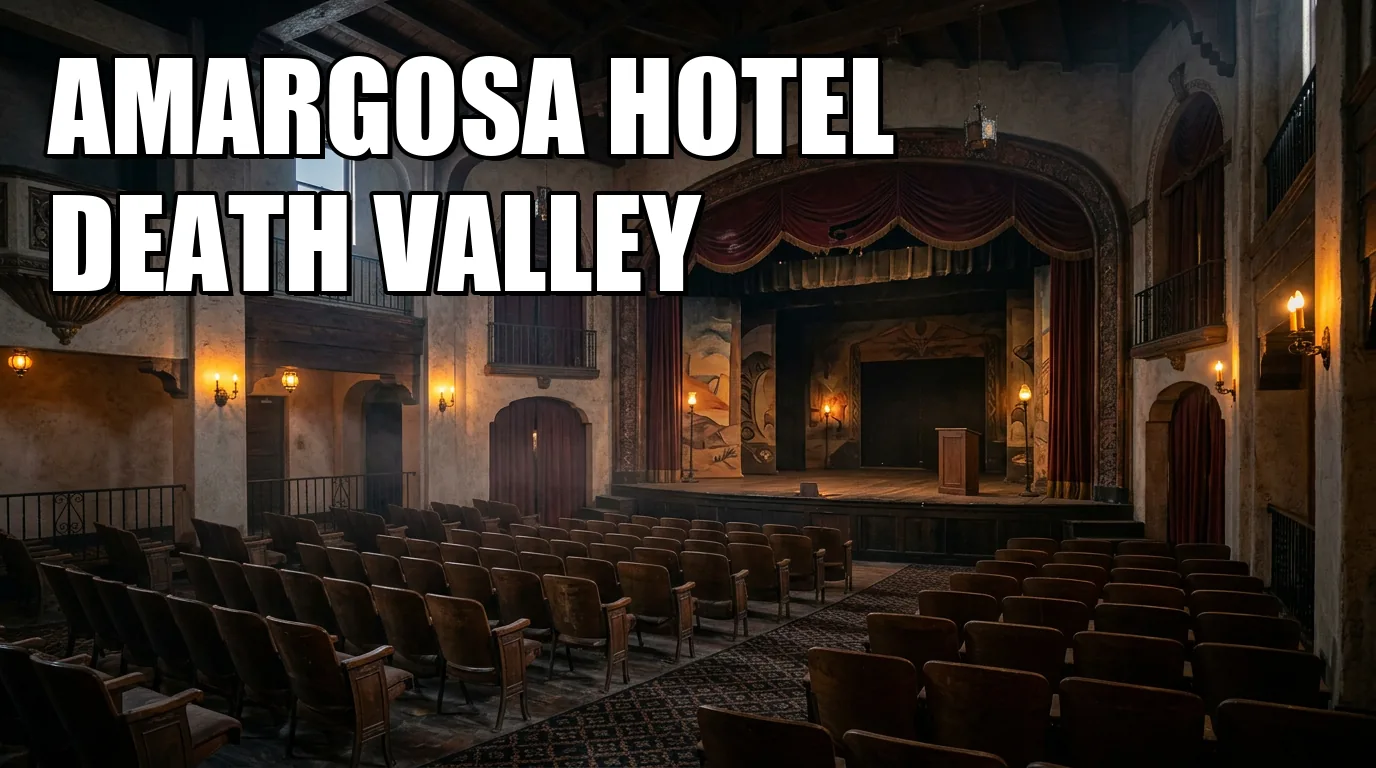
What truly makes the Amargosa stand apart from countless other historic inns with a resident "friendly ghost" isn't merely the alleged hauntings, but the sheer, improbable audacity of its existence. Imagine a grand, Spanish Colonial Revival complex, complete with an opera house, rising from the stark, sun-baked earth of the Mojave Desert. This structure, initially known as Corkhill Hall, emerged between 1923 and 1925, a practical if somewhat grand gesture by the Pacific Coast Borax Company. They built it to house their visiting executives and potential investors, a symbol of stability and prosperity in a region defined by extraction and hardship. When the borax mining operations dwindled in 1928, the entire company town faded into near-oblivion, another ghost town waiting to be reclaimed by the desert winds. That is, until 1967, when an enigmatic artist named Marta Becket stumbled upon it, painting its bare walls with vibrant murals and reviving its silent opera house with her own one-woman shows of mime and ballet. Her artistic spirit, a fierce, tenacious commitment to beauty in desolation, is as much a part of the Amargosa's spectral tapestry as any restless spirit.
Unearthing the Past: More Than Just an Artist's Retreat
Stepping into the Amargosa is akin to walking onto a forgotten movie set, or perhaps, into Marta Becket's dreamscape itself. Her hand-painted murals, vivid and imaginative, adorn the walls of the hotel and the opera house, transforming stark adobe into a living gallery. This artistic legacy isn't just decorative; it's integral to the hotel's atmosphere, blurring the lines between reality and imagination, past and present. You'll find yourself wondering if the figures in her murals are merely painted, or if their eyes follow you, a subtle suggestion that the veil between worlds here is exceptionally thin. It's a sensation few other "haunted" locales can genuinely replicate, often relying on gimmicks rather than an inherent, almost organic, creepiness.
But the hotel's allure extends far beyond its artistic guardian. For decades, staff and guests have cataloged a peculiar array of phenomena that defy easy explanation. Dining room conversations have been interrupted by disembodied voices, often described as a high-pitched female tone, seeming to emanate from nowhere specific. In the desolate quiet of the Opera House, shadowy figures are said to glide across the stage, ghostly performers continuing their silent acts long after the final curtain. Even the mundane becomes unsettling: showers activating on their own, the inexplicable scent of lilacs clinging to empty hallways, and the distinct sound of footsteps and whispers echoing through locked corridors. It’s a slow burn of unease, a cumulative effect that suggests the Amargosa isn't just old; it's *occupied*.
Whispers from the Walls: Specific Hauntings That Linger
Many places claim to be haunted, but the Amargosa offers something more tangible, more localized. Certain rooms carry a heavier weight, a more pronounced presence, often tied to specific, tragic narratives. These aren't vague, generalized hauntings; they feel personal, almost intimate, as if the spirits are still reliving their final moments within these very walls. It’s this specificity that makes the Amargosa so compelling for those genuinely seeking a paranormal encounter, rather than just a spooky story. You're not just hoping for a ghost; you're often expecting a particular one.
Room 24's Somber Secret: The Crying Child
One of the most frequently requested, and reportedly active, spots is Room 24. Here, the alleged resident is the anguished ghost of a child, said to have drowned tragically in the bathtub in 1967—a heartbreaking detail that gives pause to anyone who hears it. Guests who dare to spend the night in Room 24 often report hearing soft, mournful crying and whimpering, particularly after dark, even when no other children are present in the hotel. Imagine lying in bed, miles from civilization, and hearing the faint, inconsolable cries of a child; it's enough to fray even the most hardened nerves. Beyond the auditory, some visitors have described a sudden, profound cold chill around the bathroom door, as if an unseen presence just passed through. Others have found towels inexplicably moved or, more disturbingly, small, child-sized footprints appearing on the floor where none were moments before. While one Tripadvisor reviewer noted a surprisingly peaceful night despite the room's reputation, hotel staff are quick to point out Marta's "hidden ghosts" in the murals, adding another layer of playful, yet still eerie, mystique to the experience. It's an interesting juxtaposition: the hotel acknowledging its spectral residents while also hinting at the power of suggestion and artistry.
Room 32: A Grimmer Presence, A Mining Boss's Revenge
Venturing a few doors down, Room 32 offers a decidedly different, and arguably more menacing, experience. This room is reputedly home to the spirit of a former borax-mining boss, a man said to have met a grim end, hanged on site for his unspecified misdeeds. The atmosphere here isn't one of sorrow, but of palpable oppression. Visitors often describe feeling an overwhelming sense of being watched, a menacing presence that seems to press down on them, almost suffocatingly. Some have even reported feeling as if they are being physically held down in their beds, a terrifying sensation that blurs the line between nightmare and waking reality. Furniture has been known to shift on its own accord, and doorknobs have reportedly turned, rattling ominously, even when the corridor outside is demonstrably empty. The energy in Room 32 is less about a lingering sorrow and more about a simmering, angry resentment, a stark contrast to the mournful cries of Room 24. This room, in particular, challenges the skeptical mind, pushing the boundaries of what one might dismiss as an old building's creaks and groans.
Navigating Your Spectral Stay: Practicalities for the Brave
Deciding to spend a night at the Amargosa, especially in one of its notorious rooms, is more than just booking a hotel; it's embracing an immersive experience. First, temper your expectations: this is not a luxury resort. It’s a historic hotel, charmingly rustic, with original furnishings and a distinct lack of modern polish. That's part of its charm, but it also means air conditioning, while present, isn't always robust, and amenities are minimal. You're here for the atmosphere, the history, and perhaps, the chills. Parking is readily available right outside the hotel, a welcome convenience in this isolated locale. Expect a quiet stay, punctuated only by the desert wind and, perhaps, the whispers of the past.
If you're intent on a paranormal encounter, specify your preference for one of the "haunted" rooms, particularly Room 24 or Room 32, when booking. These are considered Standard Haunted Rooms and typically fall within a nightly rate of $104 to $140 USD, inclusive of taxes and fees, depending on the season and booking platform. Expedia, for instance, has listed rates around $115.49 for a mid-week stay in November 2025. Booking directly with the hotel or through aggregators like Tripadvisor provides a good sense of current availability and pricing. For the full immersion, consider adding the $5 per person guided ghost tour of the Opera House, available at check-in. This tour often provides a deeper dive into the legends and reported phenomena, offering context that might enhance your own experiences.
When is the ideal time for this eerie pilgrimage? Given Death Valley's extreme temperatures, I'd strongly advise against visiting during the searing summer months (June through September), when daytime highs routinely exceed 100°F (38°C). The best time for comfort and exploration, both historical and spectral, is during the cooler, drier months of late fall (October, November) or early spring (March, April). You’ll find the desert landscape far more hospitable, allowing for pleasant daytime walks and truly dark, silent nights where every creak and whisper feels amplified. Arriving during the week usually means fewer crowds, ensuring a more intimate, and potentially more unsettling, experience in the quiet halls.
Beyond the Apparitions: Why Amargosa Truly Matters
While the allure of ghosts is undeniably strong, reducing the Amargosa to merely a "haunted hotel" misses a crucial point. This place is a living museum, a stark reminder of a bygone era of American enterprise and artistic solitude. It’s a testament to preservation against overwhelming odds, a fragile outpost that has defied the desert's relentless embrace for a century. The isolation here is profound, a palpable presence that shapes the entire experience. There’s no bustling town square, no nearby chain restaurants; it’s just you, the hotel, and the vast, empty expanse of Death Valley. This profound quiet amplifies everything, from the rustle of your sheets to the whispers you might or might not hear.
Does the Amargosa live up to its reputation for terror? It largely depends on what you seek. If you're looking for jump scares and manufactured frights, you might be disappointed. The hauntings here are subtle, atmospheric, and deeply intertwined with the history and the art. They are less about overt poltergeist activity and more about a persistent, unnerving sense of presence, a feeling of not being alone. It's the kind of place that slowly gets under your skin, making you question every shadow and every unexplained sound. What few guides tell you is that the real "ghost" might be the enduring spirit of human ambition and artistic dedication that refused to let this place die. Whether you encounter a weeping child, an angry boss, or merely the profound silence of the desert, a stay at the Amargosa Hotel is guaranteed to be an unforgettable journey into history, art, and the unexplained. It challenges you to look past the obvious, to listen closely, and to decide for yourself where reality ends and the spectral realm begins.