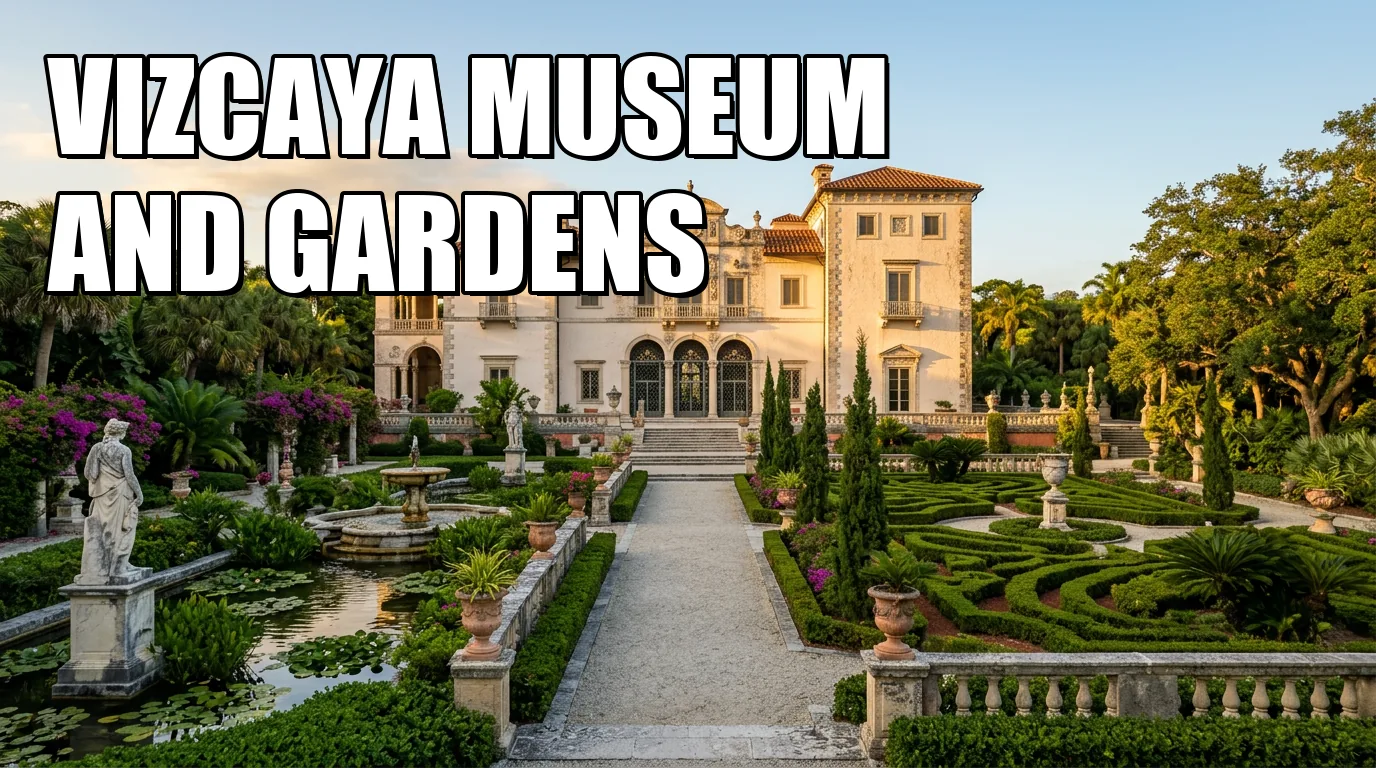
There are historic homes, and then there is Vizcaya. Nestled improbably amidst the modern sprawl of Miami, this estate doesn't just invite you to step into the past; it insists you immerse yourself in a world built on colossal wealth, artistic ambition, and, ultimately, a profound vulnerability to the very elements it sought to command. I’ve wandered through countless Gilded Age mansions, from Newport’s opulent summer cottages to the sprawling estates of the Hudson Valley, but Vizcaya always manages to stand apart. It’s less a house and more a meticulously crafted fantasy, a European dream transposed onto a subtropical canvas, constantly at odds with its surroundings.
Deering's Dream: How an Industrialist Built His Venetian Palace in Miami
How does a pharmaceutical magnate from Chicago end up constructing an Italianate villa on the shores of Biscayne Bay? This isn't just a tale of lavish spending; it's a testament to James Deering’s singular vision. As an industrialist — co-founder of International Harvester, a name synonymous with agricultural machinery — Deering possessed not only immense wealth but also a sophisticated eye for art and architecture, cultivated through extensive European travel. He wasn't content with a mere winter retreat; he wanted to create a personal museum, a living testament to his eclectic tastes and passion for European design. The sheer audacity of the project, begun in 1914, is startling, especially when you consider Miami was still very much a frontier town at the time.
His arrival for his inaugural winter residency on Christmas Day, 1916, wasn't just the completion of a house; it marked the beginning of a legend. Deering envisioned Vizcaya as a place where art, architecture, and nature would converge, a private world where the formal elegance of Europe could breathe freely under the warm Florida sun. What many casual visitors miss, however, is the meticulous planning that went into this grand illusion. It wasn't simply a matter of buying old-world artifacts; it was about designing an entire ecosystem to house them, creating rooms specifically tailored to showcase pieces collected from across the continent. This wasn't a static accumulation of treasures, but a dynamic, unfolding artistic statement.
The Unsung Architects Who Forged Vizcaya's Grandeur
Behind Deering’s grand vision stood a remarkable team of creatives, each bringing their distinct genius and, sometimes, their formidable egos to the project. Francis Burrall Hoffman Jr., appointed as Vizcaya’s architect of record in 1912, laid the foundational blueprint for the Main House. Educated at Georgetown and Harvard, then trained at Paris's prestigious École des Beaux-Arts – the pinnacle of architectural education at the time, emphasizing classical proportions and grand scale – Hoffman was perfectly suited to translate Deering's European-inspired fantasies into a tangible structure. He crafted the spatial framework, an intricate dance of rooms designed to complement the decorative elements and artwork amassed by Deering and his artistic advisor, Paul Chalfin. Hoffman's departure in 1917 to serve in World War I underscores the project's ambitious timeline and the tumultuous backdrop against which it unfolded.
The estate’s breathtaking formal gardens, which often draw as much awe as the house itself, were the brainchild of Diego Suarez. Born in Bogotá to Colombian and Italian parents and educated in Florence at the Accademia di Belle Arti, Suarez possessed an innate understanding of classical Italian garden design. Introduced to the project in 1914, he expertly created the “Mound” as a central feature, employing exaggerated perspective lines with low hedges to dramatically enhance the garden’s geometry. Walking through these meticulously planned spaces, one feels a sense of deliberate theatre, where every vista is framed, and every pathway leads to a new discovery. Yet, even such artistic collaboration wasn't without its friction; Suarez, too, left in 1917 following disagreements with Chalfin. It's a reminder that even in the creation of beauty, human dynamics often play a complex, sometimes challenging, role, leading to an interesting tension between the planned perfection and the human element of its creation.
When Paradise Crumbled: Vizcaya's Brutal Encounter with Nature's Fury
No account of Vizcaya would be complete without acknowledging its dramatic collision with nature. Just one year after James Deering’s passing in September 1925, the Great Miami Hurricane of September 18, 1926, roared ashore, unleashing a devastating blow. This wasn't merely a bad storm; it was a catastrophic Category 4 hurricane, making landfall near Palmetto Bay with a force that forever etched itself into South Florida’s history and, crucially, into Vizcaya's very fabric. The timing feels almost tragically poetic, a testament to the fact that even the grandest human endeavors remain subservient to the raw power of the natural world.
The damage inflicted upon the estate was extensive and, unlike some historical events, meticulously documented. Vizcaya’s cherished formal Italian gardens bore the brunt of the hurricane’s fury, assaulted by both fierce winds and a powerful storm surge that swept across the property. Imagine the meticulously sculpted landscape, designed for timeless beauty, suddenly transformed into a scene of utter chaos. The rose garden, a symbol of delicate elegance, suffered significant losses; three mer-boy sculptures in its semicircular fountain were damaged, while other individual sculptures, basins, and urns were utterly destroyed by the onslaught of high winds, tidal surge, and flying debris. This wasn't just cosmetic damage; it was a profound physical assault on the estate's very aesthetic.
Further evidence of the hurricane's destructive power could be seen throughout the grounds. A large section of coping – the protective top layer of a wall – was torn from the eastern edge of the Bassano di Sutri fountain, with washouts eroding its western side. Many columns and urns along the eastern property line were toppled, their classical symmetry shattered. The pergola connecting the villa to the laundry building, once a graceful walkway, sustained severe damage, its wooden elements vanishing and supporting columns left haphazardly resting on the ground. Even the picturesque summerhouse on the center island was either destroyed or submerged, vanishing from view. While detailed records of the Main House's structural damage from this particular event are less extensive, the impact on the gardens alone serves as a stark reminder of Vizcaya's inherent vulnerability to Florida's severe tropical weather. It complicates the narrative of static historical preservation, reminding us that these sites are living entities, constantly in dialogue with their environment.
Beyond the Gilded Facade: What a Visit to Vizcaya Truly Reveals
Visiting Vizcaya today is more than just a stroll through a wealthy man's former home; it's an opportunity to engage with history on multiple levels. You expect the opulence, of course—the meticulously arranged antique furniture, the tapestries, the paintings. What often surprises people, however, is the sheer scale of the vision. Deering wasn't just decorating; he was curating an experience, a living museum meant to educate and inspire. The rooms flow seamlessly, each with its own character, yet all contributing to a cohesive narrative of European grandeur. You might anticipate a certain stuffiness, but the light that streams through the windows, combined with the views of Biscayne Bay, imbues the space with an unexpected vibrancy, making it feel less like a mausoleum and more like a home, albeit one of extraordinary proportions.
But the true magic, for me, lies in the juxtaposition. Here you have this utterly European creation, complete with formal gardens and classical statuary, existing in a climate that constantly threatens to reclaim it. The hurricane of 1926 serves as a powerful historical marker, reminding us that the perfection we see today is the result of immense, ongoing effort. It highlights the inherent challenge of maintaining such an elaborate estate in a tropical, storm-prone environment. This constant battle with nature, the cyclical process of damage and restoration, is a story a typical tourist brochure rarely emphasizes, yet it’s central to Vizcaya’s enduring character. It prompts a deeper appreciation for the resilience of the structures and the dedicated individuals who continue to preserve them.
Planning Your Journey to Deering's Enduring Legacy
Thinking about a trip to Vizcaya? Plan strategically to get the most out of your visit. Miami's winters, generally November through April, offer the most pleasant weather, with cooler temperatures and lower humidity, making it ideal for exploring both the house and the extensive gardens. You’ll want to avoid the peak hurricane season, typically June through November, not just for the weather, but also because the intense heat and humidity can significantly detract from your enjoyment of the outdoor spaces. I’d always suggest arriving right at opening time, especially if you visit on a weekend, to beat the crowds and experience the gardens in a quieter, more reflective state. There's nothing quite like having a moment of solitude by the Barge, looking out at the bay, before the tour groups descend.
Be prepared for an admission fee, which is standard for historic estates of this caliber, and factor in parking costs if you're driving; it's a popular destination, and spaces can fill up quickly. Give yourself at least three to four hours to fully explore everything. Don't rush through the house; linger in the grand rooms, admire the intricate details of the ceilings, and imagine the lives that unfolded there. Then, step outside and allow ample time to get lost in the formal gardens, which are far more expansive than many first-time visitors expect. Notice how the formal Italian design interacts with the native Florida foliage, a subtle but fascinating tension that defines Vizcaya’s unique aesthetic. This isn't just a picturesque backdrop for photos; it's a living, breathing testament to an era of unparalleled ambition, a site that continues to reveal new insights with every visit.