Schuyler offers four different answers to the question “What is the real Walton’s Mountain?” The museum occupies a real 1932 school, but its Walton rooms recreate television sets. The Earl Hamner House is the real family home, but it is neither untouched nor reliably open every day. Quarry Gardens preserves a real soapstone landscape, but only on its own public calendar. The screen world itself was made in Wyoming and California.
Those distinctions should control the trip. Proximity does not turn the museum, house and gardens into one attraction, one ticket or one set of hours.
The useful plan: treat Walton’s Mountain Museum as the dependable anchor during its published season. Add the Hamner House only when its operator has announced tours, and add Quarry Gardens only for an open-gate day, event or arranged group visit. Check all three separately before driving to Schuyler.
Four versions of “real” require four labels
| Place | What is authentic there | What not to assume |
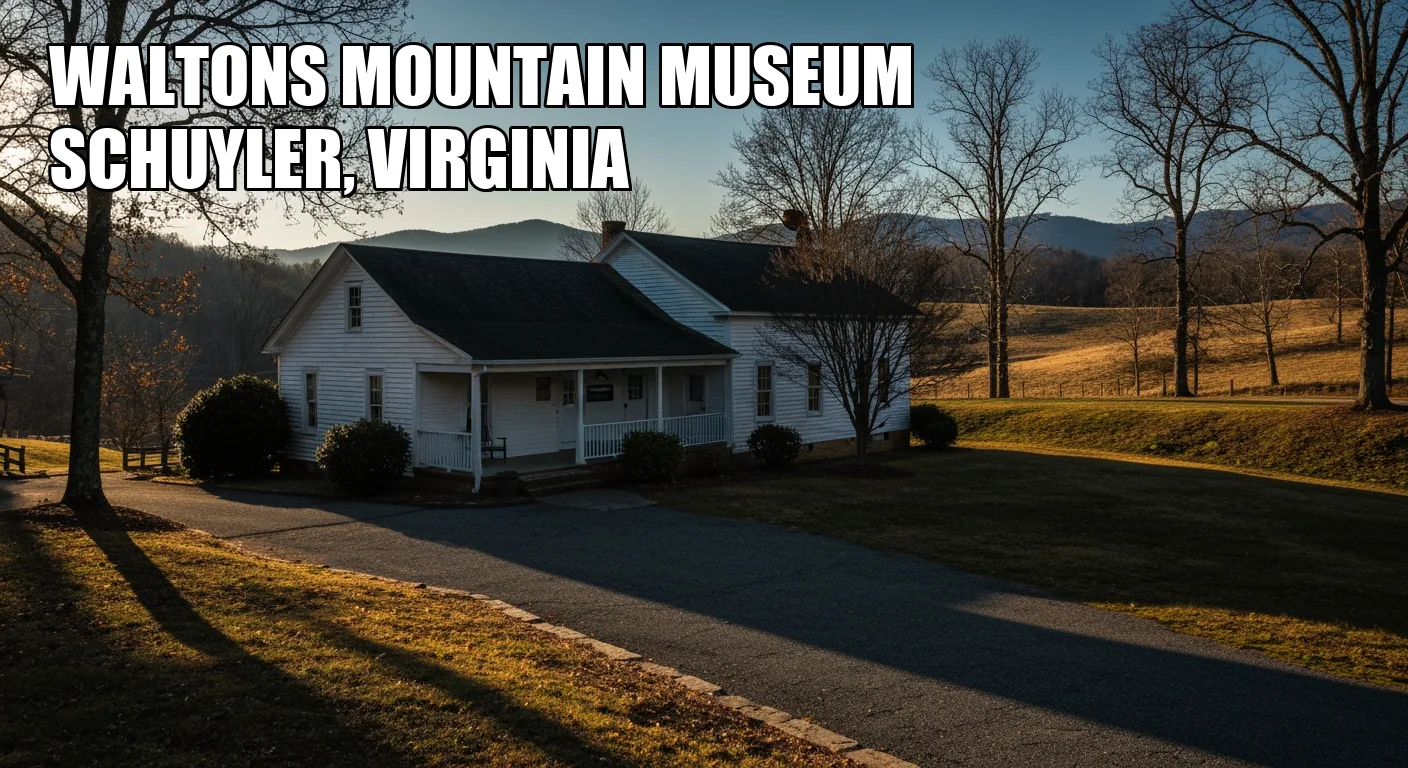
| Walton’s Mountain Museum | A 1932 Schuyler public-school building from Earl Hamner Jr.’s school years. | The Walton kitchen, living room and bedrooms are recreations of screen spaces, not preserved rooms from his house. |
| Earl Hamner House | The circa-1915 company-town house where Hamner lived from 1929 to 1940. | A museum ticket does not guarantee entry; the current house site directs visitors to check its changing tour availability. |
| Quarry Gardens at Schuyler | Abandoned soapstone cuts, spoil, quarry pools and a post-industrial native-plant landscape. | It is not a daily drop-in park; current tourism information lists select open days and arranged group access. |
| The television production | Schuyler supplied Hamner’s memories, family history and company-town geography. | The Virginia town was not the standing screen set seen in The Homecoming or the weekly series. |
The museum is a real school with fictional rooms inside
The museum at 6484 Rockfish River Road is not a generic building dressed up for tourism. Virginia’s historic-district record identifies it as a Colonial Revival public school built in 1932 after a larger 1924 school on the adjacent property burned in 1931. Earl Hamner turned nine that year and graduated from Schuyler High School in 1940.
The school story is more complicated than museum shorthand suggests. The same National Register record documents a separate Schuyler School and Theatre, built around 1900 at 6526 Rockfish River Road. Museum promotion has also called the present building a “Schuyler Baptist Church school,” but the state record describes a county public school; the church is a different building. The safe conclusion is that the museum occupies genuine school fabric from Hamner’s Schuyler childhood, not that every local school reference points to this one structure.
Inside, the evidence changes category. John-Boy’s bedroom, the Walton kitchen, living room and Ike Godsey’s store are recreated television environments. Memorabilia, production equipment, scripts and Hamner-associated objects may be authentic individual artifacts, but they do not convert the reconstructed rooms into the family’s original interior. Read the labels object by object.
This makes the museum useful rather than false. It gives visitors the screen vocabulary first: the rooms, props and visual cues that later need to be separated from the house and town that inspired them.
The Hamner House is original evidence—but not an untouched set
The house at 128 Tree Top Loop began as the Copps House, a modest Folk Victorian I-house probably built after quarry manager M. J. Copps acquired the land in 1915. Its dry-stacked soapstone foundation places it directly inside Schuyler’s company-town building culture. The Hamners rented it from 1929 and bought it from the soapstone company in June 1936 for $500.
The family did not simply occupy a frozen five-room house. After the purchase, Earl Hamner Sr. enlarged the kitchen ell, enclosed space for an indoor bathroom, added a washroom, excavated a basement for central heat and covered beaded-board walls with plasterboard. Later owners added other visible layers: aluminum over the original weatherboard, replacement doors and porch flooring, concrete-block repairs and flooring over some original pine boards.
That alteration record is the reason to visit. The house is the documented setting of Hamner’s formative years, not a promise that every surface looks as it did in 1933 or matches the generous television plan. Its narrow central hall, straight stair and compact rooms make the screen enlargement easier to understand.
Access requires a second reality check. The current official visit page does not publish fixed tour hours; it tells visitors to follow the house’s Facebook account to learn when tours are available. Treat the museum and house as separate operators with separate access. If no house tour is posted, do not build the day around an assumed interior.
The soapstone town explains more than another replica could
Walton’s Mountain loses part of its meaning when Schuyler is reduced to one family and one television series. The National Register district covers a company town organized around a central soapstone plant, quarries, rail connections and worker neighborhoods. Management houses occupied elevated ground; worker districts such as Gold Mine, Stumptown and New Town spread along the surrounding roads. Soapstone appears not just in industrial ruins but in house foundations, chimneys, dams and the former hospital.
This is the economic landscape behind the Hamner story. The family home is company housing. The company-owned dwelling, the town’s stores and the uneven relationship between plant, management and workers supplied a more specific social world than the television phrase “hard times in the mountains” can convey.
Quarry Gardens at 1643 Salem Road is the legitimate public way to read that landscape without trespassing on industrial property. Its 40-acre garden area sits within a much larger protected holding and uses two miles of trails to connect native-plant galleries, quarry faces and water-filled pits. A visitor center interprets the soapstone industry and the Nelson and Albemarle Railroad. The route includes substantial elevation change and many stone steps, so it is not interchangeable with a flat museum visit.
The access model is also different. Current Virginia tourism information says the gardens open on selected days for self-guided visits, group tours and programs, with an events calendar controlling open-gate times. The practical rule is to confirm a date rather than arriving because the gate is nearby.
Do not substitute the rest of the historic district when the gardens are closed. Worker houses, the old Walker Store associated with the model for Ike Godsey’s store, company buildings and quarry remnants include private homes, active property and unsafe ruins. They are context visible from public roads, not an invitation to enter yards, mill land or abandoned pits.
Schuyler supplied the source material, not the standing screen set
The production geography prevents one final category error. Exterior work for the 1971 television film The Homecoming took place around Jackson Hole, Wyoming. The weekly series built the Walton house and most of its village world on Warner’s Burbank backlot, with domestic interiors built on Stage 26 and additional outdoor work elsewhere in California.
Even the familiar Hollywood house was not one continuous artifact. The original backlot house burned in November 1991. A replacement built for the reunion productions was later moved to the Warner ranch, remodeled as the Dragonfly Inn for Gilmore Girls, and dismantled in 2016. The museum therefore reconstructs a screen world whose principal house sets no longer stand as public attractions.
Schuyler’s claim is stronger and narrower: it preserves the house, school-era fabric and industrial landscape that Hamner transformed into fiction. It should not be sold as the Virginia filming location for images made elsewhere.
Build the day around confirmed access
Start at Walton’s Mountain Museum. It is the most dependable public orientation and makes the later provenance distinctions legible. If the Hamner House has announced tours, treat it as a separate historic-house appointment, not an automatic extension of museum admission.
Add Quarry Gardens only when its calendar aligns with the trip and the trail conditions suit the visitor. Otherwise, the honest visit may be museum-only. A short day with one open institution is better than turning private company-town buildings or closed quarry land into unofficial attractions.
The real Walton’s Mountain is not one surviving set. It is a 1932 school containing television reconstructions, an altered 1915 house carrying family evidence, a scheduled post-industrial garden explaining the town’s economy, and a production history made elsewhere. The visit becomes coherent only when each layer keeps its own label.