There’s a particular kind of quiet that settles over a place when history hasn't been meticulously preserved, a silence deeper than the absence of crowds. I’ve felt it often, standing before markers of lives lived long ago, and nowhere is it more palpable than when attempting to trace the domestic footprint of America’s 12th president, Zachary Taylor. Many guides will point you towards his known residences, but they rarely delve into the profound gaps in our knowledge—the spaces where personal narratives should reside, yet remain stubbornly blank.
Most presidential homes offer a rich tapestry of personal effects, detailed room assignments, and anecdotes tied to specific corners. Think of Monticello, ablaze with Jefferson’s inventions, or Sagamore Hill, echoing with Roosevelt’s boisterous family life. Taylor’s story, however, unfolds differently. Instead of a clear path, we navigate a landscape of conjecture, piecing together fragments, and, perhaps more importantly, understanding the *why* behind what’s missing. It’s a compelling journey, not for what you’ll explicitly see, but for the insights gained into the fragility of historical memory and the random depredations of time and conflict.
America's "Forgotten" President: Unraveling Taylor's Domestic Footprint
Zachary Taylor, often relegated to a footnote in the grand narrative of antebellum America, presents a unique challenge for those seeking to connect with his private world. His presidency, tragically cut short, and his military career, largely fought on distant frontiers, mean his domestic life has received less scholarly and popular attention than many of his peers. This relative obscurity isn’t just a matter of public interest; it directly impacts the preservation and documentation of his homes. Without sustained focus, the intimate details that bring a historical figure to life often dissipate, leaving behind only the bare architectural bones.
What a traveler expects from a presidential home—a study where momentous decisions were made, a parlor where guests were entertained, a bedroom holding the echoes of private moments—is largely absent in Taylor's case. Instead, we’re left to contemplate what *might* have been, or what *was* but can no longer be verified. This isn't a flaw in our historical record-keeping, but rather a harsh reality shaped by specific circumstances, forcing us to consider history not just as a collection of facts, but as a discipline of intelligent inference and acknowledgment of its own limitations.
Springfield's Silent Walls: A Glimpse into Taylor's Kentucky Roots (and What We Can't See)
The true anchor of Taylor’s personal history lies in
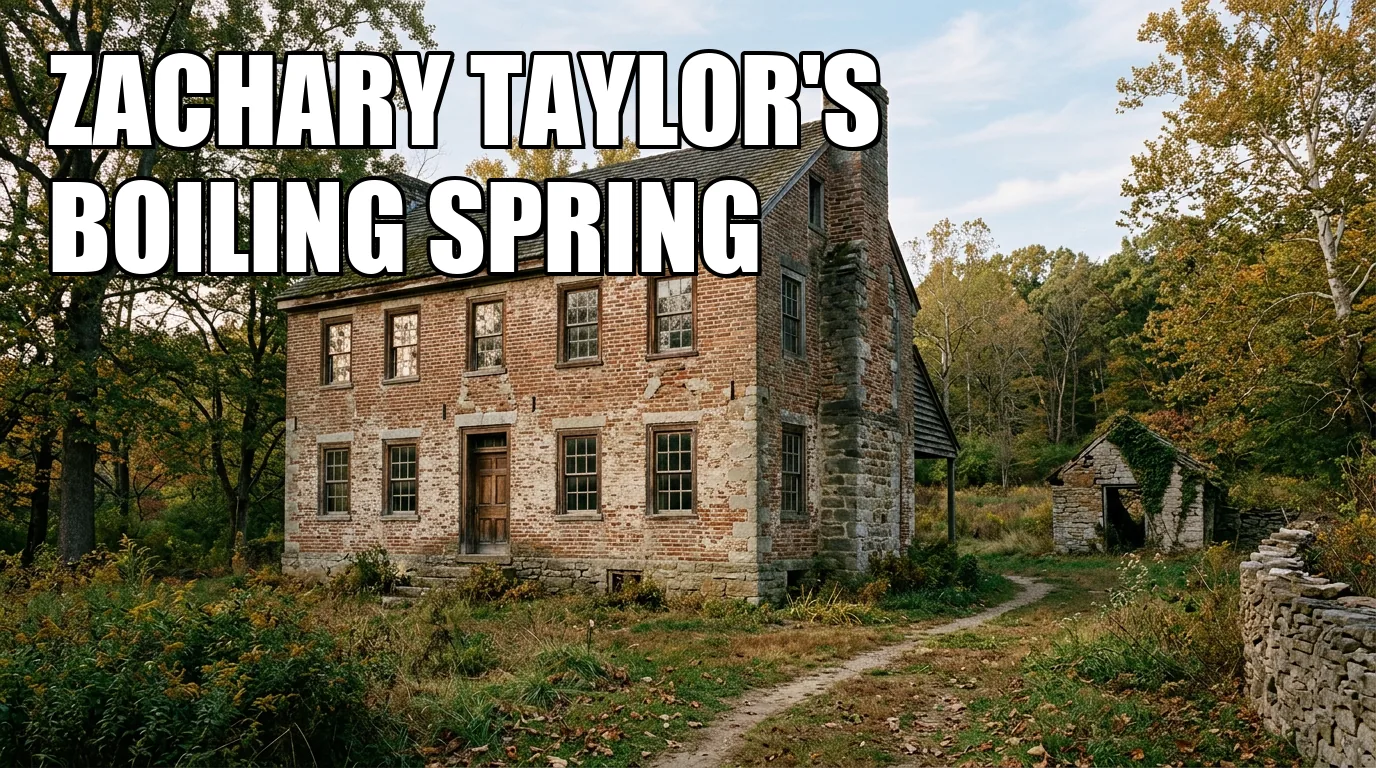
Springfield, his childhood home in what is now Saint Matthews, Jefferson County, Kentucky. This stately 2½-story Georgia Colonial brick structure, built in two stages between 1794 and 1830, stands as the sole existing property directly associated with the president. Its very existence offers a tangible link, yet the house itself, a private residence, remains inaccessible to the public. This means the typical experience of wandering through historically furnished rooms, imagining Taylor's presence, simply isn't an option for curious visitors, a practical issue that frustrates many eager to connect with his legacy.
Architectural surveys reveal intriguing details about Springfield’s interior, even if we can’t step inside. It boasted a
double-parlor configuration, each with its own fireplace, which suggests a certain social standing and a design focused on entertaining. Walnut and ash flooring graced the original sections, while
twelve-over-twelve double-hung sash windows, protected by louvered shutters, allowed light into the rooms, a common feature of homes from that period. Yet, despite these specifics, the documentation conspicuously lacks any mention of a dedicated "study" or "drawing room"—spaces we often associate with a prominent figure's private reflections or formal interactions. This absence is telling; perhaps such rigid designations weren't typical, or perhaps the records simply don't survive.
Significantly, Springfield was more than just a childhood abode; it was the setting for pivotal family events.
Taylor married Margaret Mackall Smith here on June 18, 1810 (though a few sources quibble over the precise date, noting June 21st). Furthermore,
five of his six children were born within these walls. Imagine the bustling household, the joys and sorrows experienced within that double-parlor or around one of the twelve fireplaces. However, typical guides gloss over the inconvenient truth: no specific personal incidents or decisions are documented as having occurred within particular rooms during his occupancy. We know *where* these events generally happened, but not the intimate details of *how* or *exactly where* within the house, leaving much to the imagination rather than verifiable fact.
The White House: Echoes of Power, Shadows of Ambiguity
Moving from his family roots to the zenith of his power, the White House holds a different kind of mystery concerning Taylor. Here, during his brief but tumultuous presidency, momentous events transpired, yet the historical record again frustrates our desire for spatial specificity. Consider the heated conference in February 1850 with southern leaders who were openly threatening secession. Taylor, a military man to his core, famously warned them that if he had to enforce the laws, he would personally lead the Army and
would hang those "taken in rebellion against the Union… with less reluctance than he had hanged deserters and spies in Mexico." This was a critical moment, a stark display of presidential resolve in the face of national division. The historical importance of this confrontation is undeniable, yet the specific room in the White House where this fiery exchange unfolded remains unidentified in available records. We know the *what* and the *who*, but the *where* is lost.
Equally shrouded in spatial ambiguity is the onset of Taylor's fatal illness. His presidency ended abruptly on July 9, 1850, after he fell ill on the 4th of July, having attended ceremonies at the unfinished Washington Monument. Upon returning to the White House around 4:00 PM, he consumed cherries, iced milk, and water – a combination sometimes blamed for his demise, though modern scholarship often points to gastroenteritis or cholera. While we have these tantalizing details about his last indulgences, the precise room where he consumed these items is not documented. For a figure of such national importance, this lack of detail about his final domestic moments is striking, especially compared to the extensive documentation surrounding other presidential deaths within the Executive Mansion.
The Civil War's Cruel Hand: Why Taylor's Intimate World Vanished
Why do these frustrating gaps exist? The answer lies not in oversight, but in one of the most destructive periods of American history: the Civil War. This is a critical piece of context often missing from surface-level historical accounts, and it deeply explains why connecting with Taylor's personal life through artifacts is so challenging. After his death in 1850, his widow, Margaret, took a common but ultimately ill-fated course of action: she stored most of his personal papers, military records, and possessions at "Fashion," the sugar-cane plantation home of their son, Richard Taylor, in Louisiana. This decision, seemingly practical at the time, sealed their fate.
When Union forces occupied Louisiana during the Civil War, Richard Taylor, a Confederate general, found his home, along with countless others in the South, subjected to the ravages of war.
Union forces either plundered or deliberately destroyed the contents of "Fashion." Imagine the chaos, the indiscriminate looting, the utter disregard for personal property, even that of a former president. This wasn't merely a loss of sentimental items; it was the wholesale destruction of primary source material that would have offered unparalleled insights into Taylor's thoughts, his daily life, and the specifics of his domestic environment. This catastrophic loss means that the intimate details—diaries, letters, household inventories, even sketches of his rooms—that bring other historical figures into sharp relief, simply don't exist for Zachary Taylor.
Beyond the Bricks: A Historian's Dilemma and the Modern Visitor's Quest
So, what does this mean for the dedicated history enthusiast or the curious traveler hoping to connect with Zachary Taylor? It means adjusting expectations. You won't be strolling through his study, admiring his writing desk, or seeing the original parlor where his children played. Instead, your journey becomes one of appreciation for the surviving architectural shell of Springfield, viewed from a respectful distance, and a deep dive into the broader historical context that shaped his life and the eventual erasure of his personal effects. It's a reminder that history isn't always neat and tidy, nor always perfectly preserved for our convenient consumption.
For those determined to feel a connection, I recommend focusing on the *context* surrounding Taylor. Visit battlefields where he commanded, such as those from the Mexican-American War, to understand the formative experiences that shaped his presidency. Research the political climate of the 1840s and 1850s to grasp the pressures he faced in the White House. While Springfield itself is off-limits, the surrounding area of Saint Matthews offers glimpses into the Kentucky landscape he knew. Perhaps one can only truly appreciate Zachary Taylor by accepting the profound silence around his personal spaces and understanding the historical forces that created it. It’s a somber but uniquely insightful way to engage with a complex presidential legacy, challenging the conventional wisdom that access to a physical structure is the only pathway to understanding a historical figure.