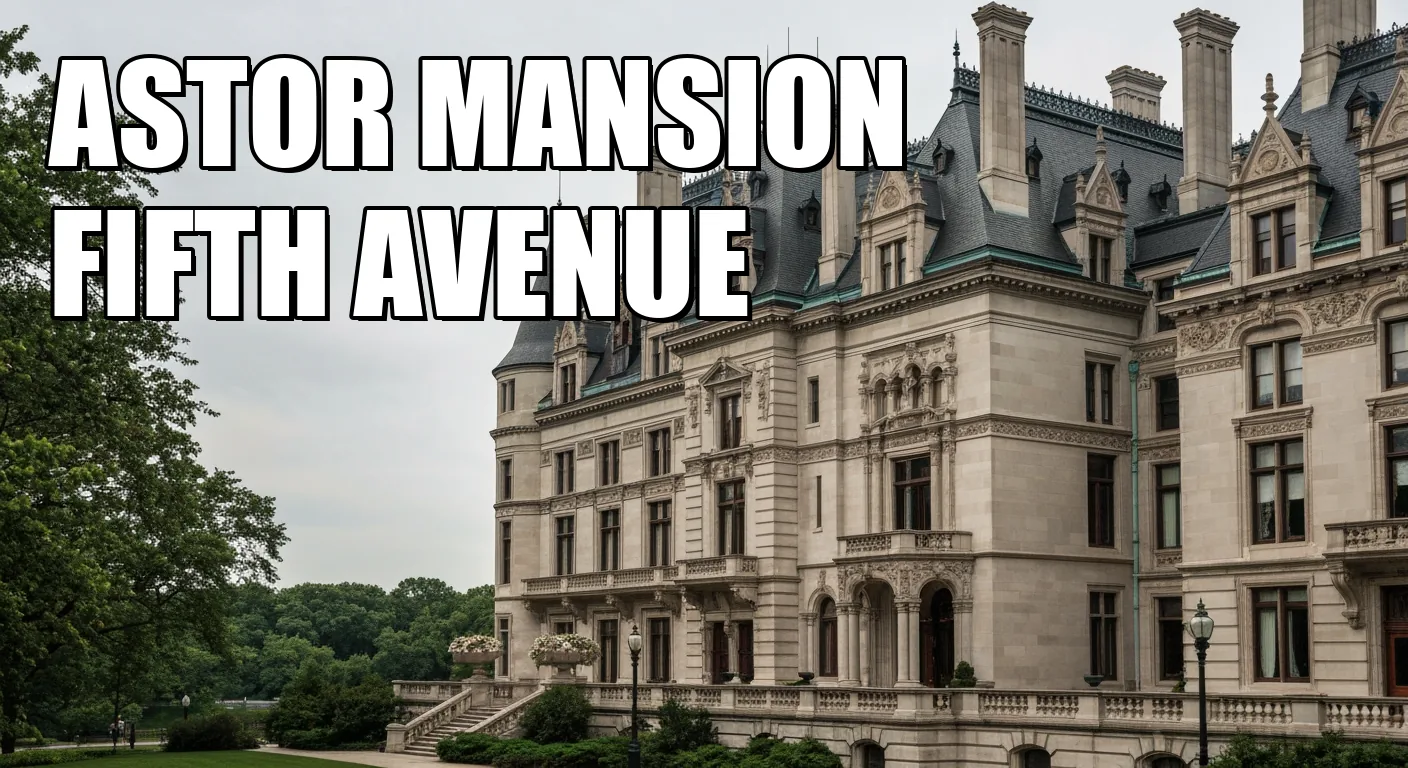
Venturing through the annals of American wealth, one often stumbles upon tales of monumental homes built to flaunt fortunes. Yet, few resonate with the dramatic depth and ultimate impermanence of the John Jacob Astor Mansion. Standing proudly, if briefly, on Fifth Avenue and 65th Street, this wasn't merely a house; it was a fortress of social power, a stage for a dynasty, and ultimately, a poignant reminder that even the most formidable structures can succumb to change.
For decades, the Astor name itself was synonymous with New York society's very pinnacle, and this particular residence, completed in 1896, served as its grandest physical manifestation. Perched majestically overlooking Central Park, its sheer scale and audacious design spoke volumes about the Gilded Age's unchecked ambition. Most casual observers, passing by the sleek modernism of today's Fifth Avenue, might never imagine the French Renaissance château that once commanded that corner, nor the complex domestic drama unfolding within its walls.
Who Designed This Colossal Fifth Avenue Statement?
The architect behind the Astor Mansion was none other than Richard Morris Hunt, a name that, if you've delved into American Gilded Age architecture, should instantly conjure images of stately homes and public buildings that blend classical grandeur with a distinctly American ambition. Hunt, the pioneering American to attend Paris's prestigious École des Beaux-Arts, wasn't just building a house; he was importing a European aesthetic and stamping it with Gilded Age authority. He was known as the "Dean of American Architecture," a title earned through a career of shaping the very face of American opulence. You see his fingerprints across Newport and in the original Met Museum wing, and here, he was given carte blanche for the Astor family.
One might wonder what spurred such a specific, almost theatrical, choice of style. Hunt spent three months researching across Europe, ultimately drawing inspiration from early 16th-century French châteaux, specifically the Château de Blois, infusing the design with the architectural vocabulary of Louis XII and Francis I. This wasn't merely a stylistic preference; it was a deliberate statement of lineage, of old-world sophistication brought to the new world, a clear signal that American wealth could not only rival but perhaps even surpass European aristocracy in its outward display. But here's the rub: even the most authentic "mock-chateau" on Fifth Avenue was still just that – a mock-chateau, a carefully curated fantasy.
Beyond a Single Residence: The Mansion's Dual Identity
What many contemporary accounts, and certainly most fleeting glances at old photographs, fail to convey is the truly peculiar nature of this grand edifice: it was, in fact, a double mansion. Imagine the architectural gymnastics involved! Designed as two distinct residences under one sprawling exterior, it housed Caroline Schermerhorn Astor—the redoubtable Mrs. William B. Astor Jr. and the matriarch of New York society—in the northern section at 841 Fifth Avenue. Her son, Colonel John Jacob Astor IV, and his family resided in the southern half at 840 Fifth Avenue. It's a fascinating reflection of Gilded Age familial dynamics: close enough to project a unified front, yet separate enough to maintain a semblance of individual autonomy and, perhaps, avoid daily friction. This arrangement, while ingenious, speaks volumes about the social conventions and psychological distances even within the closest of families when enormous wealth was involved.
The illusion of a single colossal structure was meticulously maintained on the exterior, but inside, two grand staircases and distinct living quarters prevailed. This duality often gets lost in the simplified narrative of "the Astor Mansion." The shared glass-domed entrance hall was the primary concession to unity, a common threshold into two otherwise independent domains. One can almost picture the subtle competition, the unspoken rivalry, in decorating and entertaining within what appeared to be a single, harmonious palace, especially given Caroline's legendary grip on the social reins.
Inside the Walls: A Glimpse into Lavish, Yet Unused, Splendor
Step through those formidable doors – or at least, imagine doing so – and you entered a world orchestrated by Jules Allard et Fils of Paris, one of the Gilded Age's most celebrated interior design firms. The interiors were French, exclusively so, each space a meticulously crafted historical pastiche. The sheer commitment to lavish detail in every room speaks volumes about the era's obsession with demonstrating wealth through ornamentation and art. It wasn't about comfort in the modern sense; it was about impression.
Take the Cream Salon, for instance, a veritable jewel box of a room decorated in the French Rococo Louis XV style. It was considered the epitome of feminine taste, a delicate counterpoint to the more masculine, heavy wood rooms. This room, with its elaborate decoration and delicate proportions, perfectly exemplified the ornamental grandeur of Rococo, a style that, to a modern eye, might seem almost overwhelmingly ornate. Then there were the Drawing Rooms, vast entertaining spaces adorned with floor-to-ceiling gilded wall panels and antique European furnishings. John Astor himself, a man often caricatured as purely driven by business, found solace there, often retreating to play the piano. It's a small, humanizing detail in a house built for public performance.
The Ballroom, however, was the mansion's undisputed showstopper. Capable of accommodating 1,200 guests, it dwarfed Caroline Astor's famous ballroom at her previous residence—the very space that gave rise to her exclusive "400" list of New York society. This room was a statement, a challenge, its walls entirely covered with artworks, functioning as both an elegant entertainment venue and a private art gallery. A concealed minstrel gallery on the mezzanine level housed musicians, hidden from view, ensuring the magic of the music without the distraction of its source. Yet, after John Jacob Astor IV’s 1910 renovations, which involved replacing furniture with red velvet, this magnificent space was, ironically, never extensively used under his ownership. One must wonder if the novelty had worn off, or if the sheer scale of such a room made it feel less like a home and more like a museum, even for its inhabitants.
Perhaps the most intricately detailed and decorated spaces were the Dining Rooms. Both of the original residences featured dark oak paneling, decorative ceilings, and large tapestries, each capable of seating approximately 200 guests. John Astor's dining room proudly displayed a portrait of the first John Jacob Astor above the fireplace, a constant reminder of the dynasty's origins and the immense fortune upon which this entire edifice was built. These rooms weren't just for eating; they were for conducting business, cementing alliances, and displaying the family's lineage, all under the watchful gaze of ancestors.
Tragedy and Transformation: When Grandeur Met Reality
The mansion, for all its architectural bravado, was not immune to the vulnerabilities of human life. In 1905, a few days after her final annual ball, the aging Caroline Astor, then in her late seventies, suffered a devastating fall down her own grand marble staircase. The injuries, deep cuts and gashes to her head, proved to be more than just physical. Though she initially recovered, the accident was catastrophic to her mental health. She subsequently endured a series of strokes and progressive dementia, effectively ending her reign as New York society's arbiter of taste. Her physicians forbade entertaining, and one can only imagine the heartbreaking scene of servants reportedly finding her wandering the now-empty reception rooms, greeting invisible guests, hosting phantom parties in the echoing silence. This poignant decline, culminating in her death in 1908, is a stark reminder of the fragile nature of even the most powerful human influence, and what happens when the stage is still set but the star can no longer perform.
Following his mother's death, John Jacob Astor IV embarked on a significant renovation, commissioning the firm of Carrère & Hastings to consolidate the double mansion into a single, unified residence. Completed by 1910 at a reported cost of $3 million – an astronomical sum then – the renovation removed the dividing party wall, replaced the dual grand staircases with a single, sweeping bronze-domed entrance hall, and pushed smaller, more discreet staircases to the rear. This transformation was meant to create a more cohesive living space, a unified palace for a single family. Yet, John Jacob Astor IV never truly had the chance to enjoy his consolidated masterpiece. In 1912, while returning from his European honeymoon with his pregnant second wife, Madeleine Force Astor, he perished aboard the ill-fated RMS Titanic, dying at the age of 47. The ultimate irony: a man who commanded so much, lost to the indifferent vastness of the Atlantic, leaving behind a mansion he barely had the chance to live in as he had envisioned.
Madeleine, his widow, was granted use of the mansion, but only until her inevitable remarriage. The property remained in Astor hands until 1926, when Vincent Astor, John's son, sold it to developer Benjamin Winter Sr. The sheer speed of its demise is astonishing: built in three short years, lived in for barely three decades, and then gone. The entire interior was auctioned separately, a veritable archaeological dig of Gilded Age excess. Today, if you want a tangible connection to this lost landmark, you must head south. Significant elements, including the magnificent Cream Salon and parts of the Library, were purchased by John Ringling – yes, *that* Ringling – and installed in the Ringling Museum of Art in Sarasota, Florida, where they remain on display. So, while the building itself is gone, replaced by the stoic elegance of Temple Emanu-El, pieces of its soul still endure, preserved not in New York, but under the Florida sun.
What can we learn from the Astor Mansion's fleeting existence? It wasn't just a casualty of shifting architectural tastes or changing demographics. It was a victim of its own colossal scale and the transient nature of Gilded Age excess. It exemplifies a period where wealth was so abundant, and the desire for ostentation so fervent, that even the most extravagant constructions were ultimately deemed disposable. It prompts us to question the true cost of such grandeur, not just in dollars, but in its human impact and its inevitable, quiet disappearance from the landscape it once so dramatically defined.