Photo by Sarah Chen for Cornerstone Mansion · April 2, 2026
For years, I've trekked across the country, seeking out those places that hum with history, where the past isn't just recorded in plaques but seems to breathe in the very air. Few sites in America possess the eerie, compelling draw of the Winchester Mystery House in San Jose, California. It’s not merely an old mansion; it’s a physical manifestation of grief, superstition, and an architectural obsession unlike any other, making it an irresistible muse for filmmakers.
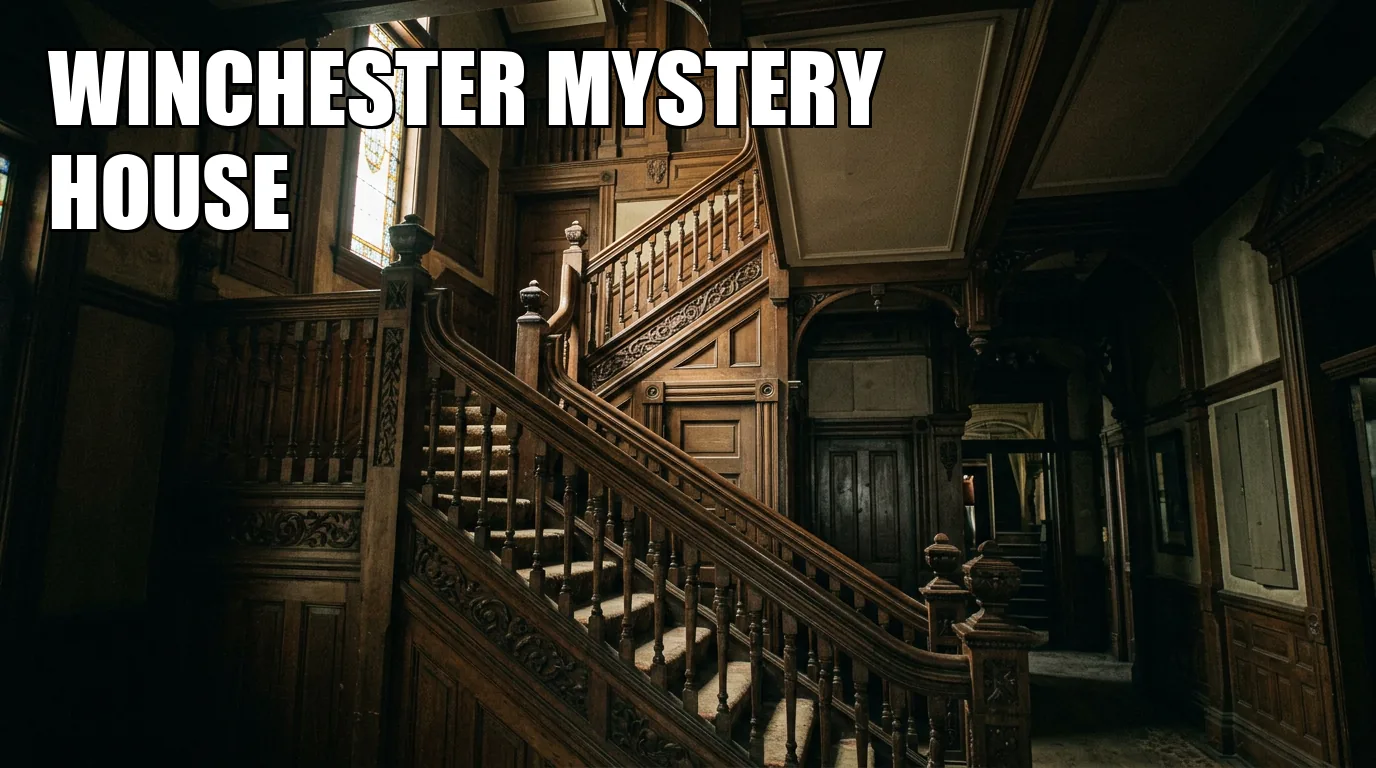
Imagine a house built for decades, 24 hours a day, seven days a week, a sprawling edifice with 160 rooms, staircases that lead to ceilings, doors that open onto brick walls or sheer drops, and windows overlooking other rooms. This isn't the whimsical eccentricity of a rich recluse; it’s the calculated, desperate act of Sarah Winchester, heiress to the Winchester Repeating Arms fortune. Convinced she was haunted by the spirits of those killed by her family's rifles – the very weapons that "won the West" but left a trail of bloody vengeance – she believed constant construction would confuse and appease them. That chilling premise alone offers a potent cocktail of architectural horror and psychological drama, practically writing the script itself.
It’s this profound sense of a house as a living, breathing, even malicious character that resonates so deeply with storytellers. Sarah Winchester’s paranoia, her spiritualism, and the sheer physical impossibility of her creation provide a ready-made canvas for tales of the supernatural. When you walk those halls, you don't just see strange design; you *feel* the weight of a woman's lifelong struggle against unseen forces. It's no wonder Hollywood keeps knocking, hoping to capture a piece of that unique, unsettling magic.
The Labyrinth's Cinematic Allure: Why Filmmakers Can't Resist
What makes the Winchester Mystery House such an enduring fascination for cinema, setting it apart from other grand, historic homes? It's the palpable sense of a place defined by its owner's torment, a sprawling, nonsensical monument to fear and guilt. Sarah Winchester, after suffering immense personal tragedy, consulted a medium who told her she was cursed by the spirits of those felled by Winchester rifles. The only way to placate them, the story goes, was to build, and never stop building. This isn't just a quirky historical anecdote; it’s a gothic tragedy tailor-made for the screen, ripe with symbolism and psychological depth.
Think about it: a wealthy widow, burdened by an inherited fortune soaked in blood, constructing a chaotic edifice not for comfort or beauty, but as an elaborate trap and prison for the restless dead. The very structure is designed to confuse, featuring staircases that lead directly into ceilings and doors that open to brick walls or several-story drops to the ground below. These aren't mere decorative flourishes; they are central to the house's lore, representing Sarah's frantic, endless battle against the unseen. Any filmmaker worth their salt sees this as more than just a spooky backdrop; it’s a narrative engine, a character in its own right, capable of generating genuine dread without relying on jump scares alone.
Moreover, the sheer scale of Sarah's project, continuing for 38 years until her death, speaks volumes about her unwavering conviction. Her personal story, intertwined with America's violent expansion and the devastating efficacy of the Winchester Repeating Arms rifle – which became known as "The Gun That Won the West" – adds layers of historical and moral complexity. Filmmakers aren't just adapting a ghost story; they're tapping into a unique strain of American gothic, where industrial innovation and personal tragedy converge in a tangible, architectural nightmare.
Helen Mirren & The House: A Direct Encounter with the Winchester (2018)
It seemed inevitable that eventually, a film would attempt to tackle Sarah Winchester's story head-on, with all its inherent drama and supernatural undertones. Enter the 2018 film, *Winchester*, starring the incomparable Helen Mirren as Sarah. The premise was certainly tantalizing: a renowned actress embodying the enigmatic heiress within a faithful recreation of her infamous mansion. Directors Michael and Peter Spierig clearly aimed to leverage the house's actual legend, centering the plot around Sarah's architectural madness as a means to confuse and trap the vengeful spirits she believed pursued her.
The movie leans heavily into the mansion's unique architectural features, making the staircases and doorways that lead nowhere integral to the plot. Characters repeatedly encounter these dead ends and dangerous drops, emphasizing Sarah Winchester’s desperate design to outwit the malevolent forces. The film posits that these spirits are specifically those killed by Winchester rifles, adding a direct, visceral link between the family fortune and the haunting. It’s a compelling notion, turning the house into a literal battlefield between the living and the dead, with Sarah at its heart.
However, despite its promising premise and the gravitas of its lead, *Winchester* garnered a rather dismal 9% on Rotten Tomatoes. Critics largely dismissed it as "dull" and "pointless," suggesting that while it painstakingly recreated the house's eccentricities, it struggled to imbue them with genuine tension or coherent narrative drive. This serves as a potent reminder that even the most fascinating historical subject matter, with an acclaimed actress attached, can falter if the script and direction fail to elevate the story beyond its sensational surface. While it did pull in a respectable $44 million worldwide against its $3.5 million budget, proving some audience interest in the lore, for many, the film failed to live up to the chilling potential of its real-world inspiration.
Stephen King's Ghostly Blueprint: How Rose Red Reimagined the Legend
Sometimes, the most profound tributes aren't direct adaptations but rather powerful reimaginations that capture the spirit of a place. Stephen King, a master of the haunted house genre, found in the Winchester Mystery House a blueprint for his own terrifying creation: the 2002 miniseries *Rose Red*. While entirely fictional, anyone familiar with Sarah Winchester's story immediately recognizes the unmistakable influence, the way King absorbed the house's core concepts and amplified them into something uniquely his own.
King explicitly borrowed the Winchester's most iconic architectural elements, crafting a mansion that is not merely haunted but actively malevolent, changing and growing to ensnare its victims. *Rose Red* features an ever-changing mansion with staircases leading to nowhere, doors opening to dangerous voids, and rooms that shift and rearrange themselves, directly paralleling Sarah Winchester's obsessive construction. This transformation of a historical oddity into a living, breathing antagonist that feeds on fear is where King's genius truly shines; he understood the *implications* of the Winchester architecture beyond just superficial scares.
Critically, *Rose Red* fared significantly better than *Winchester*, earning 68% on Rotten Tomatoes from critics. Reviewers praised King’s script for its atmospheric tension and ability to deliver genuine scares, even if some felt the pacing occasionally dragged. This success highlights a crucial insight: sometimes, an indirect homage, freed from the constraints of historical accuracy, can more effectively tap into the psychological horror inherent in the original inspiration. By distilling the essence of the Winchester's architectural madness and giving it a life of its own, King created a story that, for many, offered a more satisfying and terrifying experience, proving that a reimagined legend can often outshine a literal retelling.
Hollywood's First Glimpse: When 13 Ghosts (1960) Visited the Real Mansion
Before ambitious dramas or miniseries sought to delve into Sarah Winchester's psyche, the actual house made a notable, if brief, appearance in a classic piece of B-movie showmanship. William Castle's 1960 horror film, 13 Ghosts, holds a unique place in cinematic history for using the actual Winchester Mystery House for exterior shots of the Zorba family's inherited, ghost-infested mansion. This marks one of the earliest and most direct uses of the real property in cinema, intertwining its distinctive architecture with a tale of the supernatural right from the start.
William Castle was a master of promotion, known for his audacious gimmicks as much as his films. For *13 Ghosts*, he introduced "Illusion-O," a marketing ploy where audiences received special glasses – red cellophane for "seeing" the ghosts, blue for "hiding" them. While the film itself might have been dismissed by critics as "amateurish and crude," Castle’s innovative approach to audience engagement generated immense publicity and interest. This early cinematic encounter serves as a fascinating historical footnote, demonstrating that even in its nascent days, the Winchester's mysterious aura was perceived as a powerful draw for horror narratives.
The film's use of the real house, however fleeting, lends an undeniable authenticity to its setting, grounding its fantastical premise in a place already steeped in local legend. It's a testament to the house's inherent photogenicity and its existing reputation as a truly haunted locale. While *13 Ghosts* may not stand as a cinematic masterpiece, its direct, physical connection to the Winchester Mystery House ensures its enduring relevance for anyone exploring the mansion's impact on popular culture. It reminds us that the house's fame wasn't just built on local lore, but on its very real, tangible presence, ready for the silver screen.
The Asylum's Haunted Attempt: A Look at The Haunting of Winchester House (2009)
Not every cinematic foray into the Winchester legend is destined for critical acclaim, and that’s certainly the case with The Asylum’s 2009 direct-to-video release, *The Haunting of Winchester House*. The Asylum, known for its "mockbusters" and low-budget genre films, took a stab at the infamous house, producing a film that, while sincere in its intentions, ultimately struggled to capture the nuanced dread of its inspiration. It serves as a valuable case study in the challenges of translating such a complex and specific historical haunting to the screen.
The film introduces a specific, albeit simplified, interpretation of the house's haunting: "Winchester Tormentors." These are presented as manifestations and apparitions of victims killed by Winchester rifles, who haunt the house and terrorize a new caretaker family. The narrative escalates their paranormal activity, culminating in the possession of residents, a common horror trope but one that here feels somewhat generic compared to the house's unique lore. It’s an attempt to directly address the source of Sarah Winchester's fear, but perhaps without the budget or script to truly pull it off.
Unsurprisingly, this film received poor critical reception and audience ratings, averaging 3.4/10 on IMDb. Reviewers frequently noted its weak production values and often unintelligible plotting, despite acknowledging some sincere efforts from its cast. What *The Haunting of Winchester House* really highlights is that merely having a compelling concept isn't enough; execution is paramount. The intricate, almost poetic madness of the real Winchester Mystery House requires a nuanced touch, a respect for its bizarre architecture and the psychological depth of its creator, elements that often get lost in the rush of low-budget, direct-to-video productions focused on quick scares. It's a reminder that not all adaptations are created equal, and some legends are simply too grand to be contained within modest means.
Ultimately, the Winchester Mystery House isn't just a tourist attraction; it's a profound, tangible piece of American folklore that continues to inspire. From William Castle’s early exploitation of its physical presence to Stephen King’s masterful reimagining of its architectural terror, and even through the mixed fortunes of more direct adaptations, the house stands as a testament to the enduring power of a truly unique ghost story. Each film, whether lauded or lambasted, offers a different lens through which to view Sarah Winchester’s extraordinary legacy, inviting us all to ponder the line where grief ends and madness begins, and where the spirits of the past might truly reside.
More Film & TV Locations
These guides identify the real building or site first, then explain what visitors can still see in person.
The Complete Guide to Winchester Mystery House & Its Cinematic Legacy
Is the Winchester movie worth watching?
The 2018 film offers atmospheric cinematography and Helen Mirren's strong performance, though it relies heavily on jump scares and has been criticized for its generic horror formula; worth watching if you enjoy supernatural thrillers despite receiving only a 12% Rotten Tomatoes rating from critics and a 5.5/10 IMDb score.
What is so special about the Winchester Mystery House?
The mansion is remarkable for its 160 rooms, 2,000 doors, 10,000 windows, bizarre architecture including stairways leading nowhere and doors opening to blank walls, and its unique Victorian design with continuous construction for 38 years by heiress Sarah Winchester.
Are there any movies about the Winchester House?
Yes, the 2018 horror film 'Winchester: The House That Ghosts Built' directed by Michael and Peter Spierig is the primary cinematic adaptation, starring Helen Mirren as Sarah Winchester and Jason Clarke as Dr. Eric Price.
How accurate is the Winchester movie?
The film takes significant creative liberties with historical facts; while Sarah Winchester was a real person and the house exists, most supernatural events in the movie are fictional, and the film portrays her as an ominous recluse when historical records suggest she was actually a social, intelligent woman who held community events.
What is the no. 1 scariest movie ever?
According to Rotten Tomatoes and critics, 'The Exorcist' (1973) is widely considered the scariest horror movie ever made, followed by 'Hereditary' (2018) and 'The Conjuring' (2013).
Does anybody live in the Winchester House today?
No, the Winchester Mystery House has not had anyone living in it since the 1990s; it now operates exclusively as a tourist attraction with security services protecting the property.
Winchester mystery house film reviews
The film received mixed to negative reviews; critics called it 'dull' and 'pointless' with a 12% critics score on Rotten Tomatoes, though some audiences appreciated its atmosphere and Helen Mirren's performance despite the predictable scares and weak plot.
Is the movie Winchester based on a true story?
The film is loosely based on true events about Sarah Winchester and the real Winchester Mystery House, but the supernatural haunting plot is entirely fictional; Sarah Winchester was a real heiress who built the mansion for architectural passion, not to ward off ghosts.
What is the scariest movie based on a true story?
While 'The Exorcist' (1973) is often cited as both the scariest movie overall and one based on a purported true case, other highly-regarded horror films based on true stories include 'The Conjuring' (2013), 'The Silence of the Lambs' (1991), and 'Hereditary' (2018).
How accurate is the Winchester 1895?
The Winchester Model 1895 rifle featured in the film is historically inaccurate when depicted as a Civil War weapon; the rifle was not developed until 1895, after the Civil War ended in 1865, making its portrayal in the movie factually wrong.
How many rooms does the Winchester Mystery House actually have?
The mansion contains 160 rooms across 24,000 square feet, including 40 bedrooms, 47 staircases, 13 bathrooms, 6 kitchens, 2,000 doors, 10,000 window panes, and 52 skylights.
What are the current visiting hours for the Winchester Mystery House in 2025?
September through April: 10am-4pm weekdays, 10am-5pm weekends; May through August: 10am-5pm weekdays, 10am-7pm weekends; closed on Thanksgiving and Christmas Day.
How much does it cost to tour the Winchester Mystery House?
The guided Mansion Tour costs approximately $40-45 per adult for a 65-minute experience through 110 rooms; basement access can be added for approximately $13 more per person (available through December 2025).
What special tours are available at Winchester Mystery House for 2025?
In addition to the standard Mansion Tour, guests can book Flashlight Tours (starting at $49.99 for adults), Explore More Tours with basement and attic access, and seasonal special events throughout the year.
Can you visit the actual Winchester Mystery House after watching the movie?
Yes, Winchester Mystery House is open to the public as a major tourist attraction in San Jose, California, offering guided tours; however, note that most of the 2018 film was shot on soundstages, so the movie's portrayal differs significantly from the actual architectural layout.
Why This Page Exists
Maison builds place guides to help readers plan a real visit or understand a real site. When a page makes present-day access, booking, or visitor claims, those details are revised against public-facing source material and editorial review. For the wider standards behind that work, see methodology.
The Cornerstone Brief
One historic place, once a week — what it is, why it matters, whether it's worth going. No filler, no paid placements.
Coming soon. Unsubscribe any time.
We use cookies to enhance your experience. By continuing to visit this site you agree to our use of cookies.