There’s a peculiar alchemy that happens when a film immortalizes a place. For millions, 370 Beech Street in Highland Park, Illinois, isn't just a suburban address; it's the legendary home of Ferris Bueller, the ultimate high school slacker with a knack for mischief. We picture the sleek lines, the glass walls, the famous Ferrari defying gravity in the pavilion. But peel back the silver screen glamour, and you uncover a story far richer than a joyride. This isn't merely a movie set; it’s a profound piece of modernist architecture, a structure with its own struggles, a testament to design principles often misunderstood, and a fascinating narrative of decline and dramatic rebirth.
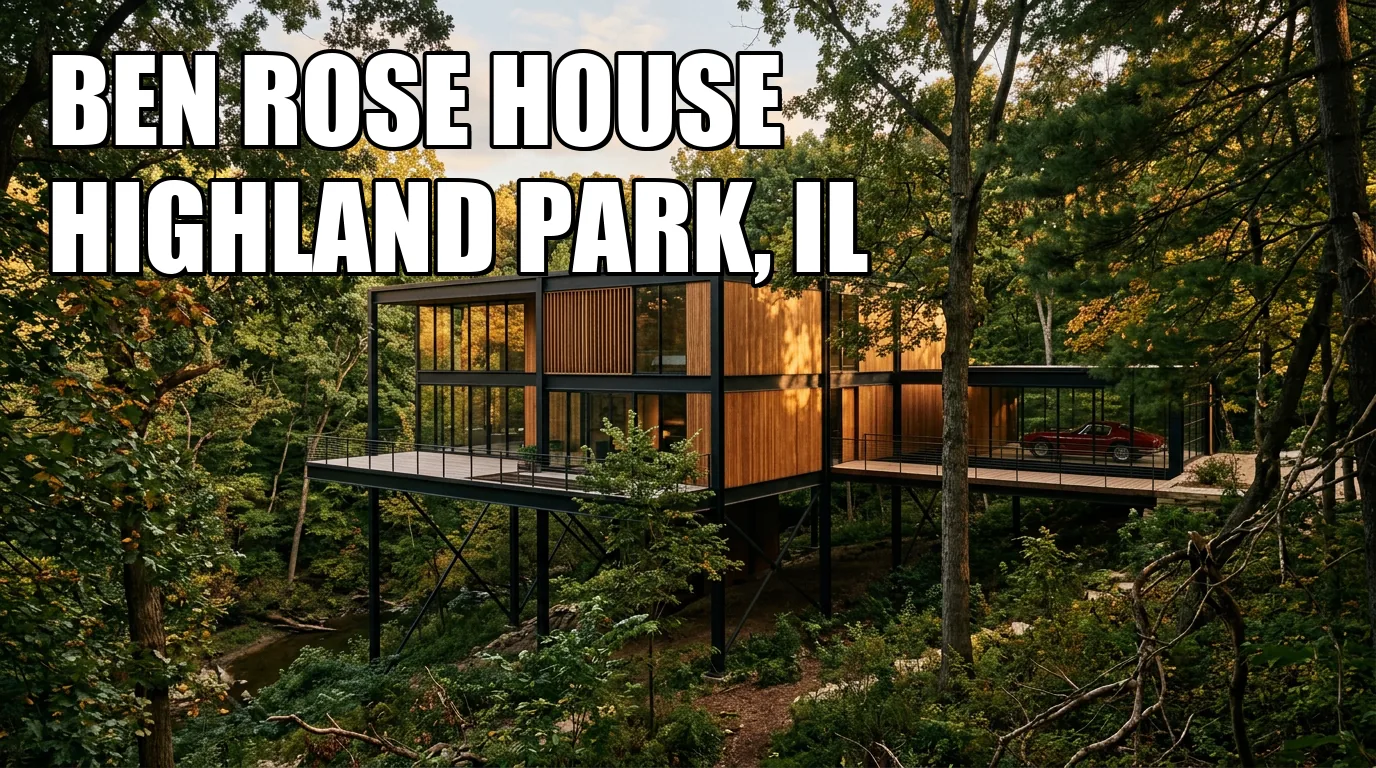
My first drive past the property felt almost reverent, a pilgrimage of sorts, yet it quickly became clear that the house itself, the one truly worth studying, remains largely unseen by the casual fan. Most arrive, snap a photo of the main gate, and perhaps glimpse the main house through the trees, missing the deeper architectural context entirely. This residence, officially known as the Ben Rose House, was designed by A. James Speyer, a name that ought to resonate far more widely among design enthusiasts. Speyer, a protégé of the legendary Ludwig Mies van der Rohe, completed the main house in 1953, manifesting a pure form of International Style modernism. Imagine, if you will, steel beams, glass, and cypress slats, all elevated on pylons, hovering over a wooded ravine – a daring statement for its time, and still breathtaking today.
What Mies van der Rohe's Shadow Means for This House
To truly grasp the Ben Rose House's significance, one must understand the indelible mark left by Mies van der Rohe. Speyer wasn't just a student; he absorbed and reinterpreted his mentor’s ethos of "less is more," pushing the boundaries of spatial purity and material honesty. What makes this house unique isn't just its celebrity, but its almost surgical precision in design: floor-to-ceiling glass walls blurring the line between interior and exterior, a minimalist aesthetic that prioritizes light and openness. It’s an architectural philosophy that says, "Here are the bones, exposed and celebrated," rather than "Here is a house disguised by ornamentation." This commitment to transparency and industrial materials, while visually striking, often brought with it a host of practical challenges, particularly in the unforgiving climate of the Chicago suburbs.
Years after the main structure, in 1974, Speyer's own student, David Haid, added the iconic glass pavilion. This wasn't some afterthought tacked onto an existing design; it was a deliberate, harmonious extension, echoing the main house's elevated, minimalist form. Originally conceived as a sophisticated showcase for the Roses' collection of exotic sports cars—Bugattis, BMWs, Porsches, a true enthusiast's dream—the pavilion included a small kitchenette and bathroom, making it more than just a garage. It was a statement piece, a jewel box for mechanical art. Few visitors realize this original purpose, often just connecting it to the ill-fated Ferrari in the film. The pavilion's design itself, floating weightlessly above the ravine, underscores the property's dedication to architectural integrity, even in its additions.
The Long, Painful Market Journey of a Modernist Icon
The house's path to its current state wasn't paved with ease. After the owners decided to sell, the property languished on the market for an astonishing five years, initially listed in May 2009 at a hopeful $2.3 million. Why such a struggle for a cinematic landmark? This is where the practical realities of modernist architecture butt heads with romantic ideals. Despite its fame, the house had significant issues. Its original single-pane glass, a hallmark of its minimalist aesthetic, was a thermal nightmare in an Illinois winter. The flooring and roof lacked adequate insulation, turning the structure into a costly energy sink. It was, in essence, a beautiful, celebrated icebox in the colder months. This candid assessment reveals a truth often overlooked: architectural purity doesn't always equate to comfortable living, especially when designs of the 1950s clash with 21st-century expectations and energy codes. The house was repriced multiple times, its value plummeting by more than 50% before it finally found new owners.
Imagine the weight of inheriting such a structurally challenged masterpiece. The final sale in May 2014, at a mere $1,060,000—a stark 54% drop from its initial asking price—marked the beginning of its true restoration. The buyers, an investment banker and attorney with local roots, weren't just purchasing a piece of film history; they were acquiring a formidable architectural project. What typical guides don’t tell you is the sheer scale of the rehabilitation that followed. This wasn't a superficial facelift; it was a deep dive into modernist preservation, tackling the very practical issues that nearly doomed the house.
A Radical Renovation: Preserving Spirit, Conquering Flaws
The transformation began in 2017, led by the architectural firm Baranski, Hammer, Moretta & Sheehy. Their task was unenviable: maintain the original International Style aesthetic while making the house habitable and sustainable. One of the most ingenious interventions involved excavating a 15-foot underground trench beneath the house itself. This subterranean expansion created a hidden two-car garage, much-needed storage, a children's play area, and a laundry room—all without altering the original exterior façade or compromising the modernist purity above ground. It's a testament to creative problem-solving, acknowledging the need for modern amenities without betraying the architectural vision.
Beyond the hidden additions, critical structural and environmental upgrades were implemented. The flimsy, original single-pane glass was replaced with high-performance thermal/insulated glass windows, finally addressing the house's notorious heat loss. A comprehensive hot water radiator system was installed directly into the flooring, providing efficient, radiant climate control that respects the minimalist interior. Even the steel beams, originally painted charcoal, were meticulously restored to their authentic brick-red color, a subtle but vital detail that connects the house back to Speyer's original material palette. An older, non-original garage that had been added decades prior and unfortunately obscured part of the front façade was removed, restoring the clean lines of Speyer's initial design. This wasn't merely a repair; it was an act of architectural reverence, ensuring the house could function as a modern home while honoring its historic design.
Experiencing the Bueller House Today: A Respectful Glimpse
So, what does this mean for the intrepid traveler hoping to catch a glimpse of this architectural and cinematic marvel? First, understand that this is, unequivocally, a private residence. Unlike many historic homes, it is not open for tours, nor should you expect to wander its grounds. Your experience will be limited to a respectful drive-by. Highland Park itself is a beautiful suburb, full of impressive architecture, and the drive through its tree-lined streets is pleasant. However, be prepared for a reality check: the house sits on a private lot, often obscured by mature trees and a gate. You won't be able to peer through the glass walls or stroll through the pavilion where the ill-fated Ferrari once met its end (a scene, by the way, famously achieved with sugar glass, quickly replaced after filming).
If you plan to visit the area, consider a weekday during late autumn or early spring when foliage is less dense, offering a slightly clearer view. Arrive in the mid-morning to avoid any potential peak traffic, though the street itself isn't typically busy. Parking nearby is usually easy, allowing for a slow, appreciative drive past. What you gain from this pilgrimage isn't a direct interaction with a film set, but rather an appreciation for a significant piece of American modernism—a house that has not only endured cinematic fame but also overcome inherent design challenges through thoughtful, extensive renovation. It stands today as a testament to the enduring appeal of bold architecture, a structure with a quiet dignity far removed from its boisterous on-screen persona. This is no tourist trap; it's a living monument to design and resilience, best appreciated with a keen eye and a respectful distance.